LangChain Anthropic 1.7.5 Released: Claude Sonnet 5.5 Compatibility Added

langchain-anthropic 1.7.5 adds Claude Sonnet 5.5 support and fixes a tool call replay serialization bug.
LangChain has released langchain-anthropic 1.7.5, a minor update focused on compatibility and bug fixes. The two key changes are: official support for Anthropic's new Claude Sonnet 5.5 model, allowing developers to switch to the new model in existing code after a simple dependency upgrade; and a fix for a bug where invalid tool calls were incorrectly serialized as valid tool use structures during Agent replay, eliminating a subtle source of errors in conversation state management. With no breaking changes, the upgrade is low-risk for teams building Agents, RAG pipelines, or content generation apps with Claude.
LangChain has released langchain-anthropic version 1.7.5. As the official integration package connecting the LangChain framework with Anthropic's Claude model family, this minor release is small in scope but delivers critical fixes for model compatibility and tool call stability — well worth the attention of developers building with Claude.
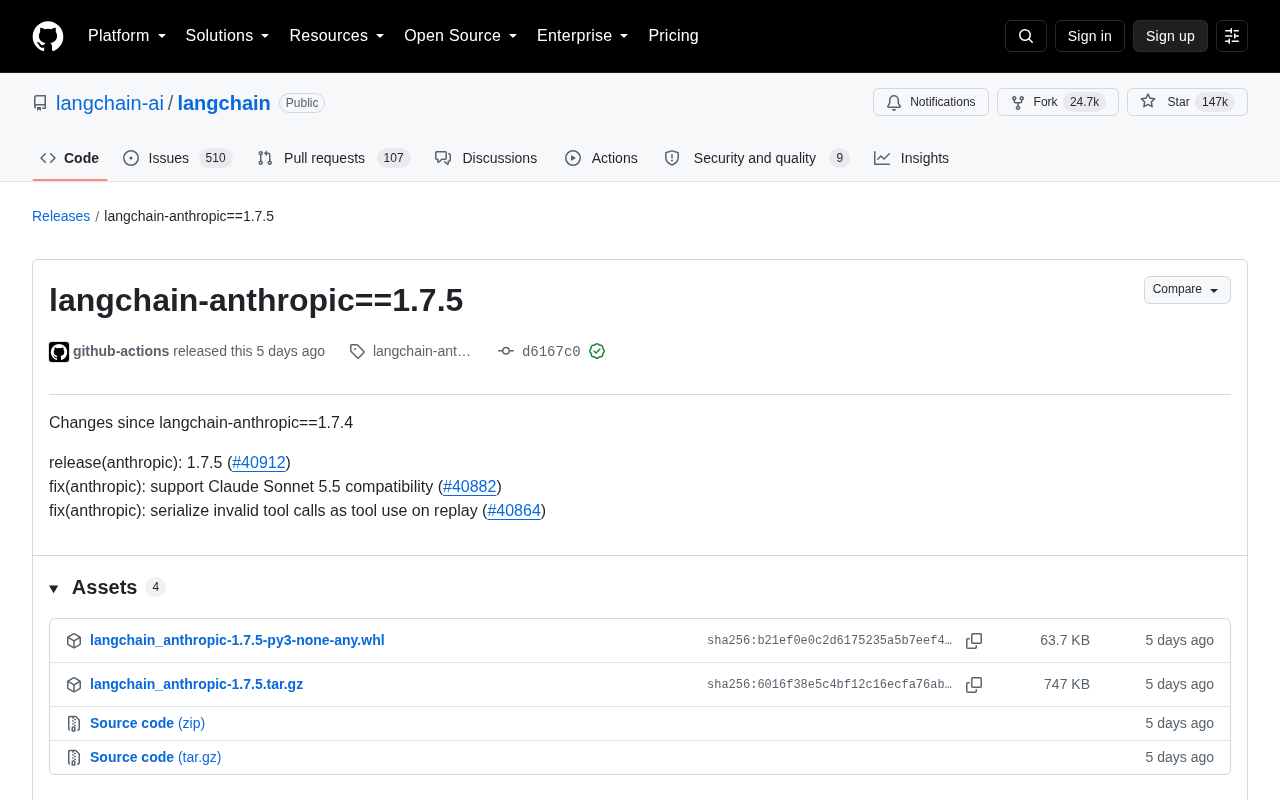
What's Changed in This Release
According to the GitHub Release page, version 1.7.5 includes three changes compared to the previous 1.7.4 release:
- Claude Sonnet 5.5 compatibility support (PR #40882): The headline change in this update, enabling the integration package to correctly interface with Anthropic's newly released Claude Sonnet 5.5 model.
- Fix serialization of invalid tool calls as tool use during replay (PR #40864): Resolves a bug where invalid tool calls were incorrectly handled during message replay scenarios.
- Version bump to 1.7.5 (PR #40912): A routine release commit.
The update cadence for integration packages like this typically follows the underlying model provider's releases closely. Whenever Anthropic updates or adjusts its model interfaces, the LangChain side needs to respond quickly to ensure developers don't run into unexpected issues when upgrading their models.
Why Claude Sonnet 5.5 Compatibility Matters
For developers calling Claude through LangChain, model compatibility directly determines whether you can adopt a new model on day one. The Sonnet series is Claude's flagship line for balancing performance and cost, and is widely used in production environments for Agent, RAG, and content generation use cases.
The 1.7.5 update closes the gap on Claude Sonnet 5.5 support, meaning developers no longer need to apply custom hacks or wait for third-party patches — simply upgrade the dependency and switch to the new model within your existing LangChain code. For teams relying on stable interfaces, this kind of official synchronization is far more reliable than maintaining your own compatibility layer.
The Claude model family is typically structured across three tiers: Haiku (lightweight and fast), Sonnet (balanced performance and cost), and Opus (flagship, highest capability). Sonnet occupies the "sweet spot" tier for production environments, striking a balance between latency, throughput, and capability — which is why it sees the highest real-world deployment rates in enterprise Agent and RAG applications. The "5.5" in the version number follows Anthropic's internal iteration naming convention, typically signaling targeted improvements over the previous generation in areas such as instruction following, code generation, or multi-step reasoning. Compatibility updates in the LangChain integration layer primarily involve: correctly recognizing the new model ID, handling any adjusted request/response fields, and syncing with newly supported features (such as an expanded context window or new tool use parameters).
What the Tool Call Fix Actually Means
The second fix addresses the serialization behavior of tool calls during replay. When building Agents, models generate a series of tool calls, and these call records frequently need to be persisted, replayed, or used for debugging.
In the previous implementation, invalid tool calls could be incorrectly serialized into a valid tool use structure during replay, leading to state inconsistencies or downstream parsing errors. Version 1.7.5 corrects this behavior, ensuring that abnormal tool calls are handled properly during replay. While this is a relatively edge-case scenario, for applications that heavily rely on Agent workflows and conversation state management, this kind of fix eliminates hard-to-trace latent bugs.
Tool Use (also known as Function Calling) is a core mechanism in LLM Agent architectures: the model outputs a structured "call intent" during inference, the runtime framework parses and executes the corresponding function, and the result is fed back to the model for the next reasoning step. Replay refers to the ability to reload a historical conversation or Agent execution trace and resume execution — commonly used for debugging, checkpoint recovery, or restoring session state from persistent storage. When a tool call is flagged as "invalid" due to missing parameters, formatting errors, or other issues, the correct behavior during replay is to preserve it as an error record rather than "correcting" it into an apparently valid tool use structure to pass to the model. The latter causes the model to continue reasoning under false pretenses, producing hallucinations or logic errors that are difficult to trace back to their source.
Upgrade Recommendations
Since this is a purely compatibility- and bug-fix-focused release with no breaking changes, projects using langchain-anthropic can upgrade with confidence:
pip install -U langchain-anthropic==1.7.5
If your application plans to integrate Claude Sonnet 5.5, or if you've encountered tool call anomalies in your Agent replay logic, upgrading to 1.7.5 is essentially a must. For projects without these immediate needs, the urgency is relatively lower — but keeping your dependencies in sync with the model provider is always a good practice.
Summary
langchain-anthropic 1.7.5 is a classic "follow-along" maintenance update: its primary job is to add Claude Sonnet 5.5 compatibility, while also fixing a tool call serialization issue. It once again reflects LangChain's ecosystem pattern of rapidly iterating alongside major model providers — whenever there's movement on the model side, the integration layer responds quickly to keep the developer upgrade path as smooth as possible.
Related articles

Chain of Thought Isn't Just for AI: How Humans Can Use CoT to Improve Thinking Quality
Chain of Thought isn't just a prompt trick for large models. Starting from a Hacker News discussion, this article analyzes why CoT works for human thinking too, breaks down actionable ways to transfer it, and highlights the key differences between human CoT and machine CoT.
Cloudflare Teams Up with OpenAI: Closi…
Cloudflare Teams Up with OpenAI: Closing the Loop from Vulnerability Discovery to Defense with AI
Cloudflare uses OpenAI Daybreak to investigate security vulnerabilities and generate reviewable remediation plans, while developers use Codex to boost coding efficiency and quality.

Orca Multi-Agent Orchestration in Practice: A Guide to Parallel Collaboration with Claude and Codex
Orca is Stable AI's free open-source agent workbench supporting 34 agents like Claude Code and Codex in parallel. Learn its Git worktree isolation, multi-model orchestration, and mobile management.