LangChain Beginner's Guide: Core Concepts and Three Key Capabilities for AI Agent Development

LangChain extends LLMs with web access, private data retrieval, and conversation memory to build real AI agents.
LangChain is an open-source framework for building LLM-powered applications, built around the formula: Agent = Model + Harness. Bare LLMs have three core limitations — a knowledge cutoff date, no access to private external data, and no multi-turn memory. LangChain addresses all three by chaining models together with web search tools, RAG-based knowledge retrieval, and context management. Its learning path covers model invocation, structured output, and tool calling. One key tip: always rely on the official English documentation, as translated docs are often incomplete or inaccurate.
What Is LangChain
For those just getting started with large language model (LLM) application development, LangChain is often the first framework they encounter. Its purpose is clear: an open-source framework for building applications powered by large language models. If you're coming from backend development, think of it like Spring for web development — Spring helps you rapidly drive web applications, while LangChain helps you rapidly drive models.
The official LangChain documentation distills everything into a concise formula: Agent = Model + Harness. The model refers to the LLMs we're already familiar with — DeepSeekAd, Claude, Gemini, GPT, and so on — while the harness refers to the entire LangChain ecosystem. In the English documentation, this supporting system is called a Harness (the framework that runs and supports an agent), and LangChain is one complete solution for that harness.
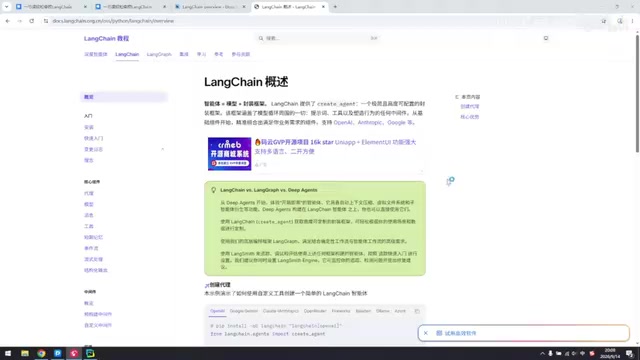
The name itself hints at the design philosophy: Lang (Language) + Chain (chaining). The core idea is to let models connect — in a chained fashion — to local resources or external services, ultimately building a powerful agent capable of solving real-world problems.
Why LangChain Exists: Three Fundamental Limitations of LLMs
A large language model on its own is far from omniscient. It has several inherent weaknesses, and LangChain was built to address them. The original video author frames LangChain's core value around three key areas.
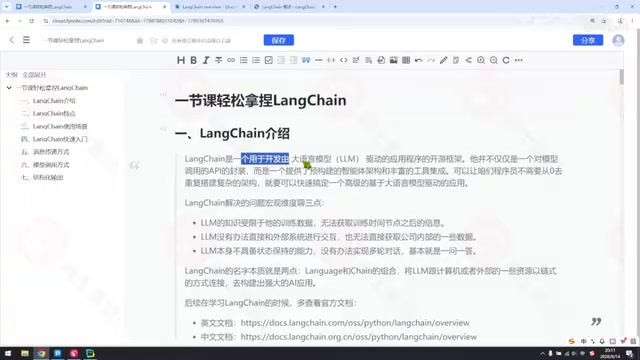
Limitation 1: A Knowledge Cutoff Date
A model's knowledge is frozen at its training cutoff. It only knows what happened before that point — anything after is a blind spot. For example, if a model finished training in June, and you ask it about something that happened in August, it simply cannot answer, because a bare model has no way to invoke tools or access the internet on its own.
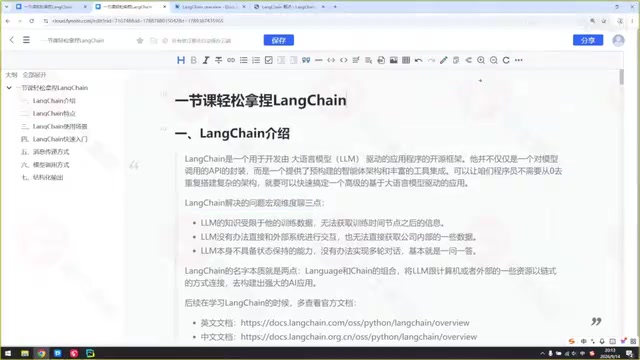
The model knows it doesn't know — but it can't go look it up. This is where LangChain's built-in web search tools come in: the framework fetches the latest information from the internet on the model's behalf, then hands the results back to the model for processing.
One common point of confusion worth clarifying here: the DeepSeek chat product you use every day is not the same as a bare model. It's already an agent — one that has been integrated with a knowledge base or web access capability. The raw model underneath has no such abilities.
Limitation 2: No Access to External Private Data
The second scenario involves accessing external data — things like RAG (Retrieval-Augmented Generation), enterprise knowledge bases, and similar applications. These use cases require connecting to vector databases, enabling data provenance, and even integrating with internal company systems. A bare model cannot do any of this on its own, but LangChain bridges that gap, allowing models to interact with internal databases and other enterprise systems.
A note on RAG: RAG (Retrieval-Augmented Generation) is one of the most widely adopted technical approaches in enterprise AI applications today. The core idea is straightforward: before sending a question to the model, first retrieve the most relevant document chunks from an external knowledge base (typically a vector database), then pass those chunks along with the question to the model, so it can generate an answer grounded in "just-in-time retrieved context." The key advantage is that the model doesn't need to be retrained to "know" private data, and since answers are traceable back to source documents, hallucination risk is reduced. Vector databases — such as Pinecone, Chroma, and Weaviate — are the core infrastructure for RAG. They store text as high-dimensional vectors and retrieve semantically similar content quickly via similarity search. LangChain provides out-of-the-box integration interfaces for all major vector databases, making it a popular choice for building enterprise knowledge base Q&A systems.
Limitation 3: No Memory or Context Management
The third limitation is state management — in other words, memory. A great conversational experience requires multi-turn coherence: the model should understand your new message in the context of everything you've discussed before. But a bare model operates in a purely stateless, one-shot manner — it has no awareness of previous exchanges.
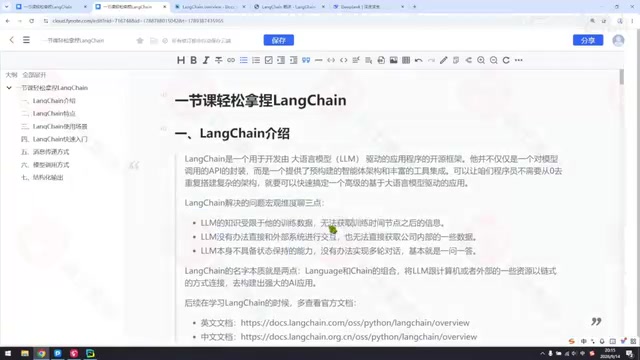
LangChain provides a context management mechanism that makes multi-turn conversations straightforward to implement. You could build this logic yourself, of course, but LangChain simplifies the work considerably.
Why models have no memory — a technical perspective: At its core, a large language model is a stateless function. Every time you call its API, the model only sees the token sequence passed in that specific request — previous conversations simply don't exist from its perspective. The most common way to implement multi-turn dialogue is "full history concatenation": appending each round of user input and model output to the prompt for the next request, forming a rolling context window. This introduces a new challenge: context length is bounded by the model's maximum token limit (e.g., 128k for GPT-4o), and once a conversation grows long enough, earlier content must be truncated or compressed. LangChain's Memory module encapsulates several strategies to handle this — such as retaining only the last N turns (
ConversationBufferWindowMemory) or replacing full history with a running summary (ConversationSummaryMemory) — so developers don't have to manage these details manually.
LangChain's Learning Path and Core Modules
As an entry-level framework for LLM application development, LangChain's overall learning curve is quite manageable, and its official documentation is thorough — covering everything from beginner demos to code examples. The original video outlines a learning path that spans the following modules:
- Framework overview: Understanding what LangChain is and what problems it solves
- Core features: Exploring its design philosophy through the official documentation
- Use cases and quick start: The official getting-started code is simple and approachable
- Message passing: How communication between models works
- Model invocation: How to connect different models
- Structured output: Getting models to return well-formatted data
- Tool calling and short-term context management: Advanced agent capabilities
This path makes it clear that LangChain is far more than a thin wrapper around model APIs. Tool calling, context memory management, and other capabilities are already integrated within the ecosystem — developers don't need to build complex architecture from scratch. You can get a functional basic agent up and running right out of the box.
One Important Tip: Always Go to the Official Documentation
Whether you're learning LangChain or any other framework (such as the toolchains for OpenAI or DeepSeek), the original author repeatedly emphasizes one principle: always treat the official documentation as the authoritative source.
The reason is that third-party notes, tutorials, and even translated documentation can contain inaccuracies. The video highlights a telling example: the Chinese documentation once mistranslated "Agent" as "代理" (proxy), leading readers to think they needed to configure a VPN proxy — until they checked the original English docs and realized it was a translation error. This happens because Chinese documentation is often machine-translated and incomplete in coverage — for instance, OpenAI examples may be well-documented, but clicking over to Gemini or Claude might turn up missing content, forcing you back to the original English source.
A practical approach: developers who aren't confident in English can start with the Chinese docs for a quick conceptual overview, but for any critical concept, cross-check against the English original. Use translation tools to assist when needed.
Summary
At its core, LangChain upgrades a large language model from a "closed, one-shot Q&A system" into an agent that can browse the web, read private data, and remember conversational context. It does this by chaining together models with external tools, data sources, and memory mechanisms. For developers who have solid Python foundations and are ready to enter the LLM application space, LangChain offers a low-barrier, well-documented entry point. Understanding the three core problems it solves gives you a clear mental model of the entire landscape of Agent development.
Related articles

Anthropic IPO Explained: Fuel for the AI Boom or the Spark for a Bubble?
Anthropic files for an IPO under ticker ANT. Breaking down the prospectus: 80% of revenue from usage-based pricing, $72B of an $80.7B net loss being non-cash charges, 900% net revenue retention, and how past IPOs like SpaceX performed on day one and over three years — answering the AI bubble question.

Will AI Kill the Research Paper? Mathematicians Offer a New Answer
Mathematicians on the Lex Fridman podcast discuss whether AI will kill research papers—from journal review pressure to Lean formal verification, GitHub open source fatigue to Mathlib's crowdsourcing model, exploring the evolution of academic contributions and the future of mathematical knowledge verification.

Enterprise LLM Development: From RAG to Multi-Agent in Practice
A course breakdown of enterprise LLM application development: from prompt engineering and RAG to multi-agent engineering practice and FDE project delivery, helping developers understand why Agent technology is a key focus for enterprise deployment and learn systematically to avoid detours.