LangChain Beginner's Guide: Understanding the Core Concepts of the LLM Development Framework

LangChain is a development framework that makes large models truly usable, solving deployment challenges with chain-style invocation and a unified integration layer.
LangChain is an open LLM application development framework initiated by a Harvard team and released in October 2022, earlier than ChatGPT's public debut. Its name reveals the core: organizing and invoking large models through chaining. The article outlines four major application scenarios—general and vertical agents, intelligent Q&A customer service, document search (RAG), and NL2SQL—and notes that the core barrier for vertical agents is data acquisition. It focuses on why you can't just use a large model directly (it's a model, not a system—data cutoff, no internet, no database, no tools) and why not use official APIs (each vendor is different, switching means rebuilding). Like JDBC unifying database access, LangChain provides a unified access layer for large models, simplifying development, focusing on business, and lowering learning costs.
Large language models are astonishingly capable, but when it comes to actually integrating them into business systems, developers often run into a pile of headaches: model training data has a cutoff date, the model can't access the internet, can't query databases, and switching to a different model vendor means rewriting the entire project. LangChain is the framework built to solve these problems.
What Is LangChain?
According to a Bilibili tutorial, LangChain was initiated by a team from Harvard University. It's an open-source development framework for large language model applications, first released in October 2022—a time point even earlier than ChatGPT's public debut. The team bet on the direction of large language models ahead of the curve, and after ChatGPT set off a global frenzy, LangChain's star count grew exponentially.
Its name is itself a hint: Lang stands for Language, and Chain stands for chain-style invocation. Together, it means organizing and invoking large language models through chaining.
If you've used visual workflow tools like Dify or Coze, you'll find that LangChain's way of thinking is similar—the difference is that Dify builds workflows by dragging and dropping nodes, while LangChain achieves the same goals through code-level design.
Chain-style invocation is the key to understanding LangChain. A "Chain" refers to stringing together multiple reusable components—such as prompt templates, LLM calls, external tools, and output parsers—into an executable pipeline in sequence: the output of the previous step becomes the input of the next, ultimately producing a structured result. For example, a typical Q&A chain completes three steps in order: "fill in the prompt template → call the LLM → parse and format the output." Compared to cramming all the logic into a single model call, the chain design makes each stage independently testable, replaceable, and reusable, and allows complex tasks to be broken down into controllable steps. LangChain's early APIs centered on various types of Chains; later versions shifted to the more flexible LCEL (LangChain Expression Language) and Runnable interface, but the core idea of "organizing model capabilities with composable chains" has never changed.
LangChain's Four Major Application Scenarios
LangChain's official documentation lists many use cases, four of which are most worth noting.
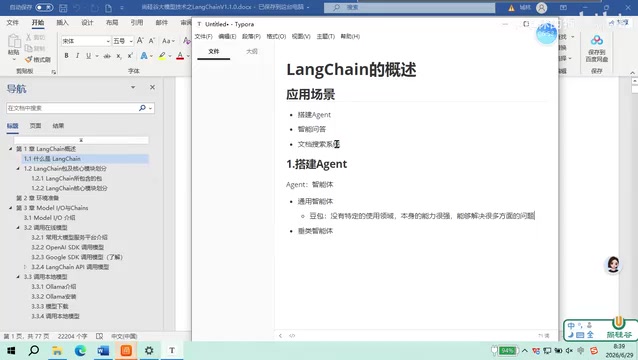
Building Agents
Agents are one of the hottest directions right now, and the industry generally divides them into two categories:
General-purpose agents have comprehensive capabilities—they can chat about anything, recognize images, and search news. A typical example is Doubao. But their market demand is actually limited—the more comprehensive the capabilities, the higher the difficulty, and the more easily they're monopolized by big companies. It's hard for startup teams to enter this track.
Vertical agents focus on specific domains and represent the direction with more job demand. Take a medical agent as an example: on the model side, it requires large amounts of specialized medical data for dedicated training, and needs to be connected to web tools for domain processing. The biggest barrier is data—medical data typically isn't publicly available for purchase, and even when sold, it's highly de-identified. Well-funded giants can obtain data sources through large-scale partnerships, while small and medium teams find it hard to replicate. In addition, vertical agents require domain experts to participate in the design—after all, medical decisions can't be entirely left to AI.
Intelligent Q&A Systems
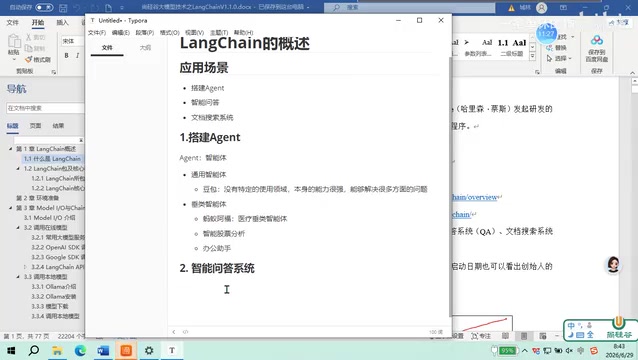
The most typical implementation is customer service systems. The changes in recent years are quite intuitive: in the past, a bot would answer first, and if it couldn't, the query was transferred to a human; now AI is deeply involved in intent recognition, automated responses, and remediation measures, with human handoff only when truly urgent. This type of scenario has high demand and a relatively low technical barrier—it's essentially a matter of designing complex workflows.
Document Search Systems
A common enterprise need: input ten years of financial reports, regulations, and other documents into a system to enable one-sentence retrieval of any content. This isn't just as simple as "throwing it into a database"—it requires designing a RAG (Retrieval-Augmented Generation) system, involving vector databases and combinations of multiple retrieval methods.
The difficulty range is enormous—if the documents are paper-based, they first need to be scanned into images, OCR-recognized, converted to text, segmented, and then stored with multimodal considerations. It can be ridiculously simple, or unimaginably complex.
RAG (Retrieval-Augmented Generation) is the core paradigm for document search applications. A large model's knowledge is frozen in its training weights and it can't directly perceive an enterprise's private documents; RAG's approach is: first split documents into chunks, use an embedding model to convert each chunk into a vector and store it in a vector database; when a user asks a question, the question is likewise converted into a vector, and the most relevant chunks are recalled through similarity search, then these chunks are assembled as context into the prompt and handed to the large model to generate an answer. This way, the model can "see" external material when answering. In practice, single vector retrieval is often insufficient and usually needs to be combined with keyword retrieval (such as BM25) into "hybrid retrieval," supplemented by reranking (Rerank) to improve precision—this is exactly why the article says document search has an "enormous difficulty range."
NL2SQL (Natural Language to SQL)
This scenario is very practical: a mall salesperson who doesn't know programming but has backend query permissions only needs to ask "help me check last month's T-shirt sales," and the system automatically converts the natural language into SQL adapted to the database and returns the result. It looks unremarkable, but the internal conversion logic is quite ingenious.
The difficulty of NL2SQL lies not in generation, but in "making the model understand the database." The model first needs to obtain table structure information—table names, field names, field types, foreign key relationships between tables—usually accompanied by a small amount of sample data or historical Q&A pairs, all placed into the prompt as context (this process is often called Schema Linking). After the user asks a question in natural language, the model infers which table to query, how to filter and aggregate, and outputs the corresponding SQL. Since natural language expressions often don't match database field names (for example, "T-shirt" might correspond to a certain value in the category field), the system also needs to perform semantic mapping. The generated SQL typically needs to be executed in a secure sandbox to prevent injection or accidental deletion; if execution errors out or the result is abnormal, the error information can be fed back to the model for self-correction.
Why Can't You Just Use the Large Model Directly?
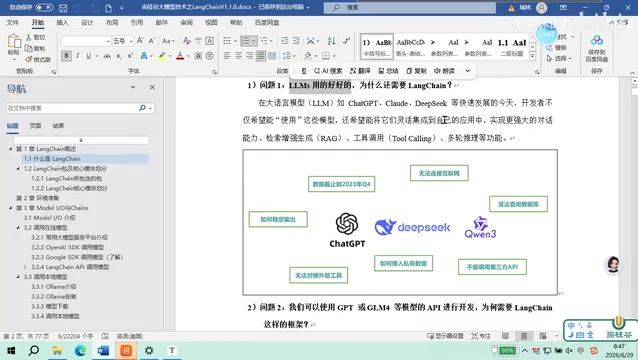
Some might ask: can't I just chat with Doubao directly, so why do I need LangChain for development? The key is that conversation and integration into an application are two different things. Developers want to deeply embed model capabilities into their own programs via APIs, and using a large model directly for conversation has several hard limitations:
- Training data has a cutoff date: the model goes through months of data collection, months of training, plus safety checks, so by release time the data may already be a year old or older, and it can't answer questions about the latest news
- No internet access: a large model is essentially a set of weight parameters and has no networking capability on its own
- Can't query databases: you haven't given it any database connection channel, so naturally it can't query
- Can't call external APIs, can't access private data, has no tool capabilities, unstable output
The root cause of all these problems is the same—a large model is just a model, not a system. LangChain's value is filling in these capabilities that lie "outside the model."
Why Not Just Use the Official APIs Directly?
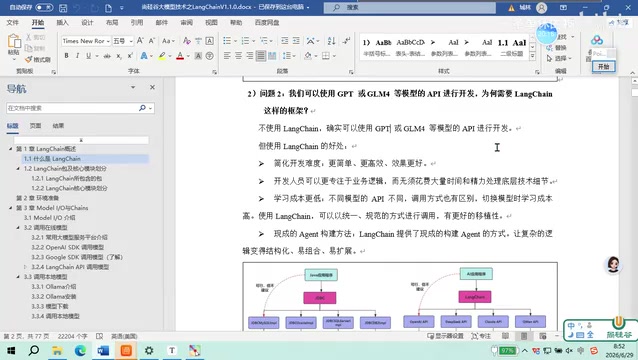
Every model vendor provides a native development API, and it seems like you can just use it directly. But the problem is: every API is different.
Today MiniMax is hot, tomorrow Kimi is hot, and the day after DeepSeekAd releases a new version. If you develop against each official API one by one, switching models means rebuilding the entire project—just like the six states before Qin Shi Huang unified them, each with its own rules. LangChain provides a kind of "unified system of weights and measures": you only need to learn one set of development rules to integrate models from different vendors and different countries.
The benefits can be summarized in three points:
- Simplified development: highly encapsulated model invocation features mean developers only need to send requests according to business needs
- Focus on business logic: no need to write large amounts of useless code for low-level handling, reducing wasted resources
- Lower learning cost: one set of rules works for all models, with extremely low switching cost
This approach actually has precedent. Just as JDBC unified the way multiple databases are accessed, LangChain unifies the way multiple large models are accessed. The LangChain team has already done highly integrated work for various model vendors—they've taken care of the complex parts.
The JDBC analogy mentioned in the article is worth expanding on. JDBC (Java Database Connectivity) is a database access interface standard defined by Java officially, with each database vendor (MySQL, Oracle, PostgreSQL, etc.) providing its own driver that implements the interface. Application code is written only against the JDBC interface, so when switching databases you usually only need to replace the driver and connection string, without rewriting business logic. LangChain plays a similar role in multi-model integration: it abstracts a unified model invocation interface, and differences between vendors are absorbed by the integration layer maintained by LangChain. Developers program against this unified set of rules, and when switching models, often the only change needed is the model name or a small amount of configuration. Of course, this abstraction has a cost—vendor-specific advanced parameters or new features may not be exposed right away, and sometimes you still need to call the vendor's native API directly.
Summary
LangChain's positioning is clear: it's not the model itself, but a development framework that makes the model truly usable. Understanding what problems it solves—data timeliness, internet access, databases, API fragmentation—is more important than memorizing its package structure. As for the core module divisions and specific usage, you can dive deeper gradually through hands-on practice.
One-line Summary
LangChain is a development framework that makes large models truly usable, solving deployment challenges with chain-style invocation and a unified integration layer.
Paragraph Summary
LangChain is an open large language model application development framework initiated by a Harvard team and released in October 2022, earlier than ChatGPT's public debut. Its name reveals the core: organizing and invoking large models through chaining. The article outlines its four major application scenarios—building general and vertical agents, intelligent Q&A customer service, document search (RAG), and NL2SQL—and points out that the core barrier for vertical agents is data acquisition. The article focuses on answering two questions: "Why can't you just use the large model directly?" and "Why not use the official APIs?" A large model is just a model, not a system, with hard limitations like data cutoff, no internet access, no database query capability, and no tool capabilities; meanwhile, each vendor's API goes its own way, and switching models means rebuilding the project. Just as JDBC unified database access, LangChain provides a unified access layer for large models, simplifying development, focusing on business, and lowering learning costs.
Related articles

How Big Can Stars Really Get? The Physical Limits of the Largest Stars
Red supergiants are the largest stars by volume, with radii up to 2,000 times the Sun, engulfing the inner solar system. But there is no precise upper limit on stellar size—models predict up to 15,000 solar radii. The most massive blue stars are far smaller than red supergiants—biggest and heaviest are two different things.

Apple HomeView Smart Display Full Feature Breakdown: Wall-Mount or Desktop, $299
Apple launches HomeView, a $299 smart display with wall-mount and desktop options, 12MP camera for facial recognition, smart home control, music playback, and recipe step-by-step cooking. Full breakdown of watch faces, apps, privacy, and cooking integration.

Where Did the Promised New Studio Go? Craft Computing Answers After Five Years
Craft Computing's host responds to viewer questions: the new studio promised five years ago was shelved as construction costs soared from $30,000 to $75,000, and was replaced by a 168-square-foot garage conversion.