LangChain Core 1.6.12 Released: Fix for Streaming Content Block Event Defect

langchain-core 1.6.12 fixes a defect where extras metadata was not correctly propagated in content-block-start events.
langchain-core has released version 1.6.12 with minimal changes: a version release commit and one bug fix. The fix addresses the extras field not being correctly passed in content-block-start events. The defect causes apps relying on this event for UI initialization, state machines, or callback routing to miss necessary context, and it's hard to detect during development since it throws no errors. The update continues the core library's small, rapid iteration cadence, with releases automated by GitHub Actions and GPG-signed.
A Low-Key but Critical Minor Version Update
LangChain's core library, langchain-core, has released version 1.6.12, not long after the previous version 1.6.11. According to the changelog on the GitHub Release page, this update contains only two entries: one version bump release commit (#41277), and one fix for the extras propagation issue in the content block start event (#41272).
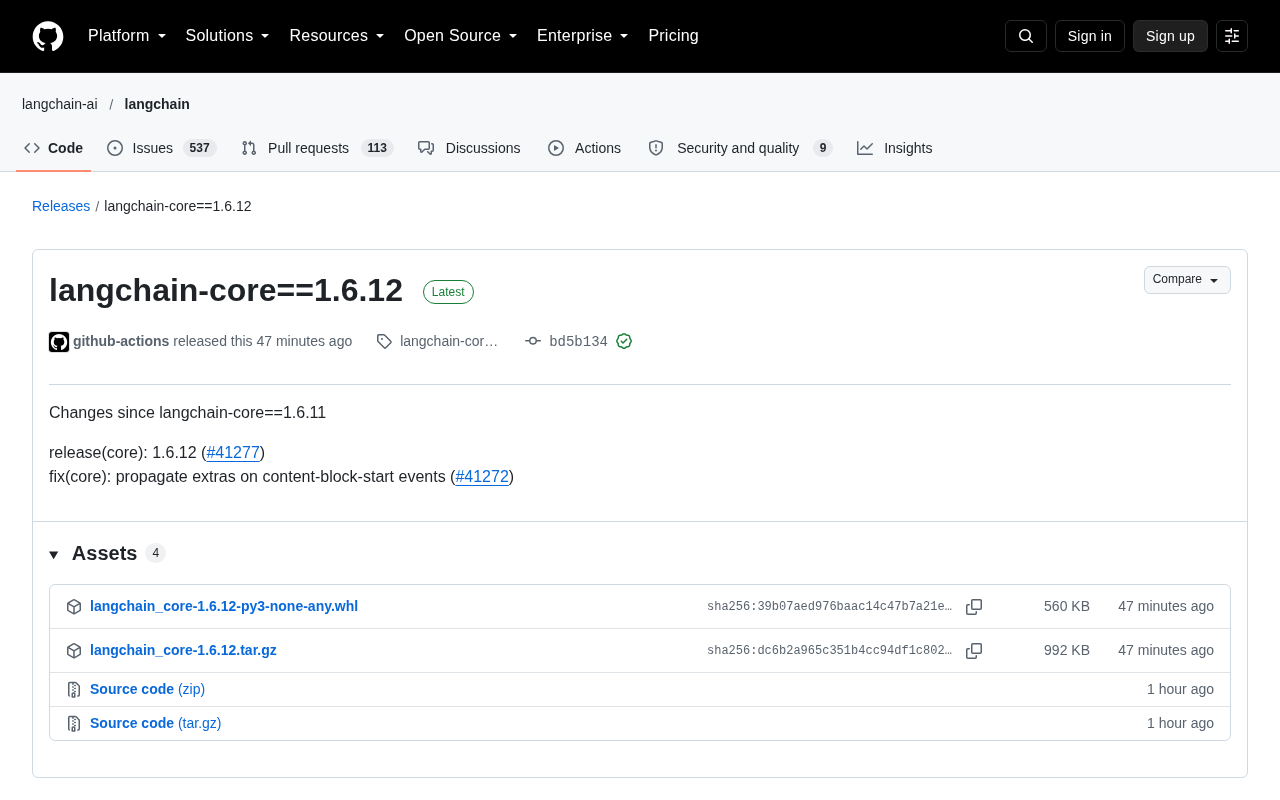
The version number isn't significant, and there aren't many changes, but for developers using LangChain's streaming output, this fix may directly affect your event handling logic.
What Was Fixed: Extras Propagation in content-block-start Events
Background
LangChain recently introduced the concept of content blocks to handle streaming content returned by large models in a more structured way. When the model begins outputting a new content block, the framework triggers a content-block-start event.
The problem lies with the extras field. extras is a general-purpose field in LangChain messages and events for carrying additional metadata. Developers can use it to pass custom information—such as source annotations, confidence scores, tool call context, and more. Before 1.6.12, when a content-block-start event was triggered, the extras information attached to the content block was not correctly passed into the event object.
Content Blocks and Streaming Events: LangChain's content block mechanism is an abstraction that structurally models large model output, breaking a single response into several semantic units (such as text paragraphs, tool calls, reasoning steps, multimodal fragments, etc.). In streaming scenarios, the framework produces output block by block and marks each block's lifecycle with a pair of events: content-block-start indicates a new block begins, followed by several incremental events, and finally content-block-end closes it out. This design allows upper-layer applications to exercise fine-grained control at the block level, such as mounting UI components when a block starts or triggering post-processing when a block ends. The extras field is precisely the general-purpose container reserved for this kind of block-level extension information—it doesn't prescribe a field structure, but instead leaves the interpretation of metadata to the caller. So once it is dropped during event construction, any logic depending on it silently fails.
Scope of Impact
The impact of this defect depends on how you use it. If you're only doing basic text streaming output, you may not notice any difference at all. But if you're building the following types of applications, you should pay attention:
- Event-driven streaming processors: Relying on
content-block-startevents to initialize UI components or state machines—losing extras means you can't get the necessary context at initialization time. - Multimodal content processing: When content blocks represent non-text modalities like images or audio, extras may carry modality-related metadata.
- Custom callback chains: Scenarios where extras are read in callback handlers for routing or logging purposes.
The fix itself is straightforward—ensuring extras is correctly propagated when events are constructed. But this type of "data lost in the pipeline" problem is often hard to catch during development, because it usually doesn't throw errors—it just silently turns certain fields into empty values.
Why Silent Data Loss Is More Dangerous: The stealthiness of this kind of defect comes from two characteristics. First, event objects are usually treated as plain dictionaries or data classes, and missing keys tend to return None or an empty dictionary rather than throwing an exception—callers won't notice unless they explicitly validate. Second, in streaming scenarios events are generated at high frequency, and developers tend to focus on whether the content is correct and the order is reasonable, rather than checking metadata fields one by one. Therefore, the real value of fixing the extras propagation issue lies in restoring the integrity contract of event payloads: what an event carries when triggered should be consistent with the extras carried by the content block itself. When building cross-cutting logic like callback routing, logging instrumentation, and source tracking, this contract is a prerequisite for correctness.
Release Cadence and Engineering Signals
From 1.6.11 to 1.6.12, the changes are minimal, which matches langchain-core's recent release cadence: small, rapid iterations, with each version focusing on a few fixes.
This cadence has pros and cons. The upside is that fixes reach users quickly, without waiting for a major version to accumulate a large number of changes. The cost is that version numbers jump frequently, and for projects that pin dependency versions, upgrade decisions need to be made more often.
Another point worth noting is that the Release was published by the github-actions bot, and the commit was verified with a GPG signature. This shows that LangChain's release process is highly automated, and signature verification provides an extra layer of supply chain security.
For production environments, the recommended approach is: if your current version runs stably and you haven't encountered extras propagation issues, there's no rush to upgrade; if you're using streaming content block-related features, especially scenarios that need to read extras, 1.6.12 is worth including in your upgrade plan.
Semantic Versioning and Dependency Pinning: langchain-core uses the major.minor.patch format, and 1.6.12 is a patch increment, which by convention indicates a backward-compatible bug fix. But frequent patch releases still have practical implications for downstream: projects using requirements.txt or poetry.lock to pin exact versions need to actively update to get the fix, while constraints like ~=1.6.0 or ^1.6.0 that allow patch versions to float will automatically pick up these small fixes. The practical trade-off is: floating ranges get security and correctness fixes faster, at the cost of build results potentially changing with upstream releases. Therefore, combining a lock file with regular dependency audits is usually the more reliable combination.
How to View This Update
langchain-core 1.6.12 isn't the kind of version that makes tech headlines. It has no new features, no performance leaps—just a precise bug fix.
But it's exactly these kinds of updates that make up the daily life of open source infrastructure. As one of the most mainstream LLM application development frameworks today, LangChain's core library stability directly affects a large number of downstream projects. The content block event mechanism is the infrastructure for streaming processing, and although the extras propagation fix is tiny, it makes this mechanism more reliable.
For framework users, the point of paying attention to these small version updates isn't about upgrading every time—it's about understanding how the abstraction layers you depend on are evolving: which boundaries are being patched, which behaviors are being standardized. This information is more valuable than the version number itself.
Paying Attention to Boundary Patches in Abstraction Layers: A framework's stability is often not determined by headline features, but accumulated through these fixes targeting boundary behaviors. Every fix for "data lost in the pipeline" is actually adding explicit definitions to some implicit contract: which fields must exist when, and must be preserved after which transformations. For users, tracking these changes helps determine whether the abstractions you depend on are converging, and can also preemptively reveal existing issues that might surface during upgrades. Compared to version numbers, understanding the evolution direction of these contracts is more helpful for making sound dependency strategies.
One-line Summary
langchain-core 1.6.12 fixes a defect where extras metadata was not correctly propagated in content-block-start events.
Paragraph Summary
langchain-core has released version 1.6.12, with minimal changes consisting of only a version release commit and one bug fix. The fix addresses the issue where the extras field was not correctly passed in content-block-start events: extras is a general-purpose field in LangChain messages and events for carrying additional metadata, holding custom content such as source annotations, tool call context, and modality information. The defect causes applications relying on this event to initialize UI, state machines, or callback routing to fail to get the necessary context, and because it doesn't throw errors, it's hard to detect during development. The article notes that this update continues the core library's small, rapid iteration cadence, and the release process is now automated by GitHub Actions with GPG signature verification. It suggests that stable, unaffected projects need not rush to upgrade, while scenarios using streaming content blocks that need to read extras should include it in their upgrade plans.
Related articles

Chain of Thought Isn't Just for AI: How Humans Can Use CoT to Improve Thinking Quality
Chain of Thought isn't just a prompt trick for large models. Starting from a Hacker News discussion, this article analyzes why CoT works for human thinking too, breaks down actionable ways to transfer it, and highlights the key differences between human CoT and machine CoT.
Cloudflare Teams Up with OpenAI: Closi…
Cloudflare Teams Up with OpenAI: Closing the Loop from Vulnerability Discovery to Defense with AI
Cloudflare uses OpenAI Daybreak to investigate security vulnerabilities and generate reviewable remediation plans, while developers use Codex to boost coding efficiency and quality.

Orca Multi-Agent Orchestration in Practice: A Guide to Parallel Collaboration with Claude and Codex
Orca is Stable AI's free open-source agent workbench supporting 34 agents like Claude Code and Codex in parallel. Learn its Git worktree isolation, multi-model orchestration, and mobile management.