LangChain Core 1.6.5 Released: Fix for Long Tool IDs in XML Buffer Strings
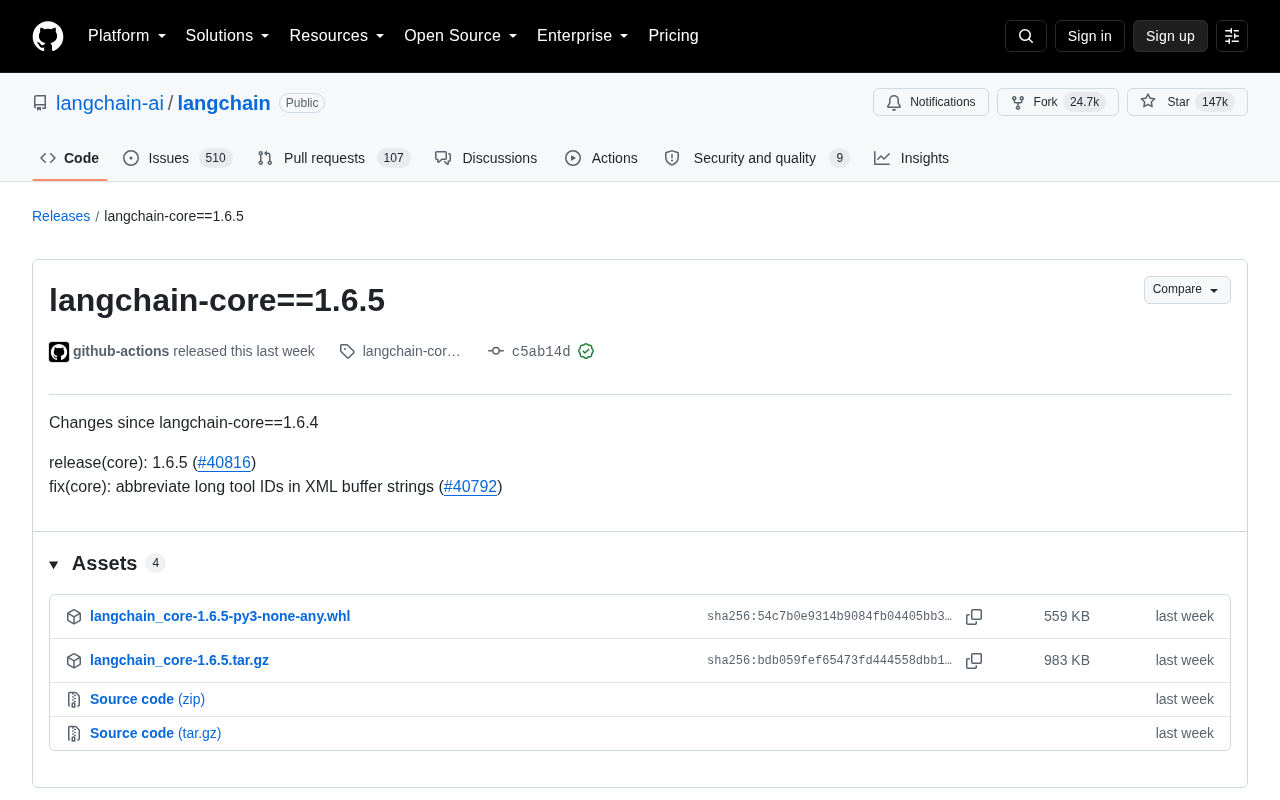
langchain-core 1.6.5 patches long tool ID verbosity in XML buffer strings with minimal upgrade risk.
langchain-core 1.6.5 is a standard patch release published on September 24th via GitHub Actions with GPG signature verification. It includes just two commits: a version bump and a bug fix (#40792) targeting tool calling scenarios. The fix addresses excessive verbosity caused by long tool IDs in XML buffer strings by abbreviating them, improving readability of intermediate state output. With no breaking changes, the upgrade is safe for all projects using tool calling functionality.
LangChain Core 1.6.5 Release Overview
As one of the most popular frameworks for building LLM-powered applications, every update to LangChain's core library langchain-core is closely watched by developers worldwide. The project has amassed over 147,000 stars and 24,700 forks on GitHub, making it a foundational piece of infrastructure in the AI application ecosystem.
This release, langchain-core==1.6.5, is a patch release published on September 24th via GitHub Actions automation. The release artifacts are signed with a verified GPG key (Key ID: B5690EEEBB952194), ensuring integrity and authenticity.
What Changed in This Release
Compared to the previous version langchain-core==1.6.4, version 1.6.5 focuses on two changes:
Version Bump & Bug Fix
- release(core): 1.6.5 (#40816): A standard version bump commit that locks in all changes for this iteration.
- fix(core): abbreviate long tool IDs in XML buffer strings (#40792): Applies abbreviation to excessively long tool IDs when they appear in XML buffer strings.
This is a classic "small, incremental" patch update — no breaking changes, just a focused robustness fix at the detail level.
Why Abbreviate Tool IDs?
The core fix (#40792) is closely tied to the tool calling workflow. In LangChain's Agent and tool-calling pipeline, each tool invocation is assigned a unique Tool ID. When these IDs are serialized into XML-formatted buffer strings, overly long IDs create redundancy, reduce readability, and can introduce unnecessary overhead in certain parsing scenarios.
By abbreviating long tool IDs, LangChain improves the output quality of XML buffers. For developers who parse tool call results in XML format, this change makes intermediate-state strings more concise and easier to read, reducing noise in the output.
Tool IDs are typically generated using UUIDs (Universally Unique Identifiers) or similar random strings, usually 32–36 characters in length. In LangChain's streaming scenarios, intermediate tool call states are continuously written to the buffer. Since XML itself already carries significant tag overhead, embedding a full UUID as an ID attribute on every tool call node can cause the overall string size to balloon noticeably. This is especially problematic in scenarios that require logging intermediate states, transmitting them over a network, or manually debugging them. The abbreviation strategy typically retains the first few characters of the ID (e.g., the first 8), which is sufficient to distinguish between different tool calls within a single session context while significantly reducing output noise.
In Semantic Versioning (SemVer), a patch release increments the third digit of the version number — the PATCH part of MAJOR.MINOR.PATCH. Per SemVer conventions, patch versions are reserved exclusively for backward-compatible bug fixes: no new features, no breaking API changes. This means developers can safely upgrade from langchain-core==1.6.4 to 1.6.5 without any compatibility concerns. LangChain's high-frequency patch release cadence also reflects its "continuous delivery" engineering culture — shipping fixes in small, fast increments rather than batching them up means users receive stability improvements sooner.
Practical Impact for Developers
Since this is a patch release, the upgrade risk is minimal for most developers using stable interfaces. Consider upgrading if any of the following apply:
- Your project heavily relies on tool calling and uses XML format for processing intermediate results.
- You've noticed excessively verbose tool ID strings affecting log readability during debugging.
- You want to keep your dependencies up to date to ensure future compatibility.
Upgrading is straightforward — just specify the version with your package manager:
pip install langchain-core==1.6.5
Summary
langchain-core==1.6.5 is a quiet but practical patch update. It introduces no flashy new features, yet it reflects the LangChain team's ongoing attention to detail in the critical area of tool calling. For developers building Agent applications, these seemingly minor optimizations have a way of accumulating into a noticeably smoother development experience in production.
It's also worth noting that LangChain continues to maintain a high-frequency release cadence. Developers are encouraged to keep an eye on the official Release Notes to stay current with the evolution of core modules like tool calling and chain orchestration.
Related articles

Random Pruning of the DPO Computation Graph: 1.4x Training Speedup and Lower Peak Memory
DPO training too slow and memory-hungry? This paper proposes a random pruning framework for the DPO computation graph, sampling independently across position, sequence, and branch dimensions; branch pruning achieves a 1.426x step-time speedup and cuts training time by about 30%, with in-depth attribution of memory and time gains.

Why Does JEPA Underperform MLM in Longitudinal EHR Representation Learning?
New study compares JEPA and MLM for longitudinal EHR representation learning on MIMIC-IV: three JEPA variants train stably without collapse but underperform MLM; target size, not heterogeneity, drives prediction error.

Transfer Learning + Visible Light Communication: A New Approach to Energy-Efficient Indoor Positioning
A study proposes a transfer learning-based visible light communication indoor positioning method, achieving 47% accuracy improvement on the BOSCH factory dataset, 67.5% model efficiency under high noise, and introducing the ME composite metric for energy-efficient positioning in energy-constrained industrial IoT scenarios.