LangChain Education Team Answers Common Questions About Agent Evals

The LangChain education team answers common questions about Agent Evals, clarifying evaluation concepts and tool choices.
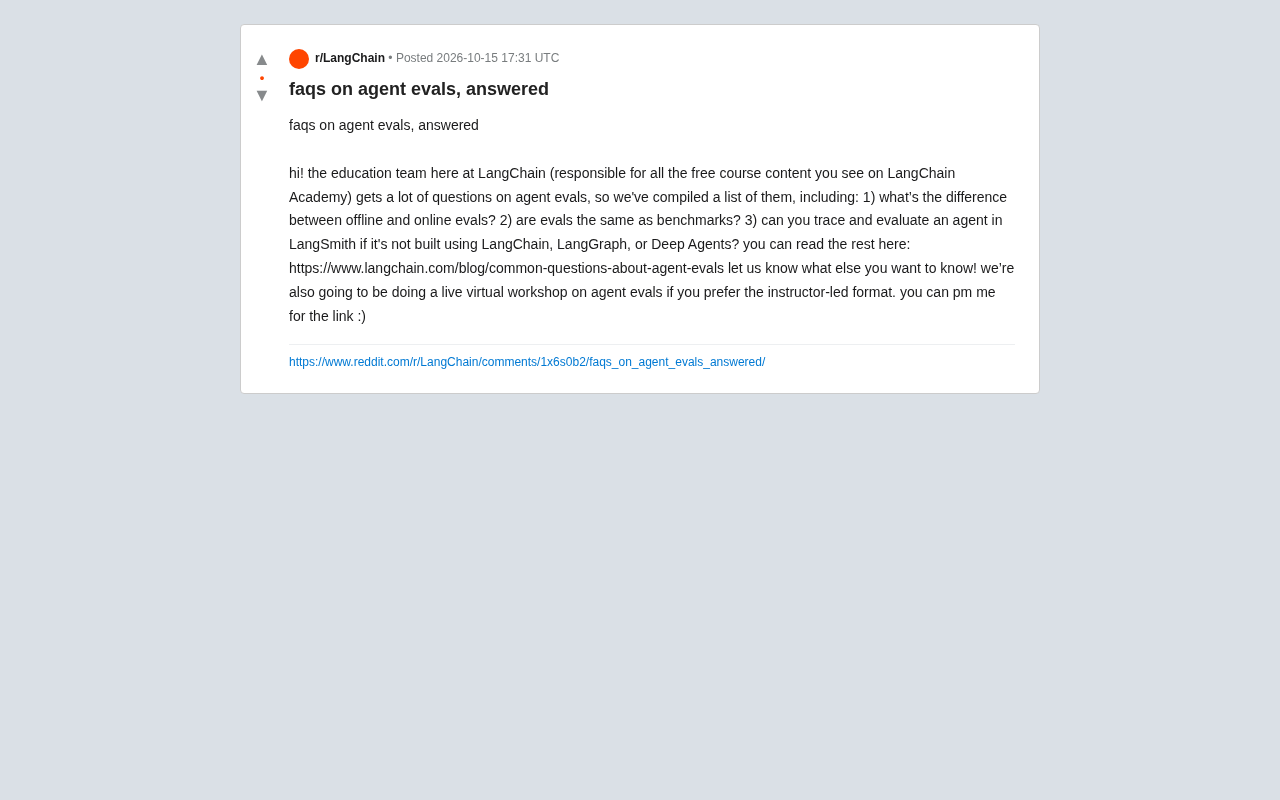
The LangChain education team gathered developers' common questions about Agent Evals on Reddit. The article focuses on three types of questions: first, the difference between offline and online evals—the former uses fixed test sets during development for repeatable version comparisons, while the latter continuously monitors production data, and the two are complementary; second, how Evals differ from Benchmarks—Benchmarks are standardized public test sets for horizontal model comparison, while Evals customize criteria for specific scenarios and assess whether an Agent meets standards on concrete tasks; third, Agents built on non-LangChain frameworks can also integrate with LangSmith via SDK or API for tracing and evaluation. The team also mentioned an upcoming online workshop on evaluation practices.
What Are Agent Evals? The LangChain Education Team Explains
The LangChain education team has published a FAQ about Agent Evals on Reddit, gathering the most frequently asked questions from the community. If you're building AI Agents or feeling confused about evaluation methods, these questions may be exactly the answers you need.
Core Question: Offline Evals vs. Online Evals
The first question the team raised is: What's the difference between offline evals and online evals?
Offline evals are typically conducted during the development phase, using a fixed test dataset to verify Agent performance. This approach can be run repeatedly, making it easy to compare improvements across different versions. Online evals, on the other hand, collect and analyze data while the Agent is actually running, staying closer to real user scenarios—though the data distribution will shift over time.
The two are not mutually exclusive but complementary. Offline evals help you catch obvious problems before launch, while online evals let you continuously monitor how your Agent performs in production.
Are Evals and Benchmarks the Same Thing?
The second common question is: Are evaluations and benchmarks the same?
Although both involve measuring the performance of AI systems, they have different focuses. Benchmarks are usually standardized, public test sets used to compare the capabilities of different models or systems horizontally, such as MMLU, GSM8K, and others. Evals, by contrast, focus more on customizing evaluation criteria for specific application scenarios—what matters is whether your Agent meets the expected goals on a particular task.
In short, Benchmarks answer "how strong is this model," while Evals answer "how does this Agent perform in my scenario."
MMLU (Massive Multitask Language Understanding) was introduced in 2020 by UC Berkeley and other institutions. It contains about 14,000 multiple-choice questions covering 57 subjects including STEM, humanities, social sciences, law, and medicine. It is mainly used to measure a model's breadth of general knowledge and reasoning. GSM8K (Grade School Math 8K) focuses on elementary school math word problems, with about 8,500 questions requiring multi-step reasoning, commonly used to test a model's chain-of-thought reasoning and arithmetic abilities. Both are regarded as typical Benchmarks because the questions are fixed, the scoring rules are clear, and the results are reproducible, making it easy to compare different models on the same scale. But they also have limitations: once the questions are made public, they may be contaminated by training data, and a high score does not mean the model is equally reliable in a specific business scenario—which is exactly why Evals are needed as a complement.
Can Agents Built on Non-LangChain Frameworks Be Evaluated?
The third question is one many developers care about: If an Agent is not built with LangChain, LangGraph, or Deep Agents, can it still be traced and evaluated in LangSmith?
The LangChain team says that even if your Agent is built on another framework, you can still trace and evaluate it through LangSmith. LangSmith provides framework-agnostic tracing capabilities and supports integration via SDK or API. This means your choice of evaluation tools doesn't have to be limited by your development framework—you can flexibly combine them based on your actual needs.
LangSmith is the observability and evaluation platform launched by LangChain. Its core capabilities include run tracing, dataset management, and automated evaluation. Its tracing mechanism is built on an OpenTelemetry-style Run tree: a single Agent call is broken down into several nested Runs, recording inputs, outputs, latency, token usage, and intermediate tool calls, thereby reconstructing the complete execution path. Because the integration layer is a general-purpose SDK and REST API rather than a LangChain-specific callback protocol, no matter whether the Agent is implemented with CrewAI, AutoGen, LlamaIndex, or purely custom code, as long as Runs are reported according to the specification, you can get the same visualization and evaluation capabilities in LangSmith. During evaluation, trace data can be added to datasets and scored using custom evaluators or LLM-as-Judge.
More Resources and Future Plans
In addition to the three core questions above, the LangChain education team also answered more questions about Agent Evals in their blog post. They are also preparing an online virtual workshop to dive deeper into practical methods for Agent evaluation in an instructor-led format. For developers who prefer structured learning, this is an opportunity worth watching.
If you want to learn more details, you can read the full article on the official LangChain blog or leave a comment under the Reddit post with your questions.
One-line Summary
The LangChain education team answers frequently asked questions about Agent Evals, clarifying evaluation concepts and tool choices.
Paragraph Summary
The LangChain education team gathered developers' most common questions about Agent Evals on Reddit. The article focuses on three types of questions: first, the difference between offline and online evals—the former uses a fixed test set during development to verify the Agent and allows repeatable comparisons of version improvements, while the latter continuously monitors based on production data, and the two are complementary; second, the difference between Evals and Benchmarks—Benchmarks are standardized public test sets for horizontally comparing model capabilities, while Evals customize criteria for specific application scenarios and answer whether the Agent meets standards on specific tasks; third, Agents built on non-LangChain frameworks can also be integrated with LangSmith via SDK or API for tracing and evaluation. The team also mentioned that they will hold an online workshop to dive deeper into evaluation practices.
Related articles

Chain of Thought Isn't Just for AI: How Humans Can Use CoT to Improve Thinking Quality
Chain of Thought isn't just a prompt trick for large models. Starting from a Hacker News discussion, this article analyzes why CoT works for human thinking too, breaks down actionable ways to transfer it, and highlights the key differences between human CoT and machine CoT.
Cloudflare Teams Up with OpenAI: Closi…
Cloudflare Teams Up with OpenAI: Closing the Loop from Vulnerability Discovery to Defense with AI
Cloudflare uses OpenAI Daybreak to investigate security vulnerabilities and generate reviewable remediation plans, while developers use Codex to boost coding efficiency and quality.

Orca Multi-Agent Orchestration in Practice: A Guide to Parallel Collaboration with Claude and Codex
Orca is Stable AI's free open-source agent workbench supporting 34 agents like Claude Code and Codex in parallel. Learn its Git worktree isolation, multi-model orchestration, and mobile management.