Boox Palma 2 Pro Review: The $400 E-Ink Reader That Got Me to Quit Reading on My Phone
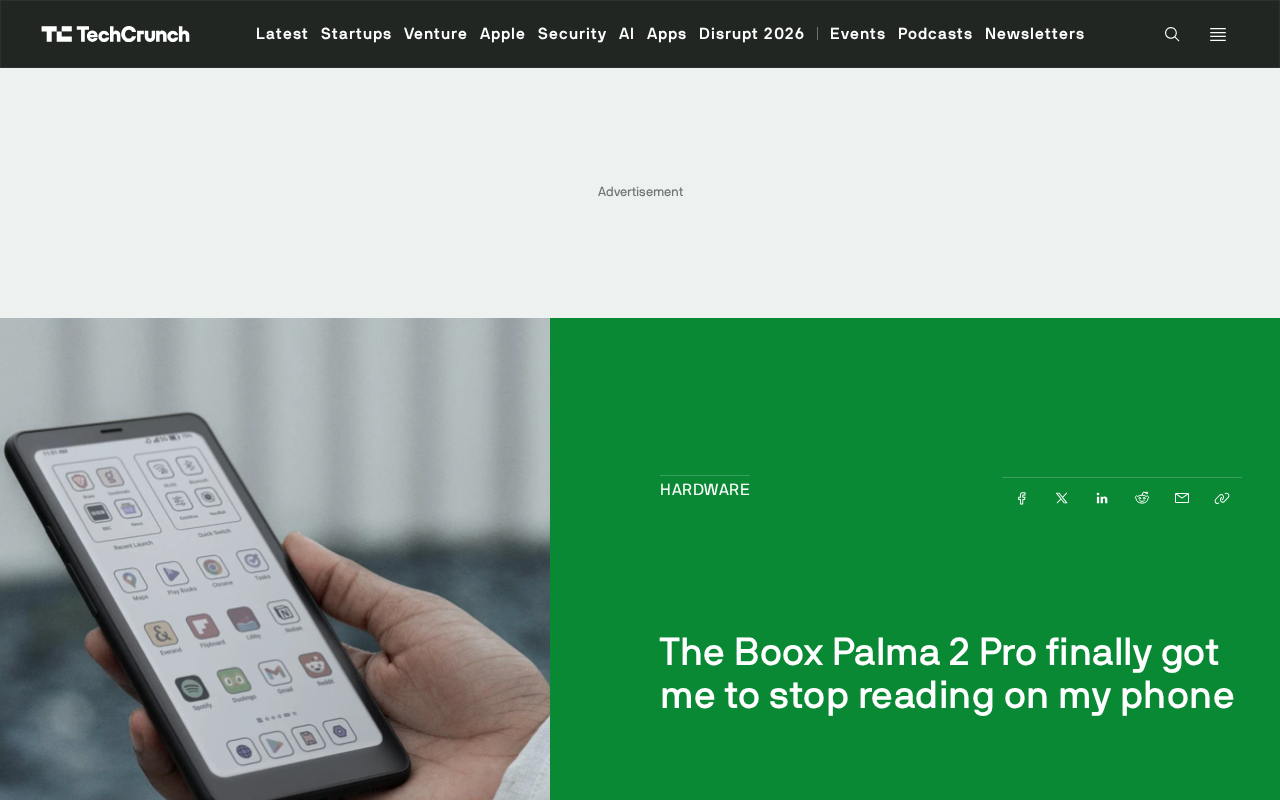
A $400 phone-sized E-Ink reader that trades features for focused reading.
The Boox Palma 2 Pro is a $400 E-Ink device with a body close to phone size, positioned not as a cheap tablet but as a dedicated tool to replace your phone for deep reading. The article explains that the biggest distraction in phone reading comes from product logic designed to retain users, and that the Palma 2 Pro forces single-tasking by dropping color screens and entertainment features and limiting its app ecosystem. Based on The Verge's review and community discussions, it suits commuters, document readers, and blue-light-sensitive users, but not multitaskers or those who already own a large-screen e-reader. Its value lies in showing a trend of users paying for focus and actively resisting the attention economy.
Everyone knows the pain points of reading on a phone: notification bombardments, harsh blue light, and fragmented attention. The Boox Palma 2 Pro, a $400 phone-sized E-Ink device, tries to win back deep-reading focus by trading features for simplicity. Is it worth it? Here's an analysis drawing on tech media reviews and discussions from digital communities.

Why Reading on a Phone Is So Distracting
When you read on a phone, the biggest enemy isn't the screen size—it's the product logic behind that screen, which is designed to "keep you." A single push notification can yank your attention away from a long-form article, and the red badges on social apps are more conspicuous than chapter titles. E-Ink devices take the opposite approach: they deliberately forgo color screens and most entertainment features, using E Ink's paper-like look and a walled-off set of use cases to turn "reading only" into an advantage.
According to a review by tech media outlet The Verge, the Boox Palma 2 Pro is designed around exactly this logic—it's positioned not as a "cheap tablet" but as a dedicated tool to get you to stop reading on your phone.
Core Design of the Boox Palma 2 Pro
A Phone-Sized E-Ink Screen
The Palma 2 Pro uses a body size close to that of an ordinary phone and comes with an E Ink electronic paper display, allowing you to read e-books, long-form articles, and documents. Compared with traditional 6- to 7-inch e-readers, it's held more like a phone, making it easier to operate one-handed and more portable for commutes. Its $400 price tag puts it in the mid-to-high-end range among E-Ink devices, but below most large-screen color e-readers.
E Ink screens work on a completely different principle from LCDs: millions of microcapsules float inside the screen, each containing black and white particles with positive and negative charges, and an electric field drives the particles up and down to form an image. Once an image is formed, it consumes no power—power is only used when turning pages—so E-Ink devices often have battery life measured in weeks. The trade-off is slow refresh rates: each page turn takes hundreds of milliseconds, and rapid successive refreshes leave behind ghosting. This is the technical root of the "page-turn lag is a common problem for all E Ink devices" mentioned in this article. In addition, most E Ink screens don't emit blue light themselves, and some devices also feature a warm frontlight—which is exactly why they appeal to blue-light-sensitive users.
Subtracting Features
The core selling point of this kind of device isn't hardware specs but the boundaries it sets on use. The review points out that the key to the Palma 2 Pro getting people to stop reading on their phones is that it can't install the apps that grab attention, nor does it have notification distractions. Reading apps, document tools, and e-book platforms make up its main ecosystem, forcing users into a "single-task" state.
Boox devices run a customized system based on Android, which contrasts with closed readers like the Kindle. A closed system only gives access to the manufacturer's bookstore, whereas Boox lets users install third-party reading apps (such as WeChat Reading, the Kindle app, Zhangyue, and others) and supports multiple formats including EPUB, PDF, and MOBI. But there's tension between "openness" and "distraction prevention": an Android system can theoretically install social and video apps, so the Palma 2 Pro's focused experience relies more on user self-discipline and the manufacturer's app-store curation than on a hard lock. Understanding this helps you judge whether it's "physical isolation" or "soft constraint."
Who Should Buy It, and Who Shouldn't
Judging from community discussions, opinions on this kind of device are clearly split. Those who suit it include: users who read on their daily commute, look at documents for long stretches, are sensitive to blue light, and already have a stable source of e-books. For them, the $400 buys "focus," not "performance."
The group it doesn't suit is equally clear: users who are used to looking things up, watching videos, or multitasking while reading will find it too limited; and those who already own a large-screen e-reader will have little incentive to upgrade unless they particularly value portability. In addition, the page-turn lag caused by E-Ink refresh rates remains a common problem for all E Ink devices.
"Attention economy" refers to a business model in which platforms compete for and extend users' dwell time, maximizing usage time through algorithmic recommendations, infinite scrolling, push notifications, and other designs, with ad revenue growing accordingly. The concept was popularized by scholars such as Tim Wu and is now often used to explain why smartphones are poorly suited to deep reading. The resurgence of dedicated devices—including E-Ink readers, portable music players, and "minimalist phones" that keep only calling functions—is essentially users' attempt to pay their way out of the attention economy. Note that such devices don't eliminate the supply side of the attention economy; they merely provide individuals with a physical boundary.
Editorial View: The Return of Value for Dedicated Devices
The arrival of the Boox Palma 2 Pro reflects a broader trend: when general-purpose devices (phones) carry too many functions, some users begin to be willing to pay for devices that "can only do one thing." This follows the same logic as the resurgence of music players and focus timers—it's not technological regression but an active rebellion against the attention economy.
$400 isn't cheap, but if you've ever had a late-night reading session interrupted by a phone notification, you'll understand the logic behind this pricing: what it sells isn't a screen but a stretch of uninterrupted time.
One-line Summary
A $400 phone-sized E-Ink reader that trades features for focused reading.
Paragraph Summary
The Boox Palma 2 Pro is a $400 E-Ink reading device with a body close to phone size, positioned not as a cheap tablet but as a dedicated tool to replace your phone for deep reading. The article notes that the biggest distraction in phone reading comes from product logic designed to retain users, and that the Palma 2 Pro forces users into a single-task state by forgoing color screens and entertainment features and limiting its app ecosystem. Drawing on The Verge's review and community discussions, it suits commuters, document readers, and blue-light-sensitive users, but not those who need to multitask or who already own a large-screen e-reader. Its value lies in reflecting a trend of users willing to pay for a focused experience and actively rebelling against the attention economy.
Related articles

Big Tech AI Engineering Interview: Full-Chain Observability from Frontend Monitoring to Agents
From PerformanceObserver metrics collection and onerror/unhandledrejection exception capture, to RAG pipeline reranking and context compression for token cost control, to designing a full-site AI full-chain observability system benchmarked against LangSmith and Sentry—breaking down the three progressive layers of big tech AI engineering interviews.

WorkBuddy Step-by-Step Guide: Build Your Own AI Agent Work Assistant
WorkBuddy step-by-step guide: starting from the limits of chat models like Doubao, learn to build your own AI Agent work assistant for batch local file processing and automation—no programming required.

Building a Local Knowledge Base with LangChain-Chatchat + DeepSeek on Windows
This article, based on a Bilibili tutorial, details the full workflow of building a local knowledge base on Windows using LangChain-Chatchat and DeepSeek, including Anaconda environment setup, Ollama model management, mirror acceleration, and common error solutions, helping you quickly implement RAG Q&A.