LangChain Fundamentals: A Deep Dive into Components, Chains, and Agents

A beginner's guide to LangChain's three core pillars: Components, Chains, and Agents.
LangChain is an open-source framework that bridges large language models with external data sources and tools. This article breaks down its three core concepts: Components provide a unified interface across LLM providers, Chains orchestrate multi-step workflows like RAG pipelines, and Agents enable models to interact with the external world through tool use — forming the foundation of enterprise-grade AI application development.
From Chatbots to Enterprise-Grade AI Applications
If you've ever written code that calls a large language model API, you've already built the most basic kind of chatbot — enabling human-machine conversation through interfaces like OpenAI or GLM. But these applications share a fundamental limitation: a large language model's knowledge comes solely from the internet data it was trained on.
The training process of a Large Language Model (LLM) is essentially a statistical learning exercise over massive volumes of internet text. GPT-4, for example, has a well-defined Knowledge Cutoff — meaning the model has no awareness of events that occurred after that date. More importantly, the source of training data defines the model's knowledge boundary. Enterprise intranet databases, private documents, and confidential business data never appear in public training sets. This "closed world" architectural limitation has given rise to two major technical approaches: continuous Fine-tuning, which retrains private data into model weights, and RAG (Retrieval-Augmented Generation), which dynamically injects external knowledge at inference time. LangChain primarily serves the latter — fine-tuning is expensive and difficult to update in real time, while RAG is better suited for frequently changing business data in enterprise scenarios.
Imagine a real enterprise scenario: you want a chatbot that not only answers general questions, but can also retrieve information from your company's internal databases or documents — and even execute actions like sending emails based on instructions. None of this is achievable by simply calling a model API.
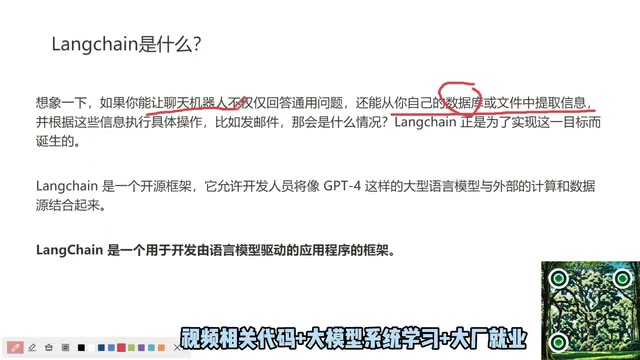
The reason is straightforward: internal data from companies like JD.com, Alibaba, or Tencent is never exposed on the public internet. Search engines can't crawl it, and applications built directly on top of OpenAI models have no way to access that private data. This is the core problem LangChain was built to solve.
What Exactly Is LangChain?
LangChain is an open-source framework that allows developers to combine large language models like GPT-4 with external compute resources and data sources. The term "model" here isn't limited to GPT-4 — it encompasses models from Google, Microsoft, and domestic Chinese providers like Baidu's ERNIE and Zhipu's GLM.
In a single sentence: LangChain is a framework for developing applications powered by language models. It uses LLMs as the core driver while providing capabilities like abstraction and encapsulation, external data retrieval, data storage, and vector database access — enabling general-purpose models to truly integrate into business contexts.
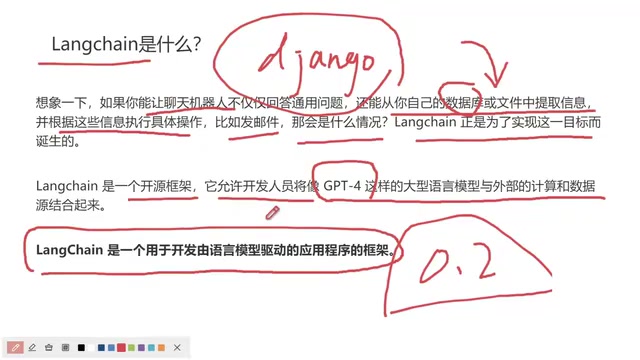
If you have a Java background, think of it this way: LangChain is to LLM application development what Spring Boot is to traditional Java development — it wraps the large model ecosystem into a production-grade development framework. This analogy goes beyond convenience; it reveals a shared design philosophy. Spring Boot solved the problem of giving developers unified, composable access to infrastructure like databases, message queues, and HTTP services. LangChain does the same in the AI space — abstracting away the underlying complexity of prompt template management, conversation history, vector retrieval, and tool calling. It's worth noting that LangChain primarily offers Python and JavaScript/TypeScript versions, with the Python ecosystem being more mature. It has since evolved into a full LLMOps platform encompassing LangGraph (stateful multi-agent workflows) and LangSmith (debugging and monitoring).
LangChain's Three Core Components
LangChain delivers its capabilities through three core concepts. Understanding them is the key to mastering the entire framework.
Components: A Unified Model Interface
Components provide a unified interface layer for large language models. Given the wide variety of LLMs available, LangChain offers a set of abstract drivers — similar to JDBC Drivers in Java.
This analogy is technically precise: JDBC defines unified interfaces like Connection, Statement, and ResultSet, with each database vendor providing its own Driver implementation so developers can program against the interface. LangChain's abstract classes — such as BaseChatModel and BaseLanguageModel — play the same role. OpenAI, Anthropic Claude, Google Gemini, Baidu ERNIE, and Zhipu GLM all implement this unified interface. The practical value of this design: if a model service goes down or raises its prices, developers only need to change one line of model initialization code — the entire application's business logic stays intact. Under China's compliance requirements, this swappability is especially important — the same codebase can use GPT-4 internationally and seamlessly switch to a domestic large model within China.
This design means developers can write code against a single abstract interface and call any large model — whether it's OpenAI, Google, or domestic options like GLM — with minimal changes to business logic when swapping the underlying model.
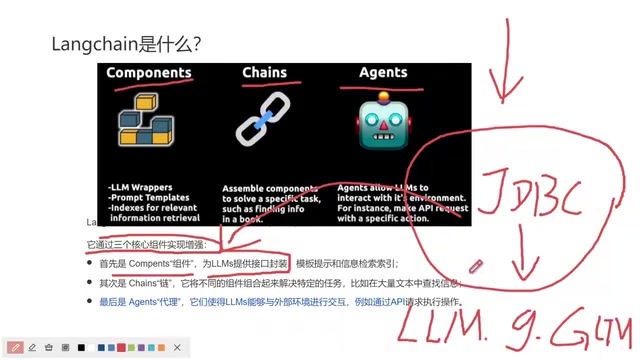
This decoupling means: use domestic models when they serve you better, use international ones when they do — while your core business logic remains stable throughout.
Chains: Orchestrating and Connecting Components
Chains refer to the mechanism for combining different components together to solve specific tasks.
Building a complete AI product typically requires multiple capabilities working in concert: large language models, relational databases, vector databases, text embeddings, and more. It's worth explaining vector databases and embedding technology specifically here: text embedding (Embedding) is the process of converting natural language text into high-dimensional numerical vectors, where semantically similar texts are positioned closer together in vector space. When a company pre-processes its internal documents into vectors and stores them in vector databases like Chroma, Pinecone, or Weaviate, user queries are similarly converted into vectors. A similarity search quickly identifies the most relevant document segments, which are then passed as context to the LLM to generate a response — this is the complete RAG (Retrieval-Augmented Generation) pipeline. The role of Chains is to automatically orchestrate and connect these three steps — embedding model calls, vector database retrieval, and LLM generation — into a complete processing workflow.
This is also where the name "LangChain" comes from — emphasizing the ability to connect each step like links in a chain, working together in sequence.
Agents: Connecting Models to the External World
Agents enable large language models to interact with external environments — the critical leap from "question answering" to "execution."
The Agent mechanism is built on the LLM's tool-calling capability (Function Calling / Tool Use). Its execution loop typically follows an iterative "Reasoning → Acting → Observation" pattern (known as the ReAct Loop): the model first analyzes the task, decides to invoke a tool (such as a web scraper, database query, or email API), receives the tool's output, and continues reasoning until the task is complete. LangChain includes dozens of built-in tools and provides a standard interface for developers to wrap custom tools.
For example: suppose you want the model to analyze information from the official Django documentation. You first need a tool to fetch that content — this "fetching" action is performed by the Agent. The retrieved data is then passed to the LLM, and all subsequent questions can be answered based on that document.
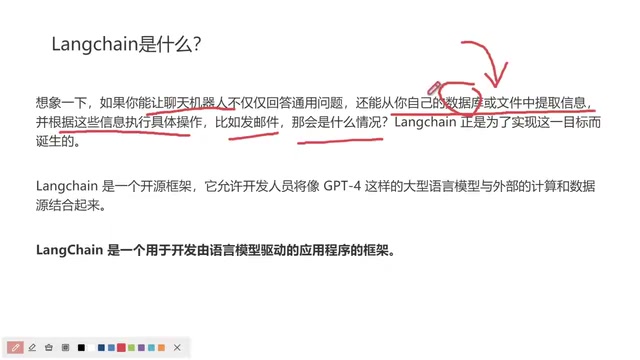
The "external" source can be a website's documentation or an enterprise's own database. JD.com, for instance, holds enormous amounts of product data. Once connected to an AI system, the LLM can use this information to power intelligent customer service or sales agents. This architecture elevates AI from a passive Q&A system to an autonomous agent capable of proactively executing tasks — and it's the technical foundation behind products like AutoGPT and Devin. Agents are the bridge between models and the real business world.
Why Developers Should Pay Attention to LangChain
Combining large models with proprietary business data and enabling AI to autonomously complete specific tasks is the core challenge of deploying AI in practice. LangChain provides exactly this layer of capability: it allows developers to transform a general-purpose LLM into a practical product that understands private data and can execute concrete actions.
When you need AI to answer specialized questions based on internal documents and automatically send a conversation record to a designated email address at the end — that complete pipeline is precisely where LangChain shines.
For developers looking to enter the RAG (Retrieval-Augmented Generation) and Agent development space, understanding the broader industry landscape matters too: Gartner named AI Agents the top strategic technology trend of 2024, and the mainstream approach has evolved from single-agent to multi-agent collaborative frameworks like AutoGen and CrewAI. LangChain occupies the foundational framework layer in this ecosystem, forming a complementary and competitive relationship with LlamaIndex (which focuses on data indexing), together making up the dominant toolchain for LLM application development today. Understanding the three core concepts — Components, Chains, and Agents — is the first step into enterprise-grade AI application development.
Key Takeaways
Related articles
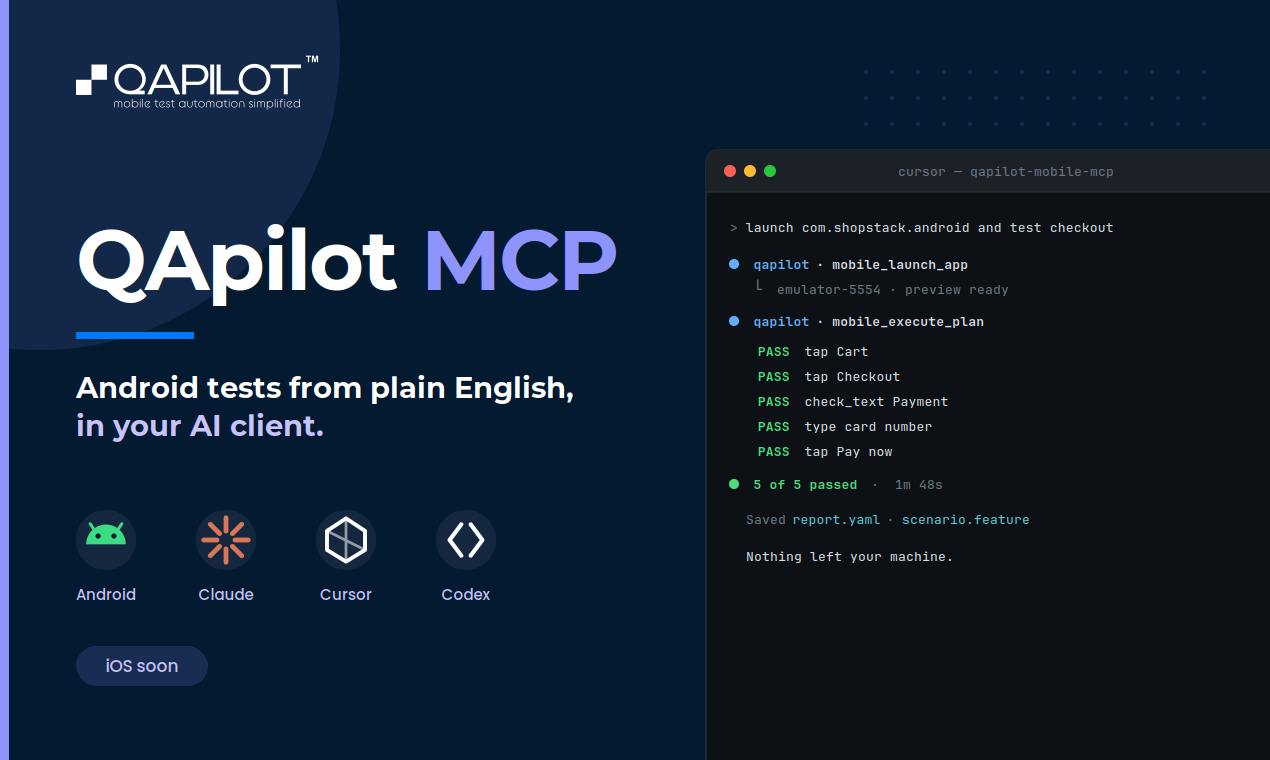
QApilot MCP: Test Android Apps in Natural Language Inside Your AI Coding Assistant
QApilot MCP lets developers test Android apps in natural language inside Claude, Cursor, and Codex — no Appium code needed. Auto-generates reusable Gherkin test cases.
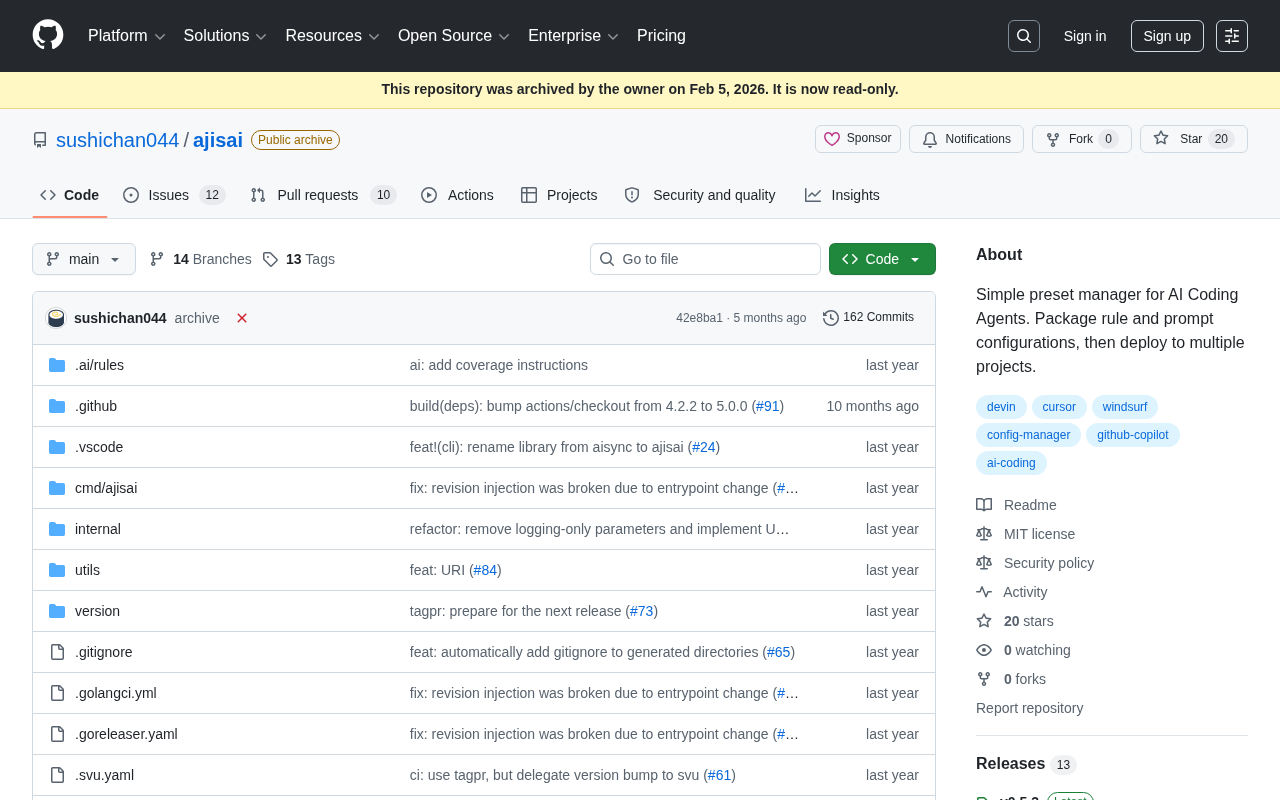
ajisai: A Preset Management Tool for Unifying Rules and Prompts Across AI Coding Assistants
ajisai is a Go-based preset manager for AI coding assistants like Cursor and Claude Code. Package rules and prompts once, deploy everywhere. Early-stage but promising.
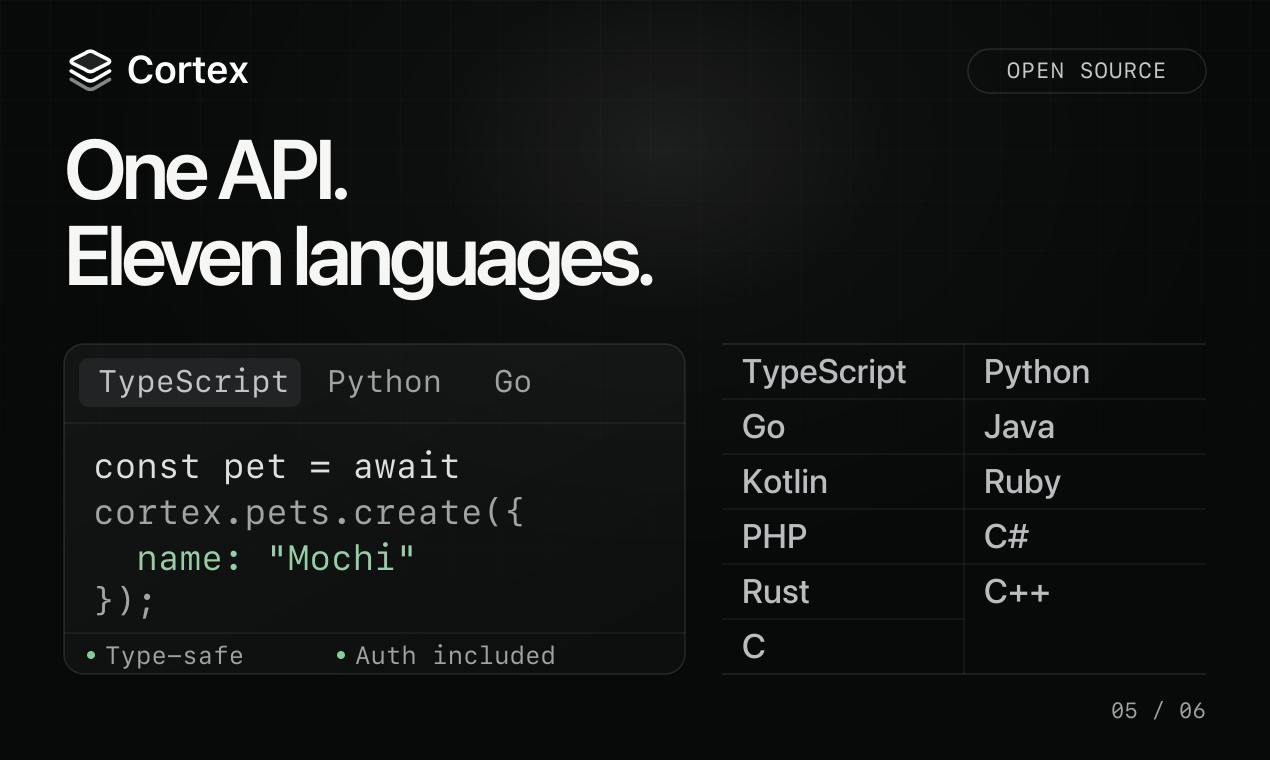
Cortex: Convert API Specs into Docs, SDKs, and MCP Servers in One Click
Cortex is an open-source tool that converts OpenAPI, GraphQL, gRPC and more into interactive docs, typed SDKs in 11 languages, and MCP servers for AI agents.