LangChain.js Agent Development Guide: Implementing an OpenClaw-Style Engine with TypeScript

A practical LangChain.js agent development roadmap for frontend developers using TypeScript.
This guide offers TypeScript-only frontend developers a concrete path into AI application development using LangChain.js, covering model invocation, structured output, tool calling, Agent Loop, multi-agent systems, RAG, and MCP. It contrasts workflow agents with Agent Loop agents to explain why tools like OpenClaw and Claude Code adopt the latter, maps the knowledge to three interview-ready skill levels, and concludes that the real competitive edge in the AI era is business understanding and architecture design — not code generation.
For frontend developers transitioning into AI application development, mastering LangChain.js is one of the most direct paths forward. This guide to agent architecture and development with LangChain.js uses an OpenClaw-style engine implementation as an analogy, walking through the underlying logic of a general-purpose agent step by step. Even if you only know TypeScript and have no Python experience, this path is entirely viable.
From Workflow Agents to Agent Loop
Understanding agent development requires contrasting two fundamental forms: workflow-based agents and general-purpose agents (Agent Loop). These aren't substitutes for each other — they're designed for different scenarios.
Workflow-based agents excel at standardizing AI-driven process automation in enterprise settings — the process is predefined, and the AI executes tasks along a fixed path. General-purpose agents in the Agent Loop model, on the other hand, delegate both the decision-making and planning layers to the AI itself. The model continuously schedules and invokes relevant tools to complete tasks and produce results.
In short, a workflow follows the pattern of "humans define the rules, AI executes them," while an Agent Loop means "AI autonomously plans and orchestrates tools." Studying both in contrast is what helps you understand why general-purpose coding agents like OpenClawAd, Codex, and Claude Code adopt the Agent Loop architecture — the tasks they face simply can't be enumerated with fixed workflows.
The Core Knowledge System of LangChain.js
The entire learning path revolves around several core modules in LangChain.js, which together form the technical foundation of agent development.
Models, Messages, and Multimodality
The foundational layer covers model invocation, the messaging mechanism, and integrating multimodal models. This is the starting point for all higher-level capabilities — yet many developers get stuck at the most basic usage, treating the model as nothing more than a chatbot for back-and-forth conversation.
Structured Output Is the Dividing Line
The critical step from "chatting" to "engineering-grade invocation" is mastering structured output. Only when a model can reliably produce JSON or other structured data can you truly embed it into a program's flow and enable automation capabilities like tool calling and data processing. This point is repeatedly emphasized as a core insight.
Structured output is typically achieved in two ways: one is to explicitly instruct the model in the prompt to return JSON and then parse the output; the other is to use a model API that supports Function Calling or JSON Mode (such as OpenAI's response_format: { type: 'json_object' } parameter), where the model guarantees schema-compliant output at the inference level. LangChain.js provides the withStructuredOutput method, which can be combined with TypeScript schema validation libraries like Zod to map model outputs directly to strongly-typed objects, significantly reducing the risk of parsing failures. The reason this capability is called a "dividing line" is that tool calling is fundamentally about the model outputting a structured "intent" (containing the tool name and its parameters), which the program then uses to execute a real operation. Without stable structured output, the entire automation chain of the Agent Loop simply cannot be established.
Tools, Agent Loop, and Streaming
Building on top of structured output are tool calling, the organization of the Agent Loop, and streaming interactions. Further up the stack are multi-agent collaboration, RAG (Retrieval-Augmented Generation), and MCP (Model Context Protocol). Together, these form the complete capability puzzle of a general-purpose agent.
RAG (Retrieval-Augmented Generation) is a technical architecture that enables large language models to dynamically access external knowledge bases when generating responses. A model's parametric knowledge has a knowledge cutoff and cannot cover private data. RAG addresses this by vectorizing the user's question, retrieving relevant document chunks from a knowledge base, and injecting them as context into the prompt — allowing the model to generate answers based on up-to-date or proprietary information without retraining. MCP (Model Context Protocol) is an open protocol led by Anthropic, designed to standardize how AI models connect with external tools and data sources — similar to a universal USB-C standard. Developers expose tool capabilities according to the protocol, and model-side clients can invoke them universally without custom adapters for each tool. Within the general-purpose agent architecture, RAG solves the "knowledge boundary" problem, while MCP solves the "tool interoperability" problem. Together they support an agent's sustained planning and execution across complex tasks.
Three Capability Levels from an Interview Perspective
If you map this knowledge system to a job-seeking context, it can be broken down into three progressively deeper capability levels — a useful reference for gauging where you stand.
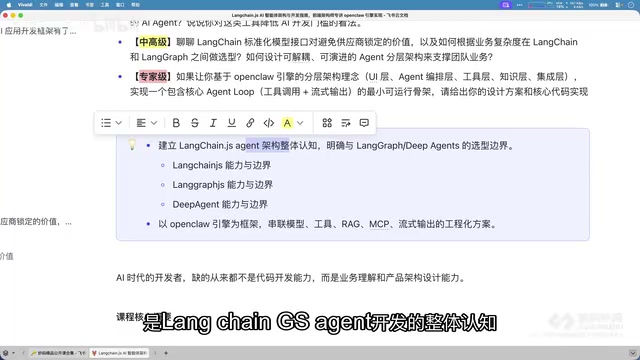
Junior to Mid-level: Are you familiar with AI application development frameworks like LangChain? Have you actually used them to build an Agent? Real project experience here is already competitive.
Mid to Senior-level: Can you clearly explain LangChain.js's standardized model layer, and articulate the selection trade-offs between it and LangGraph — which to use in which scenario, and why?
Senior-level: Do you understand the underlying implementation of general-purpose agent engines like OpenClaw, Codex, and Claude Code? Can you design an agent architecture that integrates tool calling and streaming output, and build a minimal runnable skeleton?
Can You Build an Agent Engine with Only TypeScript?
A frequently asked question is: if you don't know Python and only know TypeScript, can you build an engine similar to OpenClaw? The answer is yes.
The key lies in your engineering design capability: how to wire together the right models, how to design the accompanying tools, and how to implement streaming output through a knowledge base, MCP, and a skills mechanism. All of this can be accomplished within the TypeScript / LangChain.js ecosystem. Python is not a prerequisite.
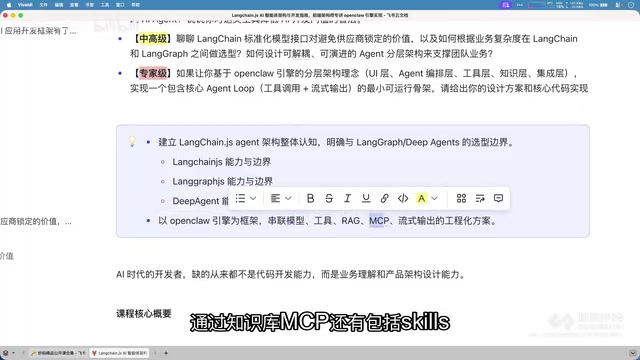
From a conceptual standpoint, this guide aims to build two areas of understanding: first, an overall picture of LangChain.js agent development — including the capabilities and boundaries of LangChain.js, LangGraph.js, and DeepAgent; second, the implementation approach for an OpenClaw-style engine — specifically, how to design an engineering solution that can be put into production.
LangGraph.js is an orchestration framework within the LangChain.js ecosystem, purpose-built for complex Agent workflows. It organizes an agent's execution flow as a "state machine": developers define nodes (each node corresponds to a model call or tool execution), edges (which control the transition logic between nodes), and shared state, while the framework drives the entire graph's execution. Compared to hand-writing an Agent Loop directly in LangChain.js, LangGraph.js has a clear advantage when dealing with multi-step workflows, conditional branching, human-in-the-loop requirements, or multi-agent collaboration. Understanding the boundary between the two — LangChain.js handles foundational model invocation and tool integration, while LangGraph.js handles orchestration and state management for complex flows — is precisely the architectural selection dimension that a "mid-to-senior" engineer should be able to articulate clearly.
What Actually Makes Developers Competitive in the AI Era
This content raises a thought-provoking point: in the AI era, whether you're a frontend or backend developer, the ability to write code is no longer what's scarce.
Shipping code is something tools like Codex, Claude Code, and Cursor can already handle quickly. What's truly rare — and what will be essential for driving deep AI-powered transformation in enterprises over the coming years — is two things: business understanding and product architecture design.
This also explains why the emphasis in agent development isn't on memorizing APIs, but on understanding the architectural design trade-offs in Agent Loop, structured output, and tool selection. When code production is no longer the bottleneck, the competitive advantage goes to those who can design the right system structure and accurately translate business requirements into technical solutions.
Related articles

Chain of Thought Isn't Just for AI: How Humans Can Use CoT to Improve Thinking Quality
Chain of Thought isn't just a prompt trick for large models. Starting from a Hacker News discussion, this article analyzes why CoT works for human thinking too, breaks down actionable ways to transfer it, and highlights the key differences between human CoT and machine CoT.
Cloudflare Teams Up with OpenAI: Closi…
Cloudflare Teams Up with OpenAI: Closing the Loop from Vulnerability Discovery to Defense with AI
Cloudflare uses OpenAI Daybreak to investigate security vulnerabilities and generate reviewable remediation plans, while developers use Codex to boost coding efficiency and quality.

Orca Multi-Agent Orchestration in Practice: A Guide to Parallel Collaboration with Claude and Codex
Orca is Stable AI's free open-source agent workbench supporting 34 agents like Claude Code and Codex in parallel. Learn its Git worktree isolation, multi-model orchestration, and mobile management.