LangChain.js + Nuxt.js: An AI Full-Stack Advancement Path for Frontend Engineers
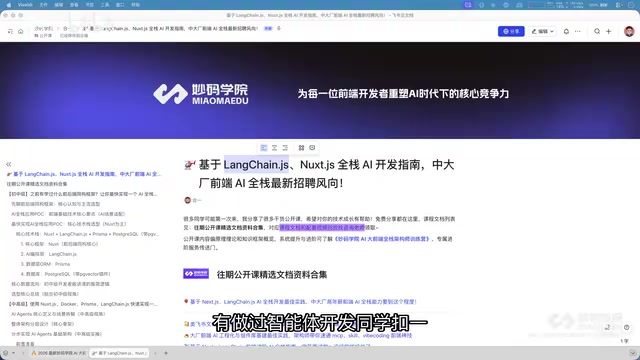
How frontend engineers can build AI full-stack apps with LangChain.js + Nuxt.js to meet rising hiring demands.
Frontend hiring bars are rising fast, with AI capabilities becoming a hard requirement. This article explains how the LangChain.js + Nuxt.js combination lets frontend developers build memory- and retrieval-capable AI full-stack apps, covering RAG, AI Agents, ReAct, streaming, and a practical advancement roadmap with action steps.
The Winds of Frontend Hiring Have Changed
If you've been paying attention to frontend job requirements lately, you probably have a clear impression: interview questions have changed. According to feedback shared by a Bilibili content creator in a public course, whether it's large, mid-sized, or small companies, the hiring bar for frontend positions is rising rapidly—and at the core of this rise is exactly "AI capability."
Industry Background: Since 2023, with the explosive adoption of large language models like ChatGPT and Claude, AI capability has rapidly leapt from being a "bonus point" to a "hard requirement." According to job data from platforms like LinkedIn and Boss Zhipin, frontend positions labeled with "AI-related experience" grew by over 300% in 2024, while the overall number of frontend positions has actually contracted due to the widespread adoption of AI-assisted programming tools—this dramatic shift in the supply-demand structure is the fundamental reason behind the rapidly rising hiring bar.
This structural change has a deeper technical logic: AI programming tools like GitHub Copilot, Cursor, and v0.dev can already automatically generate large amounts of repetitive UI component code, accelerating the replacement of traditional "pixel-pusher" junior and intermediate frontend work. Meanwhile, demand for engineers who understand the boundaries of AI capabilities and can integrate LLM capabilities into product architecture is surging—this is a classic case of "skill polarization": mid-tier positions shrink while premium for advanced engineering capabilities rises sharply. For developers, this means "knowing how to use AI tools" is merely the baseline, while "being able to build products with AI tools" is the true moat.
According to their observations, if you go interview at 10 companies now, perhaps 9 of them will ask about AI efficiency improvements and AI Agent development. More specifically, interviewers are now frequently mentioning topics like Harness Engineering (agent engineering methodology), RAG (Retrieval-Augmented Generation), knowledge base construction, and AI full-stack development. For frontend developers who have only built traditional pages and have never used LangChain.js to implement a memory-capable AI application, these questions can indeed leave you exposed during interviews.
This isn't just anxiety-mongering. From a market trend perspective, "AI + Frontend" is a direction you must enter early—slots are limited, and the earlier you claim your position, the greater your advantage.
Why Choose LangChain.js + Nuxt.js
For frontend developers, AI full-stack development has a naturally friendly technical path: the JavaScript/TypeScript ecosystem. The combination of LangChain.js and Nuxt.js is precisely the most cost-effective technology choice on this path.
LangChain.js: An AI Framework Frontend Developers Can Use Directly
LangChain was initially famous for its Python version, while its JS version (LangChain.js) allows frontend engineers to build AI applications directly using familiar languages. It encapsulates core capabilities such as LLM invocation, prompt management, memory, tool calling, and RAG retrieval chains.
Background Supplement: LangChain was created in 2022 by Harrison Chase. It was initially a pure Python framework, with the core design philosophy of orchestrating LLM calls with external tools and data sources in a "chained" manner—which is also the origin of the "Chain" name. LangChain.js is its officially maintained TypeScript/JavaScript port, with API design highly aligned with the Python version, ensuring developers can switch almost seamlessly between community documentation and tutorials. The framework's core abstractions include four layers: Chain (chaining multiple LLM calls or processing steps into a reusable pipeline), Agent (a decision-making unit that gives models autonomous planning and tool-calling capabilities), Memory (a mechanism to persist context information across multiple dialogue turns), and Retriever (an interface to fetch information from external data sources by semantic relevance). These four modules cover nearly all fundamental needs of current production-grade AI applications.
Especially noteworthy is LangChain.js's LCEL (LangChain Expression Language)—its latest-generation core orchestration syntax. LCEL uses the pipe operator (
|) to chain prompt templates, model calls, and output parsers into declarative pipelines. For example, a concise expression likeprompt | model | outputParsercan complete an entire LLM invocation chain, greatly improving code readability and maintainability. Compared to the earlier class-inheritance-based Chain API, LCEL naturally supports streaming and batching by design—streaming is particularly critical for building real-time AI chat interfaces (i.e., the "typewriter effect"), because it allows the model to immediately push each generated token to the frontend rather than waiting for the complete response to finish, thereby significantly improving the user's perceived response speed.From a technical implementation perspective, the generation process of large language models is essentially auto-regressive: the model predicts and outputs only one token at a time (roughly equal to 0.75 English words or half a Chinese character), then uses the already generated sequence as new input for another inference, looping until the end token is generated. This means fully answering a question may require hundreds of serial inference steps, with total time often reaching several to over a dozen seconds—if you wait for everything to complete before returning it all at once, the user experience is terrible. Streaming leverages this characteristic precisely: each inferred token is immediately pushed to the frontend for rendering via SSE or WebSocket, so users can see text appearing character by character in a "typewriter effect," reducing perceived latency from seconds to milliseconds. LCEL is currently the officially recommended paradigm for LangChain.js development, and new projects should prioritize adopting it.
In other words, frontend developers no longer need to learn Python backend across languages to independently complete an agent with "contextual memory" and "private knowledge retrieval"—and these are exactly the two capability points repeatedly probed in current interviews.
Nuxt.js: Handle Both Frontend and Backend in a Single Project
Nuxt.js, as a full-stack framework in the Vue ecosystem, naturally supports server-side rendering (SSR) and server-side APIs (Server Routes). This means frontend developers can write both the interactive interface and the backend logic for invoking LLMs within the same project, without needing to set up a separate independent service.
Background Supplement: Nuxt.js's Server Routes feature allows developers to write backend interfaces in the
/server/api/directory of the same code repository. These interfaces run in a Node.js environment, powered by the underlying Nitro engine. Nitro is a cross-runtime server framework developed by the Nuxt team, and its core value lies in "write once, deploy anywhere"—the same code can run unmodified across drastically different runtime environments such as a local Node.js server, Cloudflare Workers edge network, Vercel Edge Functions, and even AWS Lambda, with Nitro handling the automatic adaptation conversions during the build phase. This feature greatly reduces the engineering complexity of AI applications from local development to production deployment.More importantly, Nitro has built-in native support for Server-Sent Events (SSE). SSE is an HTTP-based one-way real-time communication protocol where the server can continuously push text event streams to the client without the client needing to poll—this is exactly the standard technical solution for implementing the AI "typewriter streaming output" effect. At the protocol level, SSE is essentially a regular HTTP response that maintains a long connection, with a
Content-Typeoftext/event-stream. The server pushes events by continuously writing text blocks in thedata: ...\n\nformat; the browser side just uses the nativeEventSourceAPI to listen, without any third-party libraries. Compared to WebSocket, SSE is based on ordinary HTTP connections, naturally penetrating firewalls and proxies, and only supports server-to-client one-way pushing—which happens to perfectly match the use case of LLM streaming generation (the user sends one request, and the server continuously pushes generated tokens), without the extra complexity of WebSocket's bidirectional communication. In Nuxt's Server Route, you just need to use thecreateEventStreamutility function to seamlessly connect with LangChain.js's streaming output API, and frontend engineers can achieve end-to-end real-time streaming responses without extra configuration. Compared to separately maintaining an Express or FastAPI service, this "single-repository full-stack" pattern greatly reduces the engineering complexity and operational burden of AI applications.
The essence of LangChain.js + Nuxt.js is providing frontend engineers with the shortest path to building AI applications as a "one-person full-stack": the frontend handles interaction, Nuxt Server handles AI chain orchestration, and LangChain.js handles interfacing with models and data.

Interview Focus: Two Core Assessment Threads
Based on the shared content, the current AI assessment points in frontend hiring mainly converge into two threads.
One, AI Efficiency: Do You Know How to Use the Tools
This thread assesses daily engineering practice capabilities, including:
- Whether you're proficient with AI programming assistant tools (like Copilot, Codex, etc.)
- Whether you understand and can apply prompt engineering
- Whether you can introduce AI methods to improve efficiency in team collaboration, code generation, and monitoring systems
This part has a relatively low bar, but it has already become a basic assessment item in interviews—not knowing it will lose you points.
Extended Background—The Engineering of Prompt Engineering: In engineering practice, prompt engineering is far more than just "writing good questions." A mature AI efficiency system usually includes prompt version management (incorporating prompt templates into Git version control, managing prompt iterations like managing code), a Few-Shot example library (pre-storing high-quality input-output examples for common tasks to improve model performance), and output structural constraints (declaring the expected output format through JSON Schema or Zod, combined with LangChain.js's
StructuredOutputParserto force the model to return in the specified format, avoiding parsing failures). In team collaboration scenarios, being able to design standardized prompt template libraries for AI-assisted programming workflows and quantify their improvement in R&D efficiency is the truly high-scoring answer for this thread.
Two, AI Agent Development: Can You Build It Yourself
This thread assesses engineering construction capabilities, mainly involving:
- Building memory-capable AI applications based on frameworks like LangChain.js
- Implementing RAG (Retrieval-Augmented Generation) and private knowledge bases
- Orchestration and engineering implementation of AI Agents
- Overall architecture design capability for AI full-stack applications
Background Supplement—What is an AI Agent: An AI Agent refers to an AI program that can perceive the environment, autonomously plan, and invoke tools to complete complex tasks. Unlike single-turn Q&A LLM calls, an Agent has three core capabilities: Memory (including short-term session buffer memory and long-term vector database persistent memory), Tool Calling (access to any external capability such as web search, code interpreter execution, database queries, REST API requests, etc.), and multi-step reasoning (the ability to automatically decompose complex tasks into multiple sub-steps and execute them sequentially, rather than just returning a single answer).
Currently, the most mainstream reasoning framework for production-grade Agents is ReAct (Reasoning + Acting), formally proposed by Google Research in 2022 in the paper "ReAct: Synergizing Reasoning and Acting in Language Models." Its core loop is: Thought (the model reasons in natural language about the step it should take) → Action (selecting and calling a specific tool with parameters) → Observation (obtaining the tool's return result as input for the next round) → repeating until the task is completed or the maximum step limit is reached. By forcing the model to explicitly output its reasoning process before each tool call, this framework makes the Agent's decision chain traceable and debuggable, greatly improving the completion rate of complex tasks.
To understand why the ReAct framework is effective, one needs to understand a key characteristic of large language models: In-Context Learning. The model has no dedicated "reasoning module"; its reasoning ability comes entirely from the format guidance in the Prompt—when we explicitly require the model in the system prompt to "output Thought first, then Action," the model follows this format by simulating similar reasoning patterns from its training data. This means the quality of the Thought directly determines the accuracy of the Action, while the richness of the Observation's information in turn affects the quality of the next round's Thought—this positive feedback loop is the fundamental mechanism enabling Agents to solve complex multi-step tasks. The
createReactAgentfunction in LangChain.js has encapsulated this framework into an out-of-the-box API. Combined with abstractions likeAgentExecutor(responsible for looping through the reasoning-action process),StructuredTool(standardizing the input-output Schema of tools), andConversationBufferMemory(injecting historical dialogue into each round's reasoning context), it greatly lowers the Agent development barrier for frontend engineers—usually you just need to define tool functions and pass them into the Agent to complete a practically capable agent prototype.
Background Supplement—What is RAG: RAG (Retrieval-Augmented Generation) is the mainstream engineering solution for addressing two core limitations of large language models: first, the "hallucination" problem (the model tends to fabricate plausible-sounding but actually incorrect information), and second, the "knowledge cutoff" problem (the model's training data has a cutoff date and cannot perceive the latest or private information). The core process of RAG is divided into two phases: the offline construction phase cuts private documents (PDF, Markdown, web pages, etc.) into appropriately sized text chunks, converts each chunk into a high-dimensional vector using an Embedding model, and stores them in a vector database, completing the knowledge base preprocessing; the online query phase occurs when a user asks a question—the system first vectorizes the question similarly, retrieves the several text chunks with the highest cosine similarity in the vector database, then splices these chunks into the Prompt as "reference context," and finally hands it over to the LLM to generate an answer based on real evidence.
Embedding (text embedding) is the foundational technology of RAG. Its core principle is to map natural language text into floating-point vectors of typically 768 to 1536 dimensions, so that semantically similar texts (such as "Apple Inc." and "iPhone manufacturer") are closer in the high-dimensional vector space, thereby making semantic similarity search possible—the essential difference from traditional keyword matching is that it can understand semantics rather than just matching literals. Intuitively: an Embedding model essentially compresses the "meaning" of language into a string of numbers, and the closer the meaning of two pieces of text, the closer the direction of their corresponding number strings (the higher the cosine similarity); vector databases leverage this characteristic precisely, using approximate nearest neighbor (ANN) algorithms to find the most relevant text chunks among millions of vectors in milliseconds. For domestic developers, besides the OpenAI
text-embedding-3-smallAPI, Zhipu AI'sembedding-2series, Baidu Wenxin Embedding API, and the completely free open-source model BGE-M3 (released by the Beijing Academy of Artificial Intelligence, supporting both Chinese and English, and deployable privately on-premises) are all highly cost-effective alternatives.Regarding vector databases, mainstream choices include cloud-hosted Pinecone (maintenance-free, suitable for production environments), locally deployed Chroma and Qdrant (data-private, suitable for enterprise intranet scenarios). For frontend engineers getting started with RAG, Chroma is the lowest-barrier first choice—it provides a pure JavaScript client
chromadb, supports local persistent storage, requires no additional infrastructure deployment, andnpm install chromadbgets you started. Document chunking strategy is equally critical; it's usually recommended to use overlapping sliding window chunking of 512 to 1024 tokens (retaining about 20% overlapping content between adjacent chunks), which both preserves cross-chunk contextual coherence and avoids diluting key information and reducing retrieval accuracy due to overly long individual chunks. This five-step process of "chunking → vectorization → storage → retrieval → injection" is the core technical architecture of enterprise-grade AI knowledge base products (such as intelligent customer service and internal enterprise Q&A assistants).
Interestingly, the sharing specifically mentioned the methodology of Harness Engineering—most current AI engineering practices revolve around this concept.
Background Supplement—What is Harness Engineering: Harness Engineering (agent engineering methodology) is an emerging conceptual framework in the current AI engineering practice field. Its core idea is to view AI Agents as engineering components that can be "harnessed" and "constrained," rather than unpredictable black-box autonomous systems. The starting point of this philosophy is engineering reality: Agents in production environments must be stable, auditable, and cost-controllable, and purely pursuing autonomy will instead bring unpredictable risks of losing control. Harness Engineering emphasizes improving the controllability and reliability of Agents through three dimensions: clear tool permission boundary definition (each Agent can only access tools within its scope of responsibility, preventing unauthorized operations), layered memory management strategy (distinguishing three memory layers—short-term session buffer, medium-term summary compression, and long-term vector persistence—invoked on demand to control token consumption), and task decomposition and Self-Reflection mechanisms (the Agent self-assesses the quality of results after completing each step task and re-plans if necessary).
Unlike academia, which focuses more on the autonomy and generalization capabilities of Agents, Harness Engineering focuses more on three practical dimensions in engineering implementation: observability (being able to trace and record every reasoning step of the Agent, every tool call and its input/output parameters, facilitating production monitoring), debuggability (being able to precisely locate which step an error occurred and reproduce specific failure cases), and maintainability (being able to iterate and upgrade the toolset and prompt strategies with business needs without rewriting the overall architecture). This aligns highly with the rapid rise of tools like LangSmith (LangChain's official LLM application observability platform, which supports tracing the complete Agent execution chain, recording the token consumption, latency, and intermediate outputs of each call, and providing a visualized Trace interface)—the emergence of such platforms is itself a product of the engineering implementation of the Harness Engineering philosophy. For developers hoping to advance to high-paying AI full-stack positions, understanding this methodology is no longer a bonus but a required course.

Frontend Advancement Panorama: AI Has Penetrated Every Layer
The sharing presented a fairly complete frontend advancement roadmap, from which we can see that "AI" has been deeply embedded into every layer of the entire tech stack:
- Foundation Layer: Language fundamentals, framework principles
- Engineering Layer: Build tools, compilation principles, toolchains, scaffolding
- Performance & Monitoring: Performance optimization, extreme performance optimization, AI-powered monitoring systems
- Multi-platform & Collaboration: Desktop, mobile, multi-platform development, micro-frontends, component libraries, low-code platforms
- Visualization: 3D visualization, digital twins, BI (Business Intelligence), AI BI products
- AI Full-Stack Layer: LLM application development, AI Agent, AI engineering, AI frontend infrastructure, AI application platforms, AI team efficiency
- Implementation Layer: Career development, resume optimization, interview methodology, big company mock interviews
Traditional frontend skills remain the foundation, but the key capabilities that truly widen the salary gap are increasingly concentrated on AI full-stack development and agent engineering. It's worth noting that directions like "AI-powered monitoring systems" and "AI BI products"—which inject AI capabilities into traditional frontend responsibility areas—are often easier to quickly implement in existing positions than pure AI application development. The former embeds the LLM's anomaly analysis capabilities into existing monitoring platforms (for example, feeding frontend error logs to an LLM to automatically generate root-cause analysis reports, or replacing complex monitoring Dashboard configurations with natural language queries), while the latter adds a natural language query interface to BI reporting systems (users describe requirements in Chinese, and the system automatically generates SQL and returns charts—the so-called Text-to-SQL capability). Both have plenty of mature existing codebases that can be reused. This makes them highly cost-effective entry points on the transition path.

Three Action Recommendations for Frontend Developers
Faced with this trend, rather than falling into anxiety, it's better to do a few specific things:
First, validate the current situation. Update your resume, actually apply and interview at a few companies, and personally experience the real requirements for AI capabilities in current frontend positions. Seeing is believing—more convincing than any "anxiety theory."
Second, build an agent hands-on. Use LangChain.js + Nuxt.js to build a minimum viable AI application with memory capabilities that can connect to a knowledge base. It's recommended to start with the simplest scenario: use ConversationBufferMemory to implement multi-turn dialogue memory (it automatically injects the historical message list into the context of each LLM call, without manually managing dialogue history), then connect a local document to implement minimal RAG retrieval—for the vector database, prioritize Chroma (local deployment, zero operational cost), and for the Embedding model, you can directly call the OpenAI API or a domestic alternative (like Zhipu AI Embedding or locally-run BGE-M3). Even if you only complete the frontend interactive interface, it's a critical step from 0 to 1. Placing such projects on your resume is far more convincing to interviewers than any theoretical description.
Engineering Detail Supplement: The typical tech stack structure of a minimum viable LangChain.js + Nuxt.js AI application is as follows: the Nuxt frontend page handles the dialogue UI and streaming text rendering (consuming the SSE stream via the
EventSourceAPI); the/server/api/chat.post.tsinterface usescreateEventStreamto establish an SSE connection, internally initializing the LangChain.js LCEL chain (ChatPromptTemplate | ChatOpenAI | StringOutputParser), calling the.stream()method to obtain the token stream andpushthem one by one into the event stream; knowledge base retrieval loads the Chroma vector store at interface initialization, vectorizes the user's question, retrieves the Top-K relevant chunks, and splices them into thecontextvariable of the Prompt. The core implementation is usually within 150 lines of code, making it very suitable as an entry-level project.
Third, focus on breakthroughs, don't be greedy. The frontend advancement path is long, and there's no need to learn everything. Identify the one or two most urgent knowledge points at the moment (such as RAG retrieval, Agent orchestration), concentrate on breaking through them, and then gradually expand. The learning curves for both RAG and Agent directions are quite smooth within the LangChain.js ecosystem—the core of RAG is understanding the five-step process of "chunking → vectorization → storage → retrieval → injection," and the core of Agents is understanding the ReAct reasoning loop (Thought → Action → Observation) and tool definition specifications (declaring the tool name, description, and Zod Schema parameter types through StructuredTool, and the LLM autonomously decides when to call based on the tool description). Completing a minimum viable project usually only requires one to two weeks of concentrated effort.
The window for combining AI and frontend is opening, but quality slots are limited. For developers who are still watching from the sidelines, entering one step earlier means one more measure of initiative.
Key Takeaways
Related articles

How Big Can Stars Really Get? The Physical Limits of the Largest Stars
Red supergiants are the largest stars by volume, with radii up to 2,000 times the Sun, engulfing the inner solar system. But there is no precise upper limit on stellar size—models predict up to 15,000 solar radii. The most massive blue stars are far smaller than red supergiants—biggest and heaviest are two different things.

Apple HomeView Smart Display Full Feature Breakdown: Wall-Mount or Desktop, $299
Apple launches HomeView, a $299 smart display with wall-mount and desktop options, 12MP camera for facial recognition, smart home control, music playback, and recipe step-by-step cooking. Full breakdown of watch faces, apps, privacy, and cooking integration.

Where Did the Promised New Studio Go? Craft Computing Answers After Five Years
Craft Computing's host responds to viewer questions: the new studio promised five years ago was shelved as construction costs soared from $30,000 to $75,000, and was replaced by a 168-square-foot garage conversion.