LangChain OpenAI 1.7.2 Released: Fixes Streaming Output Block Misalignment Issue

langchain-openai 1.7.2 fixes the issue where Responses streaming output items were split when output_index drifts
langchain-openai released version 1.7.2 on October 14, containing only two changes since 1.7.1: a routine release and a key fix. The fix addresses an issue where OpenAI Responses API streaming output incorrectly splits stream items across multiple blocks when output_index drifts, keeping the output within a single block. For conversational applications and Agents relying on streaming output, this fix ensures downstream consumers receive a complete and stable data structure, avoiding hard-to-reproduce production issues such as output truncation, misaligned concatenation, or parsing exceptions. The article recommends that projects using earlier versions and involving streaming scenarios evaluate upgrading to 1.7.2, with the upgrade command being pip install -U langchain-openai==1.7.2, and notes that this upgrade carries low risk.
The langchain-openai package in the LangChain ecosystem has released version 1.7.2. Although this is a minor iteration, it fixes a critical issue affecting the streaming output experience.
Version Overview and Changes
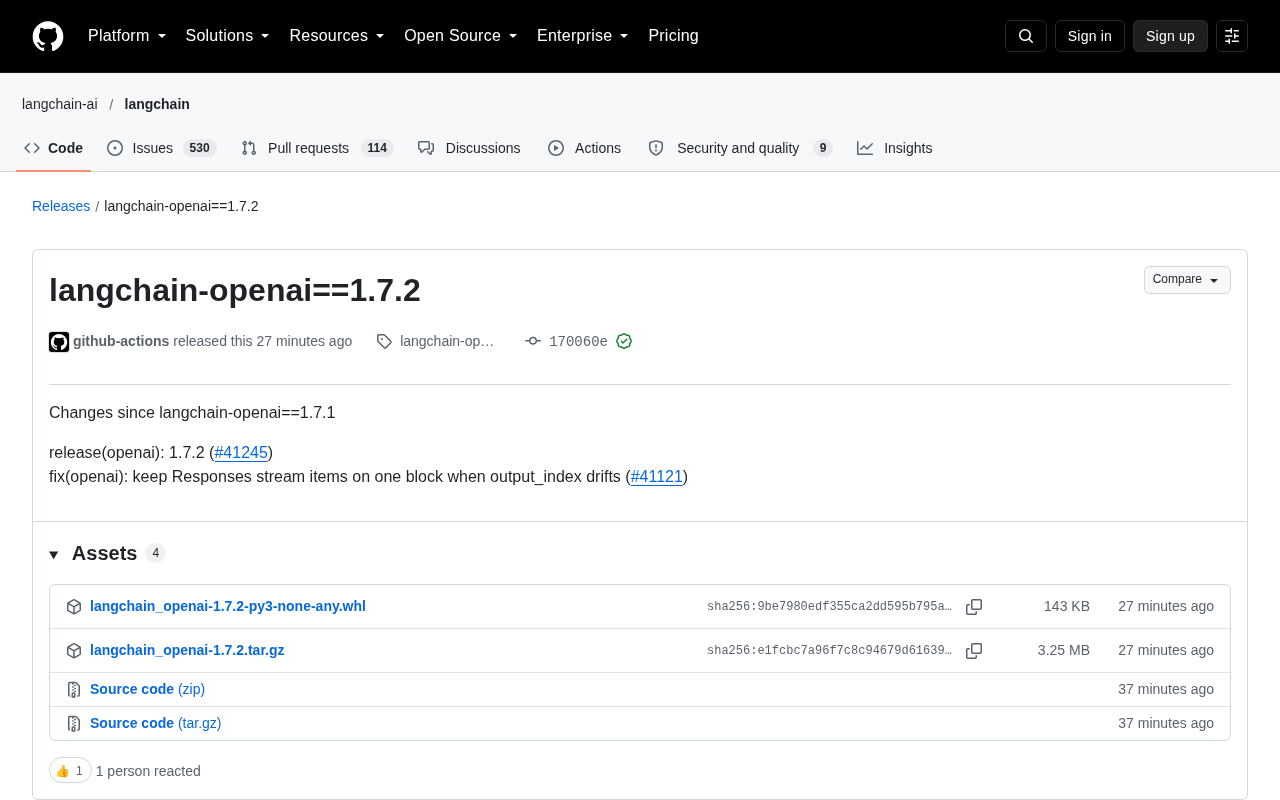
According to the release notes on GitHub, langchain-openai==1.7.2 was released on October 14, with commit hash 170060e. The commit carries a verified GitHub signature (GPG key ID: B5690EEEBB952194).
Looking at the changelog, there are two changes since 1.7.1:
release(openai): 1.7.2(PR #41245) — routine release process;fix(openai): keep Responses stream items on one block when output_index drifts(PR #41121) — the genuinely valuable fix in this release.
The second fix addresses a problem with the OpenAI Responses API in streaming scenarios: when output_index drifts, streamed items are incorrectly split across multiple blocks. This fix keeps the streaming output within a single block, ensuring downstream consumers receive a complete data structure.
Blocks and stream items in LangChain
In LangChain's message model, both AIMessage and AIMessageChunk support the "content blocks" structure, which carries richer output forms than plain strings — text blocks, tool call blocks, reasoning blocks, etc. Each block has a type and metadata, and downstream formatters, UI renderers, and Agent executors make logic decisions based on blocks.
In streaming scenarios, LangChain maps each stream item from the model server to a block. If the server disperses the content of the same item across multiple events due to index drift, the client may generate multiple blocks that should have been merged, causing the final message structure to deviate from expectations. After the fix, langchain-openai recognizes this drift and actively merges them, keeping the number of blocks seen downstream consistent with semantic boundaries. This is why the change, despite being only a line-level logic adjustment, has a direct impact on overall stability.
Why This Fix Matters
For developers building conversational applications or Agents with LangChain, streaming output is almost a standard capability. Whether it's character-by-character display in a chat interface or a pipeline that needs real-time parsing of model output, all depend on the structure of stream items remaining stable.
Problems caused by output_index drift may manifest as truncated output, misaligned message block concatenation, or in some cases trigger parsing exceptions. For streaming applications already running in production, such issues are often difficult to reproduce reliably, yet can cause user-visible failures under specific requests.
Therefore, although version 1.7.2 has only two changelog entries, this fix has practical significance for projects relying on the Responses API's streaming capabilities.
The streaming event model of the OpenAI Responses API
The Responses API that OpenAI introduced in 2025 differs fundamentally from its earlier Chat Completions API in streaming protocol. Chat Completions pushes delta increments, and consumers simply concatenate text in order; the Responses API uses a structured event stream, pushing semantic events such as response.output_item.added, response.output_text.delta, and response.output_item.done, and uses fields like output_index and item_id to identify each output item's position in the final response.
The benefit of this design is that it explicitly distinguishes text, tool calls, reasoning content, and other output types, making it easier for downstream to build Agents or handle multimodal processing. But the cost is that consumers must maintain the output_index → block mapping themselves. Once the server drifts in its handling of this index during long responses (e.g., renumbering or segmented pushing), if the client simply aggregates by index, it will split a logically continuous item into multiple blocks, breaking the merge semantics of AIMessageChunk in LangChain. The 1.7.2 fix provides a fallback at this layer, converging the output back into a single block.
Upgrade Recommendations
If you are using an earlier version of langchain-openai, especially versions below 1.7.1 and involving streaming output scenarios, it is recommended to evaluate upgrading to 1.7.2. Upgrade command:
pip install -U langchain-openai==1.7.2
For projects already locked to 1.7.1, the risk of this upgrade is low — the change scope is small and mainly revolves around fixing a known defect.
A detail worth noting: langchain-openai, as the adaptation layer between LangChain and OpenAI models, typically follows the upstream API's changes in its release cadence. When planning upgrades, developers should not only pay attention to functional entries in the changelog but also to underlying fixes for streaming protocol consistency like this one. They often don't affect the API surface but directly impact application stability.
One-line Summary
langchain-openai 1.7.2 fixes an issue where Responses streaming output items were split when output_index drifts
Paragraph Summary
langchain-openai released version 1.7.2 on October 14, containing only two changes since 1.7.1: a routine release and a key fix. The fix addresses an issue where OpenAI Responses API streaming output incorrectly splits stream items across multiple blocks when output_index drifts, keeping the output within a single block. For conversational applications and Agents relying on streaming output, this fix ensures downstream consumers receive a complete and stable data structure, avoiding hard-to-reproduce production issues such as output truncation, misaligned concatenation, or parsing exceptions. The article recommends that projects using earlier versions and involving streaming scenarios evaluate upgrading to 1.7.2, with the upgrade command being pip install -U langchain-openai==1.7.2, and notes that this upgrade carries low risk.
Related articles

Multi-task Model Accuracy Stuck at 0.40? Community Help and Diagnostic Approaches
A developer seeks help because their multi-task model's accuracy is only 0.40, suspecting model size or lack of pre-training. This article analyzes common bottlenecks in multi-task learning, including model capacity, pre-training, loss weights, and data balance, and provides systematic troubleshooting ideas and community suggestions.

Two RL Agents Team Up to 'Chopstick-Catch a Rocket': Mechazilla Captures Super Heavy Booster in Practice
A developer trains two PPO agents in JAX to control a Super Heavy booster and Mechazilla tower arms for cooperative capture, detailing staged training, rollout length, and learning rate tuning.
ConnectWise Breached by Chinese Hackers, Thousands of Enterprises Targeted by AI Agents
Microsoft discloses that ConnectWise was breached by a China-backed hacking group that used AI agents to rapidly infiltrate thousands of customer enterprises. This article analyzes the AI-driven trend in supply chain attacks, security risks of the MSP model, and defense strategies.