Multi-task Model Accuracy Stuck at 0.40? Community Help and Diagnostic Approaches

Portuguese developer's multi-task model accuracy stuck at 0.40; community suggests systematic investigation from baselines, pre-training, and loss balancing.
A Portuguese-speaking developer asked for help on Reddit because their multi-task model's accuracy has long remained around 0.40, suspecting insufficient model capacity or lack of pre-training. The article analyzes that accuracy stagnation in multi-task learning usually stems from four types of causes: model capacity mismatch with task complexity, lack of pre-training leading to insufficient data when training from scratch, imbalanced loss weights causing one task to dominate gradients, and data quality and label consistency issues. In response, the article suggests the community help from four directions: establishing single-task baselines, comparing architectures such as Hard/Soft Parameter Sharing or MMoE, introducing pre-trained encoders, and adjusting learning rate and optimizer, and provides an executable five-step troubleshooting checklist. The core conclusion is: whether 0.40 itself is close to random level needs to be judged in light of the number of task classes, while baseline comparison and loss monitoring are indispensable steps in multi-task debugging. When asking for help, adding task type, data scale, and loss curves can significantly increase the probability of receiving effective suggestions.
Title
Multi-task Model Accuracy Stuck at 0.40? Community Help and Diagnostic Approaches
Meta Description
A developer seeks help because their multi-task model's accuracy is only 0.40, suspecting model size or lack of pre-training. This article analyzes common bottlenecks in multi-task learning, including model capacity, pre-training, loss weights, and data balance, and provides systematic troubleshooting ideas and community suggestions.
Article Content
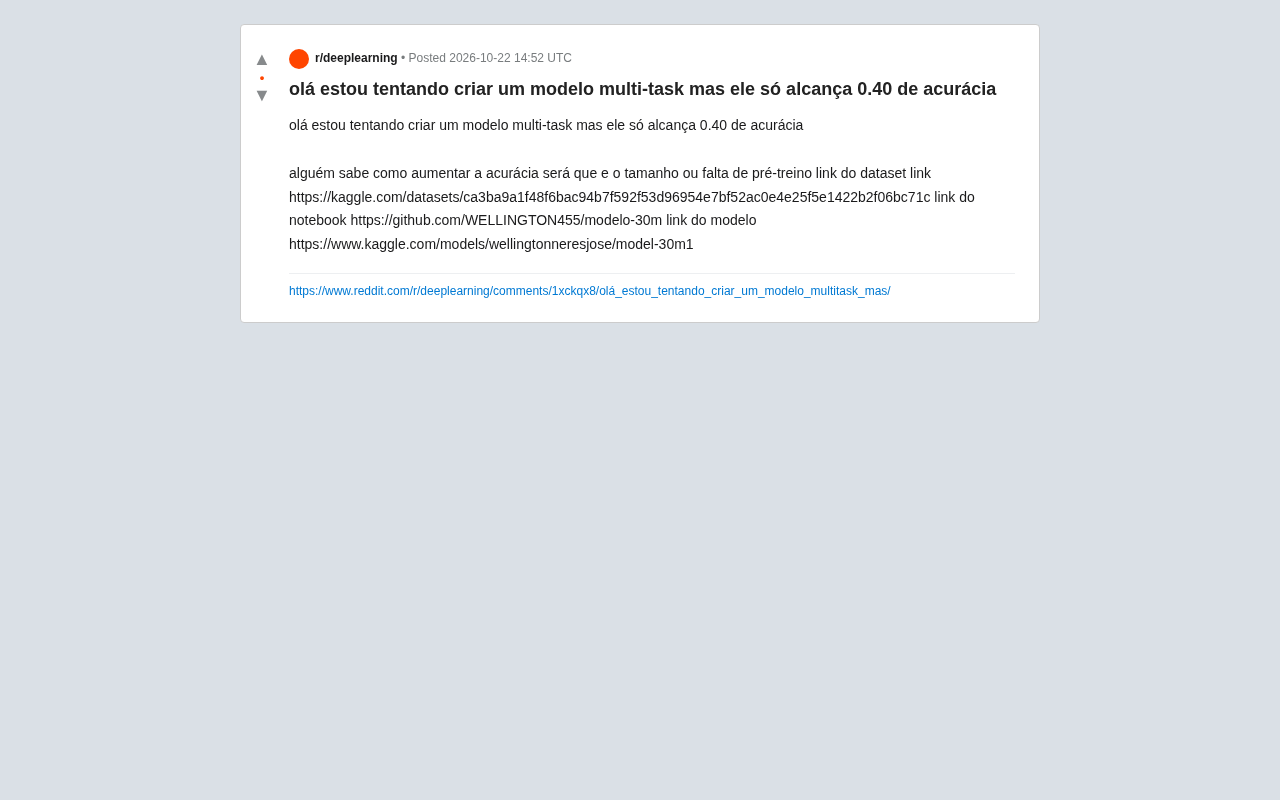
A Portuguese-speaking developer posted on Reddit asking for help: they are training a multi-task model, but the accuracy has been stuck around 0.40 and cannot be improved further. They suspect insufficient model size or lack of pre-training, and attached links to the dataset, Notebook, and model, hoping the community can help diagnose.
Background: Why Multi-task Learning Is Hard to Improve
The core idea of Multi-task Learning is to let one model learn multiple related tasks simultaneously, improving generalization through shared representations. However, conflicts between tasks, data imbalance, improper loss function weight allocation, and other issues can all cause the model to perform poorly on a certain task, or even stagnate overall accuracy.
The developer mentioned accuracy is only 0.40. This number itself needs to be judged in the context of the specific task—if the task is 3-class or 4-class, 0.40 may be close to random level; if it is finer-grained classification, further baseline analysis is needed.
Hard Parameter Sharing and Soft Parameter Sharing are the two most basic parameter sharing paradigms in multi-task learning. Hard Parameter Sharing lets all tasks share the same underlying encoder, retaining only their respective task heads at the output end. It saves the most parameters and has the lowest overfitting risk, but when tasks differ greatly, they can easily interfere with each other. Soft Parameter Sharing maintains independent network branches for each task and constrains the parameters of each branch to stay close through regularization terms (such as L2 distance) or cross-task attention. It is more flexible but also more costly in parameters and tuning. In practice, there are also compromise solutions, such as stacking task-specific layers on top of shared layers, or using gated expert structures like MMoE to let different tasks adaptively select shared sub-networks.
MMoE (Multi-gate Mixture-of-Experts) was proposed by Google in 2018. Its core is to place multiple "expert" sub-networks in the shared layer, with each task having an independent gating network to weight and combine expert outputs. This way, different tasks can reuse different experts as needed, alleviating task conflicts while retaining the generalization benefits of parameter sharing. Compared with Hard Parameter Sharing, MMoE usually performs more stably when multi-task correlations are weak, but the structure is more complex, training costs are higher, and the gating weights require sufficient data to learn well.
Possible Cause Analysis
1. Model Capacity Mismatch with Task Complexity
The developer suspects "the model is too small." This is indeed a common cause: multi-task models need sufficient capacity to capture patterns of multiple tasks simultaneously. If the shared layers are too narrow, features from different tasks will squeeze each other, causing each task to learn poorly. You can try increasing the width or depth of shared layers, or adopt a more flexible structure (such as retaining independent heads for each task, or even partially independent layers).
2. Lack of Pre-training
Training a multi-task model from scratch usually requires a large amount of data. If the dataset size is limited, pre-training (e.g., using an encoder trained on large-scale corpora) can significantly improve results. The developer mentioned "falta de pré-treino" (lack of pre-training), which is likely one of the key factors. Using a pre-trained language model or vision backbone as a starting point and then fine-tuning multi-task heads is often more stable than training from scratch.
3. Loss Weights and Task Balance
In multi-task learning, the loss magnitudes of different tasks may vary greatly. If losses are simply added together, one task may dominate gradient updates, causing other tasks to underfit. You need to check the loss weight settings and try dynamically adjusting weights (such as uncertainty weighting) or manual tuning.
Uncertainty Weighting is a multi-task loss balancing method proposed by Kendall et al. in 2018. It treats each task's loss as a noisy observation and introduces a learnable log variance parameter σ² for each task. The final total loss is written as each task loss divided by 2σ² plus log σ. During training, the model automatically reduces the weight of tasks with high noise and difficulty learning, thus avoiding manual tuning. In implementation, the logarithm of σ² is usually taken to ensure numerical stability, and note that this term causes the total loss magnitude to change during training. Monitoring the effective weight ratio (1/2σ²) of each task is a direct means to troubleshoot "one task dominating gradients."
Another common approach is gradient-level balancing strategies such as GradNorm or PCGrad: the former dynamically adjusts each task's loss weight so that gradient norms tend to be consistent, and the latter projects and resolves conflicts when gradient directions conflict. Compared with only adjusting loss coefficients, these methods act directly on backpropagation and can alleviate gradient tug-of-war between tasks at a finer granularity, but implementation and debugging costs are higher. They are suitable to try after simple weighting proves ineffective.
4. Data Quality and Label Consistency
Does the dataset contain label noise? Are multi-task labels aligned? The developer provided a Kaggle dataset link but did not state the data scale. It is recommended to first check the class distribution of each task and confirm whether there is severe imbalance.
Directions the Community Can Help With
Since the post has limited information, community members can offer suggestions from the following angles:
- Check baselines: First train single-task models separately to see what accuracy each task can achieve alone. If a single task also only reaches 0.40, the problem may lie in the data or features rather than the multi-task structure.
- Adjust model structure: Try comparing Hard Parameter Sharing and Soft Parameter Sharing, or use more advanced multi-task architectures such as MMoE (Multi-gate Mixture-of-Experts).
- Introduce pre-training: Use a pre-trained model from Hugging Face as the encoder, freeze some layers, and then fine-tune.
- Learning rate and optimizer: Multi-task training is sensitive to learning rate. You can try a smaller learning rate, warmup, or layer-wise learning rates.
Single-task Baseline is the most important control experiment in multi-task debugging. The approach is to keep the data split, preprocessing, and evaluation metrics completely consistent, train a separate model of the same or smaller scale for each task, and record its validation accuracy. If a task also only reaches 0.40 in single-task mode, the bottleneck is in data quality, feature representation, or label definition, and continuing to tune the multi-task structure has limited benefit; if the single-task result is clearly higher, the problem is more likely in task conflicts in shared layers or loss weights. The baseline also helps determine whether 0.40 is close to random level—for example, 3-class random is about 0.33 and 4-class is 0.25. Only the improvement relative to random level can reflect whether the model has truly learned something.
Specific Suggestions for the Developer
Based on the available information, the following action list can be given:
- First run single-task baselines to confirm the data itself is learnable.
- Check loss weights, print each task's loss value, and observe whether one task dominates.
- Try loading pre-trained weights (even a model pre-trained on similar data).
- Increase model capacity, but watch out for overfitting.
- If correlations between tasks are weak, consider reducing shared layers and increasing task-specific layers.
The Notebook and model links provided by the developer allow the community to reproduce the problem more directly. If information such as task type, data scale, and loss curves can be added to the post, it will be easier to get targeted help.
Summary
Multi-task model accuracy stagnating at 0.40 is not a rare problem. It usually requires systematic investigation from four dimensions: data, model structure, pre-training, and loss balancing. This developer's help post provides a typical debugging scenario and also reminds us that in multi-task learning, baseline comparison and loss monitoring are indispensable steps.
One-line Summary
Portuguese developer's multi-task model accuracy stuck at 0.40; community suggests systematic investigation from baselines, pre-training, and loss balancing.
Paragraph Summary
A Portuguese-speaking developer asked for help on Reddit because their multi-task model's accuracy has long remained around 0.40, suspecting insufficient model capacity or lack of pre-training. The article analyzes that accuracy stagnation in multi-task learning usually stems from four types of causes: model capacity mismatch with task complexity, lack of pre-training leading to insufficient data when training from scratch, imbalanced loss weights causing one task to dominate gradients, and data quality and label consistency issues. In response, the article suggests the community help from four directions: establishing single-task baselines, comparing architectures such as Hard/Soft Parameter Sharing or MMoE, introducing pre-trained encoders, and adjusting learning rate and optimizer, and provides an executable five-step troubleshooting checklist. The core conclusion is: whether 0.40 itself is close to random level needs to be judged in light of the number of task classes, while baseline comparison and loss monitoring are indispensable steps in multi-task debugging. When asking for help, adding task type, data scale, and loss curves can significantly increase the probability of receiving effective suggestions.
Related articles

GPT-Next Leak, Gemini 4 Argon Imminent: AI News Roundup
GPT-Next leak suggests extreme efficiency; OpenAI's 28-day shipping pledge boosts speed 50%; Gemini 4 Argon nears release; Anthropic subscription value report sparks debate.

GPT-Next Leaked, Gemini 4 Argon Speeds Up, Fable 5.5 May Launch Today
OpenAI's GPT-Next model leaks, expected to be extremely low-cost and possibly part of the 28-day release plan; Gemini 4 Argon internal testing accelerates, NanoBanana 2.1 is live; Semi Analysis tests show Claude Max's equivalent API value is about 5 times that of ChatGPT Pro; Fable 5.5 may launch today.

Gemini 4 Argon Launches Globally: Key Highlights from the AI Daily Brief
Google opens Gemini 4 Argon globally across Pro and Ultra subscriptions and the API, and demonstrates robot control. This article rounds up open-source models, Agent infrastructure, cost transparency, and safety governance updates.