LangChain Tutorial: Hands-On Guide to Agent and RAG Projects

Java developers face a shift toward AI large models, and LangChain4j is the key framework entry point for large model application development.
The article notes that enterprise hiring keywords have shifted from "Java" to "Java AI large models," with vector databases, RAG, prompt engineering, and instruction fine-tuning becoming essential for Java backend developers. Shangguigu's LangChain4j speedrun course covers native framework usage, Spring Boot integration, and advanced topics like RAG, vector databases, Function Calling, and MCP, with prerequisites of JDK 17 and Spring Boot 3. The article also uses employed students' resumes to show that keywords like vector databases, RAG, and MCP directly affect ATS screening, and offers a learning path: upgrade versions, master the framework, build RAG, then go deeper. Python-track and DeepSeek application-level materials can be studied in parallel.
Why Java Developers Should Pay Attention to LangChain
The traditional Java tech stack—Spring Boot, Spring Cloud, distributed microservices, containerized deployment—used to be a passport into mid-to-large enterprises. But this skill set is being redefined by the era of large models. According to an analysis by Bilibili creator "Shangguigu," corporate hiring demands have clearly shifted: recruiters are no longer just searching for "Java," but for "Java AI large models."
Specifically, current enterprise demand for large model talent centers on a few key terms: vector databases, RAG, text embeddings, prompt engineering, instruction fine-tuning, and sentiment analysis. These concepts are no longer the exclusive domain of algorithm engineers but are engineering capabilities that Java backend developers need to understand and implement.
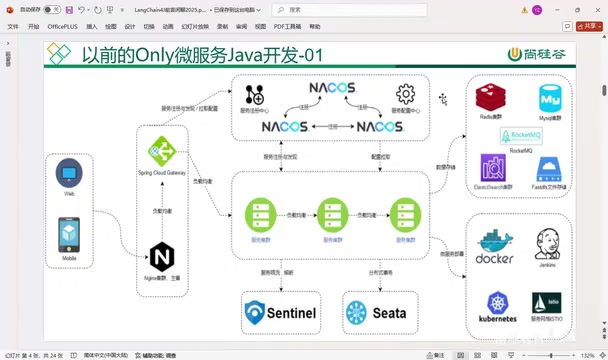
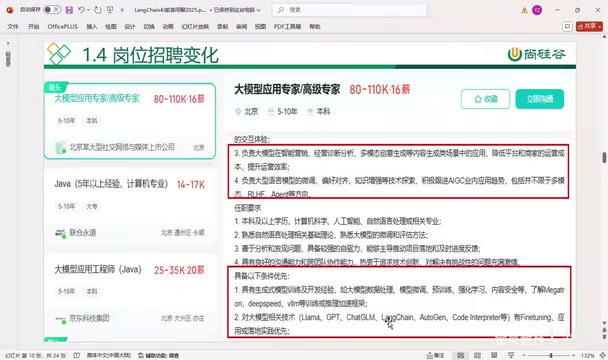
One signal worth noting: frameworks like Spring AI, Alibaba Cloud Bailian, and LangChain4j are becoming new additions to enterprise tech stacks. Job postings are starting to include requirements like "experience in large model application development preferred," and even directly list experience deploying and debugging tools like GPT, Ollama, and DeepSeekAd. This means learning AI large models is no longer an elective—it's a required course for Java developers.
Breaking Down the Core Content of the LangChain4j Course
From Getting Started to Framework Integration
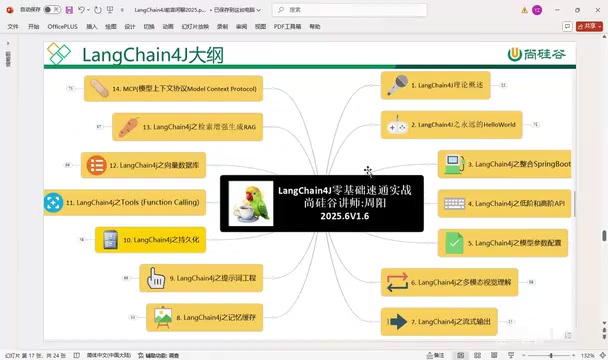
The "LangChain4j Zero-Basics Speedrun Hands-On" course launched by Shangguigu covers a complete path from fundamentals to real-world practice. The introductory phase focuses on using the native LangChain4j framework and how it integrates with Spring Boot. It also introduces integration with third-party large model platforms, including Alibaba Cloud Bailian and the Qianfan large model platform.
The value of this content lies in the fact that most enterprises won't build large model capabilities from scratch but will integrate based on existing cloud platforms and open-source frameworks. Mastering the integration of LangChain4j with Spring Boot means you can quickly embed AI capabilities into your existing Java microservice architecture.
Differences Between LangChain4j and Spring AI
LangChain4j is an independent implementation of the LangChain philosophy in the Java ecosystem—it is not a port of the Python version of LangChain. It provides unified abstractions like ChatLanguageModel, EmbeddingModel, and EmbeddingStore, shielding differences between vendor APIs, and includes built-in capabilities like conversation memory, RAG components, and tool calling. Its advantages are a mature ecosystem, rich documentation, and broad adaptation to multiple model platforms.
Spring AI is the official AI application framework from Spring, following Spring's consistent style of abstraction and auto-configuration. It integrates more naturally with Spring Boot and emphasizes portability and enterprise-grade maintainability. The two have similar positioning but different styles: LangChain4j leans more toward an "all-in-one AI capability suite," while Spring AI leans more toward a "native Spring experience." In real projects, they can also be used together—for example, using Spring AI for model abstraction and LangChain4j's RAG components to complete the retrieval pipeline. Understanding the differences helps you make sound judgments in interviews and architecture decisions.
Advanced Practice: RAG and Vector Databases
The middle and later sections of the course dive into the hottest technical areas today—RAG (Retrieval-Augmented Generation) and vector databases. This is the most common architectural pattern for enterprise-level large model applications: converting a private knowledge base into vector storage via an embedding model, retrieving relevant snippets during inference and injecting them into the prompt, so the large model produces more accurate answers.
The course also covers cutting-edge topics like prompt persistence, Function Calling, and MCP (Model Context Protocol). Engineering details such as model parameter tuning, multimodal processing, and streaming output are also within scope. These topics correspond to high-frequency needs in actual enterprise development: how to make large models serve specific business scenarios stably and efficiently.
One detail: the LangChain4j track requires JDK 17 and Spring Boot 3 or above. If you're still using Java 8, you'll need to upgrade first. In terms of prerequisites, you need to understand basic concepts of mainstream large models such as DeepSeek, Tongyi Qianwen, Wenxin Yiyan, and Moonshot.
Technical Background on RAG, Vector Databases, and Text Embeddings
RAG (Retrieval-Augmented Generation) is an architectural paradigm that combines "external knowledge retrieval" with "large model generation." The parametric knowledge of large models has timeliness limitations and domain blind spots. RAG dynamically retrieves private or real-time data during the inference stage and injects it as context into the prompt, thereby significantly reducing hallucinations and improving answer accuracy and traceability. Its typical flow is: document splitting → text embedding → vector storage → query embedding → similarity retrieval → prompt assembly → answer generation.
Vector databases are the storage and retrieval foundation of RAG. Common products include Milvus, Chroma, Qdrant, and PgVector. Through ANN (Approximate Nearest Neighbor) indexes (such as HNSW and IVF), they achieve millisecond-level similarity search among billions of vectors—a capability traditional relational databases struggle to replace. Text embedding maps text into high-dimensional dense vectors, turning semantic similarity into vector distance calculations, and is a key variable in retrieval performance. For Java developers, understanding how these three work together is a prerequisite for implementing enterprise-grade AI applications.
The Role of Function Calling and MCP
Function Calling refers to a large model outputting structured function names and parameters based on user intent, which the application layer actually executes before returning results to the model—giving the LLM the ability to call external tools, query databases, and make API requests. It is the foundational mechanism for building Agent systems, transforming a model from "only able to chat" into "able to get things done."
MCP (Model Context Protocol) is an open protocol proposed by Anthropic to standardize the way large models connect to external data sources and tools. Think of it as "the USB-C port of the AI world": in the past, every tool integration required a custom adapter; MCP uses a unified client-server protocol to let models access files, databases, APIs, and other resources in a consistent way. For the Java ecosystem, LangChain4j's support for MCP means developers can extend Agent capabilities in a standardized way, reducing the repetitive cost of tool integration.
Resume and Job Trends: Cross-Validation from Multiple Sources
Changes in Hiring Keywords
From analyses across multiple sources, hiring keywords for Java positions are undergoing structural changes. Traditional "Spring Cloud," "distributed architecture," and "middleware" remain baseline requirements, but more and more positions are adding conditions like "RAG development experience," "vector database usage," and "prompt engineering."
According to the resume cases of employed students shown by Shangguigu, students who successfully landed offers in the large model direction added the following keywords to their resumes: vector databases (such as Milvus and Chroma), RAG, MCP, prompt engineering, LangChain4j, Spring AI, and more. These keywords directly correspond to the filtering logic of enterprise ATS systems—if your resume doesn't contain these terms, it may very well be filtered out at the initial screening stage.
How ATS Keyword Filtering Works
ATS (Applicant Tracking System) is software used by mid-to-large enterprises for initial resume screening. It parses resume text and scores matches against preset keywords and skill tags from the job description. Low-scoring resumes are filtered out before human review. This means whether your resume reaches HR's eyes largely depends on whether it hits the target keywords.
For job seekers in the Java + AI direction, in addition to traditional terms like Spring Cloud, distributed systems, and middleware, you should also consciously include terminology such as vector databases, RAG, Embedding, Prompt Engineering, LangChain4j, Spring AI, Function Calling, MCP, and Agent, and support them with specific scenarios in project descriptions (e.g., "Built a knowledge base Q&A system based on Milvus, improving recall by X%"). Keywords must correspond to real experience—avoid keyword stuffing, or you'll easily expose your weaknesses during the technical interview.
Learning Path Recommendations
For developers with some Java foundation, the recommended learning path is: first catch up on the JDK 17 and Spring Boot 3 version requirements, then understand the framework's basic usage through LangChain4j's official documentation and hands-on projects. On that basis, choose a vector database (such as Milvus or Chroma) to build a simple RAG application and understand the complete flow of embedding, retrieval, and generation. Finally, go deeper into advanced capabilities like Function Calling and MCP.
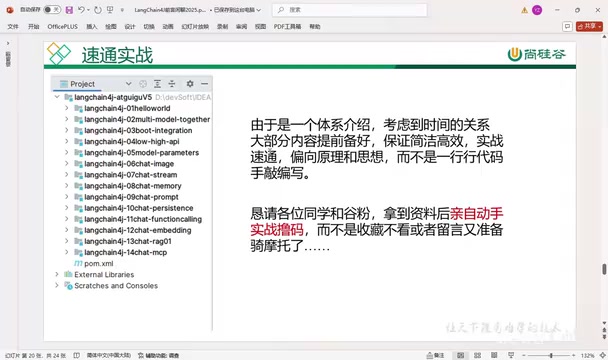
The course designers, considering learners' limited time, pre-processed repetitive and commonly used code so students can reuse it directly; for difficult parts, they aim to teach the most effective techniques in the shortest possible time. This "speedrun hands-on" approach is suitable for developers with some engineering experience but tight schedules.
Beyond the Course: The Python Track and Large Model Applications
In addition to the Java-track LangChain4j course, Shangguigu has also launched a Python-track large model course, led by another instructor. The two tracks can be studied in parallel and complement each other. For learners with weaker coding skills who lean more toward the application layer, there is also application-level learning material based on DeepSeek, covering everything from tool usage to workflow building.
From an industry trend perspective, whether on the Java or Python track, the core capabilities for large model application development are the same: understanding model capability boundaries, mastering prompt design methods, and being able to build RAG and Agent systems. The main difference lies in the language and framework chosen for engineering implementation. For Java developers, LangChain4j provides a path to smoothly transition into large model development within their existing tech stack.
Summary
The emergence of LangChain4j gives Java developers a framework-level entry point into the field of large model application development. From hiring trends to course design to actual project implementation, RAG, vector databases, and Agent systems have become standard components of enterprise-grade AI applications. For Java developers still on the sidelines, starting to learn LangChain4j now may be a direction worth investing in.
One-line Summary
Java developers face a shift in job requirements toward AI large models, and LangChain4j has become the key framework entry point for large model application development.
Paragraph Summary
The article points out that enterprise hiring keywords have shifted from simply "Java" to "Java AI large models," with capabilities like vector databases, RAG, prompt engineering, and instruction fine-tuning becoming essential for Java backend developers. Shangguigu's LangChain4j zero-basics speedrun hands-on course covers everything from native framework usage and Spring Boot integration to advanced topics like RAG, vector databases, Function Calling, and MCP, with prerequisites being JDK 17 and Spring Boot 3. The article also uses resume cases of employed students to show that keywords like vector databases, RAG, and MCP directly affect ATS initial screening results, and provides a learning path of "catch up on versions—master the framework—build RAG—go deeper into advanced topics." Additionally, the Python track and DeepSeek application-level materials can be studied in parallel, as the core capabilities are the same.
Related articles

Differentially Private Sparse Reward Estimation: A New Breakthrough in RLHF Privacy Protection
New RLHF privacy research proposes a differentially private sparse reward estimation framework, achieving a better privacy-utility trade-off under sparsity assumptions, with theoretical error bounds significantly outperforming dense methods, validated on sentiment generation and safety alignment tasks.

AtomicRL: Atomic Reinforcement Learning Solves Long-Horizon Robotic Manipulation Challenges
AtomicRL introduces atomic reinforcement learning with Semantic-Aware Policy Optimization (SAPO) and Bottleneck-Adaptive Targeted Exploration (BATE) to solve credit assignment and subtask imbalance in VLA long-horizon robotic manipulation, outperforming PPO on LIBERO-LONG and CALVIN and improving real-world task performance by 21.3%.

Gaussian Mixture NPMLE Achieves Minimax Optimality: A New Breakthrough in Hellinger Distance
Recent research proves that the nonparametric maximum likelihood estimator (NPMLE) for Gaussian mixtures achieves the minimax optimal rate log(n)/n in squared Hellinger distance, with faster rates under compact support and empirical Bayes applications.