LangChain4j from Beginner to Practice: An Advanced Course in LLMs for Java Programmers

Java programmers must master LLM skills like LangChain4j to avoid becoming "traditional Java programmers."
The article notes that Java programmers who only know microservices are being labeled "traditional Java programmers," with LLM skills shifting from a bonus to a hiring threshold. Enterprise architecture is adding an AI enablement layer atop microservices, using Spring AI or LangChain4j to let business systems call LLMs. Interview topics like vector databases, long-text summarization, prompt engineering, and RAG are now common. The author argues Java + AI LLMs are repeating Spring Boot's adoption path — from elective to required course — and advises developers to ground course knowledge in real business scenarios through hands-on projects.
Why Java Programmers Need LLM Skills
Recently I came across a tutorial series on Bilibili called "LangChain4j from Beginner to Practice." In the opening, the creator made a sharp point: Java programmers who only know microservices are becoming "traditional Java programmers."
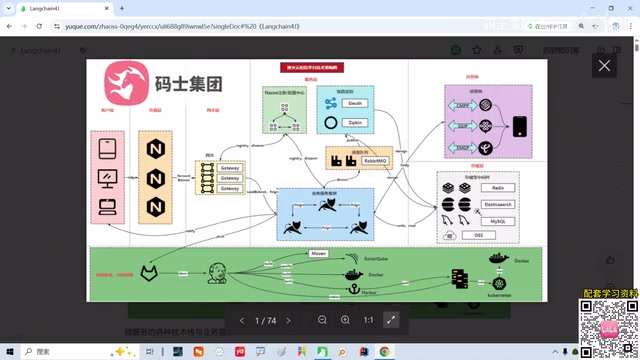
This judgment isn't alarmist. Over the past three to five years, Spring Boot, Spring Cloud, Docker, Redis, Nexus, gateways, containerized cloud deployment — this tech stack was indeed the "standard kit" for landing a Java backend job. But as the creator points out, once these became baseline skills every programmer must have, enterprise hiring requirements quietly leveled up.
According to the tutorial, when you open Boss Zhipin (a Chinese job platform) and look at backend engineer JDs today, beyond the traditional tech stack, LLM-related skills have become a hard bonus or even a mandatory requirement. It's not that microservices don't matter anymore — it's that microservices alone are no longer enough to stand out in resume screening.
Enterprise Architecture Is Adding an "AI Enablement Layer"
The most valuable part of this course is that it doesn't stop at the vague level of "LLMs are hot, so you should learn them." Instead, it gives a concrete explanation from the perspective of enterprise architecture evolution.
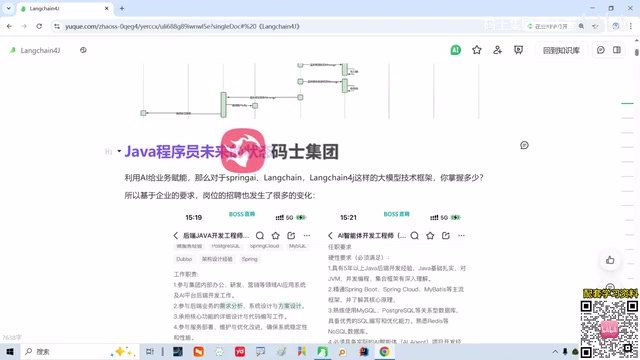
The creator mentions that many companies today — not just big tech, but mid-size and small ones too — are layering a model layer or AI enablement layer on top of their existing business systems. The purpose of this layer is to let traditional microservice systems call general-purpose LLM capabilities and intelligently transform existing business operations.
This raises a very practical technology selection question: what framework should a Java project use to connect to LLMs? The tutorial mentions two mainstream options — Spring AI and LangChain4j. The former is an AI extension of the official Spring ecosystem; the latter is inspired by Python's LangChain and designed specifically for Java developers building LLM applications.
LangChain4j's positioning is clear: let Java programmers build LLM applications using familiar programming paradigms, including Prompt template management, conversation chain orchestration, vector database integration, RAG retrieval-augmented generation, and more.
RAG (Retrieval-Augmented Generation) is one of the most mainstream architectural patterns for deploying LLMs in enterprise scenarios today. Its core idea is: rather than having the LLM answer questions from memory, first retrieve relevant fragments from the enterprise's private knowledge base, then stitch these fragments into the Prompt as context for the LLM to generate an answer. This approach offers three benefits: first, it solves the problem that LLM training data doesn't include internal enterprise documents; second, it significantly reduces model "hallucinations" because answers are grounded in evidence; third, knowledge can be updated without retraining the model — just update the vector store. A typical RAG pipeline includes: document chunking → embedding → storing in vector database → vector retrieval of Top-K similar fragments when a user asks a question → Prompt assembly → LLM generation. LangChain4j provides complete abstractions for this pipeline, such as EmbeddingModel, EmbeddingStore, ContentRetriever, and more.
Key LLM Concepts You Can't Avoid in Interviews
The tutorial has a very realistic passage: when an interviewer asks you what a vector database is, what long-text summarization is, what prompt engineering is — can you name a few vector databases?

Several core concepts here are indeed essential knowledge for Java programmers transitioning into the LLM space:
- Vector databases: Used to store vectorized representations of text and are a key component of RAG architecture. Common ones include Qdrant, PGVector, Milvus, Chroma, and more. The creator specifically mentions Qdrant and PGVector as good starting points.
- Long-text summarization: Leveraging the LLM's context window capability to process and summarize long documents that exceed single-request limits through segmentation.
- Prompt engineering: Guiding model output to meet business requirements through carefully designed Prompt templates.
These concepts all have corresponding API wrappers in LangChain4j. For example, its EmbeddingStore interface can connect to different vector databases, and the ChatLanguageModel interface unifies the invocation methods of different LLMs.
Embedding is the process of mapping unstructured data such as text and images into high-dimensional floating-point vectors, where semantically similar content is closer together in vector space. It is the prerequisite for vector databases and RAG to work. Common Chinese-compatible Embedding models include OpenAI's text-embedding-3, BGE, M3E, Tongyi Qianwen's text-embedding, and more. In LangChain4j, EmbeddingModel is responsible for converting text to vectors, and EmbeddingStore handles storage and similarity retrieval. The two are decoupled, allowing flexible replacement of underlying models and vector stores. Understanding Embedding dimensions, similarity measurement methods (cosine similarity, dot product, Euclidean distance), and chunking strategies (chunk size, overlap) is key to troubleshooting RAG performance issues.
Prompt Engineering is not simply "knowing how to write prompts" — it's a systematic methodology for guiding model output. Common techniques include: Few-shot examples, Chain-of-Thought reasoning, role setting (System Prompt), output format constraints (such as requiring JSON responses), and breaking complex tasks into multiple steps. In production environments, Prompts are often abstracted into templates (Prompt Template), with variable placeholders dynamically injecting user input and retrieved context. LangChain4j provides PromptTemplate, @SystemMessage, @UserMessage annotations, and other ways to manage prompts, separating Prompts from business code for easier version management and A/B testing. Mastering these capabilities is what demonstrates "engineering" rather than "just calling APIs" in interviews.
A Brutal Competitive Reality
The creator said something quite striking in the course: if ten Java programmers go out to find jobs, and two of them can talk about LLM-related technical points, interviewers will use that as a unified benchmark.

What does this mean? It means LLM skills are shifting from a bonus to a threshold requirement. When some candidates already have AI application development capabilities, those who don't will be at a clear disadvantage.
This is very similar to when Spring Boot was first becoming widespread — initially knowing Spring Boot was a highlight, later you couldn't find a job without it. The creator's core argument in the course is that Java + AI LLMs are following the same path, going from an elective to a required course.
Who This Course Is For
Based on the content structure, this LangChain4j tutorial is suitable for:
- Backend developers with Java fundamentals who are familiar with the Spring ecosystem
- Job seekers who want to add LLM project highlights to their resumes
- Architects or technical leads who need to introduce AI capabilities into enterprise projects
- Java programmers interested in RAG, vector retrieval, and Prompt engineering but unsure where to start
The course emphasizes "from beginner to code-based practical development," indicating it's not just concept popularization but involves specific coding practice. For developers who prefer learning by doing, this project-driven approach is usually more effective than pure theory.
However, a rational perspective is also needed: a course can help you build a knowledge framework and complete an introductory project, but true competitiveness comes from applying LangChain4j to your actual business scenarios. Whether you can write a compelling project experience on your resume after finishing depends on your own hands-on practice.
Summary
For Java programmers, learning LLMs is no longer a question of "whether to learn." LangChain4j, as one of the frameworks closest to LLM application development in the Java ecosystem, provides a path to extend from traditional backend development to AI application development. The value of this Bilibili tutorial lies in lowering the barrier to entry, but whether you can ultimately seize the opportunity still depends on whether you're willing to continuously build technical reserves on top of your existing tech stack.
As the creator said, there are no inadequate technologies, only inadequate skills.
One-line Summary
Java programmers must master LLM skills like LangChain4j to avoid becoming "traditional Java programmers."
Paragraph Summary
The article points out that Java programmers who only know microservices are being labeled as "traditional Java programmers," and LLM skills have shifted from a bonus to a hiring threshold. Enterprise architecture is layering an AI enablement layer on top of existing microservices, using Spring AI or LangChain4j to let business systems call LLMs. In interviews, concepts like vector databases, long-text summarization, prompt engineering, and RAG have become common topics. LangChain4j unifies vector store and LLM invocation through interfaces like EmbeddingStore and ChatLanguageModel. The author believes Java + AI LLMs are repeating Spring Boot's adoption path — from elective to required course — and recommends developers ground course knowledge in real business scenarios through hands-on projects.
Related articles

Why Does the Tesla Roadster Need to Fly? A Deep Dive into Musk's Wild Demo
Tesla's Roadster launch showed wall-climbing, upside-down driving, and flying stunts—but The Vergecast notes the demo car may lack a battery, the Rocket version is invite-only and not street-legal, and the website terms don't guarantee delivery. After nine years of delays, why does this car still need to exist?

AI Is Not a Replacement: Human-AI Collaboration Through the Lens of Factory Root Cause Analysis
Starting from factory root cause analysis, this article explains how AI accelerates evidence chain construction rather than replacing human experts, exploring the pragmatic implementation logic and business value of 'AI supporting people rather than replacing them.'

AI Agent Decision Auditing: Building an Evidence Chain in Regulated Workflows
Starting from a Reddit discussion, this article analyzes three core issues in AI agent decision auditing within regulated workflows: what fields audit records should contain, how to handle feedback latency for erroneous decisions, and how to continuously calibrate LLM judge consistency with human judgment.