LangChat ai-tutorials: A Beginner's Guide to AI App Development for Java Developers
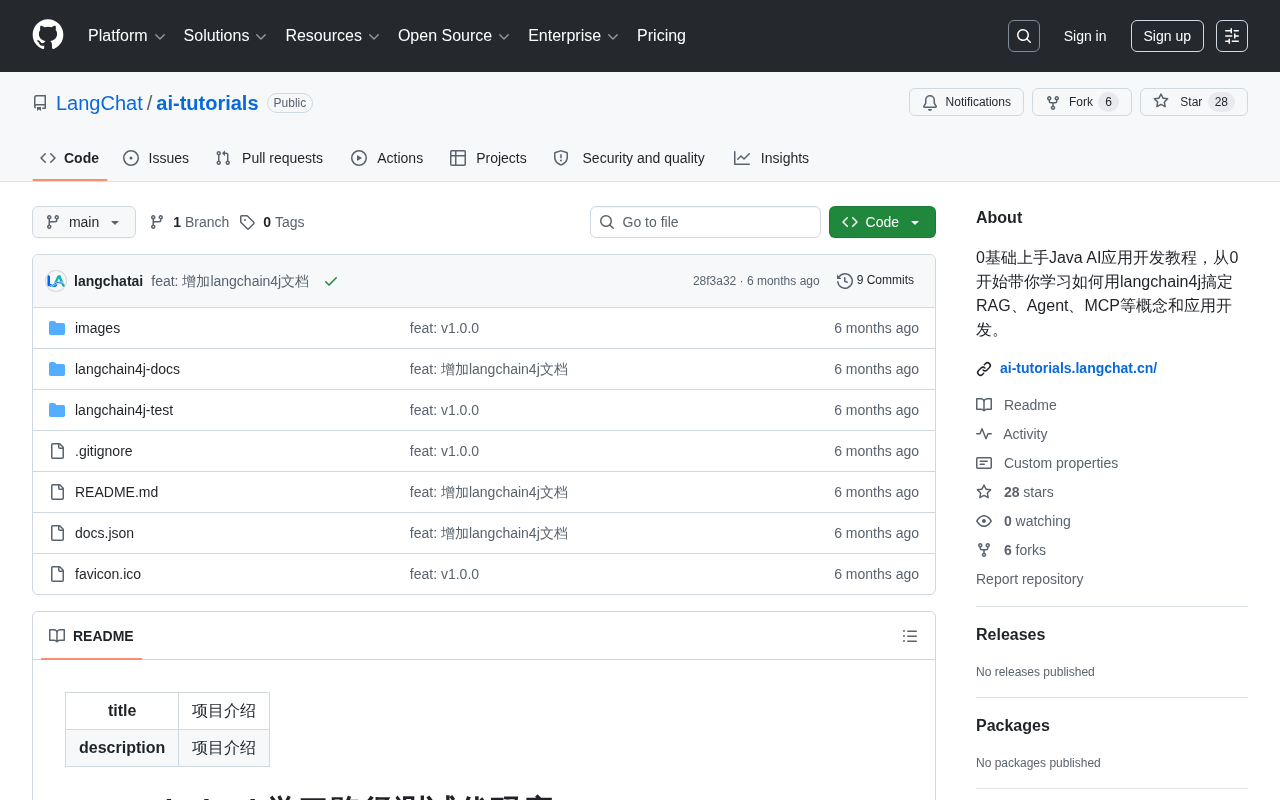
A Java-focused AI tutorial series using langchain4j to teach RAG, Agent, and MCP from scratch.
ai-tutorials is an open-source tutorial project by the LangChat team, designed for engineers who want to build AI applications using Java. Built around the langchain4j framework, it systematically covers RAG, Agent, and MCP. It fills a long-standing gap in Java AI learning resources, targeting backend engineers with Java experience but no AI background, as well as Java-first teams looking to avoid introducing Python services. The project is early-stage (24 Stars), but its practical focus and inclusion of cutting-edge standards like MCP make it a noteworthy starting point for Java developers entering the AI space.
In the world of AI application development, Python has long been the dominant force. But for the vast Java developer community, building AI applications like RAG and Agents using familiar tech stacks is just as much of a real need. The open-source project ai-tutorials, launched by the LangChat team, targets exactly this gap — it's a Java AI application development tutorial series designed for beginners, built around the langchain4j framework.
Project Purpose: Filling the Gap in Java AI Tutorials
This project has a clear goal: to guide developers from scratch in mastering how to use langchain4j to tackle RAG, Agent, MCP, and related concepts and application development. Compared to the abundance of LangChain tutorials in the Python ecosystem, systematic AI development resources in the Java world are far more scarce.
langchain4j is Java's implementation of the LangChain philosophy, wrapping capabilities like large language model calls, vector retrieval, and tool invocation into APIs that feel natural to Java developers. For engineers who have spent years working with Spring Boot and enterprise backends, it makes far more sense to plug AI capabilities into their existing stack than to switch to an unfamiliar Python environment. That's exactly where ai-tutorials delivers value — by lowering the barrier to entry.
By the numbers, the project currently has 24 Stars and 6 Forks, with Java as the primary language. It's an early-stage project with a relatively small community, but the direction it targets has clear practical value.
Core Technical Concepts Covered
The tutorials are organized around three key concepts in modern AI application development — concepts that naturally form a complete learning path from fundamentals to advanced topics.
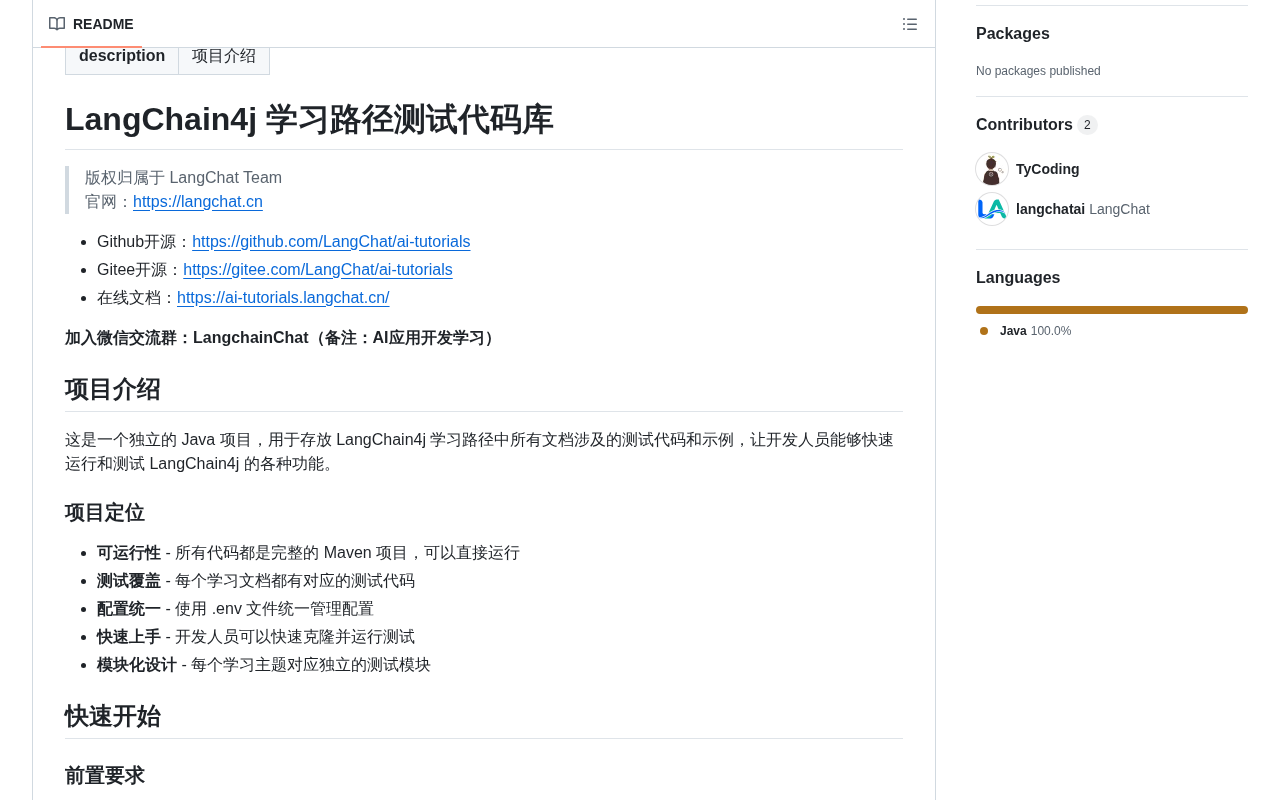
RAG: Retrieval-Augmented Generation
RAG (Retrieval-Augmented Generation) is one of the most common enterprise AI deployment scenarios. It supplements large model responses by retrieving from external knowledge bases, effectively addressing issues like hallucinations and outdated knowledge. Implementing RAG with langchain4j in a Java environment involves document chunking, vectorization, vector storage, and similarity retrieval. The tutorials walk through this entire pipeline from scratch — a highly relevant reference for teams looking to build internal knowledge Q&A systems.
Agent: Intelligent Agents
Agents enable large models to move beyond passive responses — they can autonomously plan, call tools, and complete multi-step tasks. This is the key leap from AI "chatting" to AI "doing work." The tutorials cover how to build tool-calling agents in Java and how to understand the decision loop mechanism that drives Agent behavior.
MCP: Model Context Protocol
MCP (Model Context Protocol) is a recently prominent standardized protocol that governs how AI models interact with external tools and data sources. Including MCP in the curriculum reflects a genuine effort to stay current with the AI ecosystem, and gives learners exposure to cutting-edge engineering practices.
Who Should Use These Tutorials
Given the "beginner-friendly" positioning, these tutorials are primarily aimed at two audiences. The first is backend engineers with solid Java experience who are completely new to AI application development and want to integrate AI capabilities into existing systems. The second is teams evaluating their technology choices — if a team's stack is primarily Java, using langchain4j rather than introducing a separate Python service can significantly reduce architectural complexity and maintenance overhead.
It's worth noting that AI application development involves a lot of concepts, so "beginner" here refers more to being new to the AI domain specifically. Learners will still need basic Java programming skills and familiarity with the Spring ecosystem to comfortably follow along with the hands-on sections.
Limitations and Outlook
As an early-stage open-source project, ai-tutorials still needs to prove itself in terms of community activity and content maturity. With 24 Stars, it hasn't yet gained widespread attention, and the completeness of the tutorials, update frequency, and quality of examples all require hands-on evaluation.
That said, the direction it represents is worth affirming: as AI capabilities increasingly become part of software infrastructure, mainstream enterprise languages like Java shouldn't be left out. The maturation of langchain4j and its accompanying tutorials will enable more traditional backend teams to participate in AI application development at a lower cost. For developers interested in the Java + AI intersection, this project is worth bookmarking and watching as it evolves.
Summary
LangChat's ai-tutorials is a Java-ecosystem-focused AI application development tutorial series, built around langchain4j as its core thread, systematically covering three major areas: RAG, Agent, and MCP. It fills a relative void in Java AI tutorial resources, making it well-suited for engineers who want to enter AI development using their familiar tech stack. While the project is still in its early stages, its practical focus and forward-looking content organization — including newer standards like MCP — make it a solid starting point for Java developers looking to break into AI application development.
Related articles

Spotit: Turn Every Mac App into a Real-Time Interactive Tutorial
Spotit is an AI-powered interactive tutorial tool for Mac. Press a shortcut, ask in plain language, and it highlights exactly where to click next — guiding you through any Mac app as you learn by doing.
OpenCode: The Open-Source Coding Agent That Hit 150K GitHub Stars
OpenCode is an open-source TypeScript coding agent with 150K+ GitHub stars. Learn about its features, advantages, and use cases for AI-powered development.
Learning AI Agent Development from Scratch: An Open-Source Tutorial Worth Bookmarking
Haozhe-Xing/agent_learning is a systematic, hands-on open-source tutorial for learning AI Agent development from scratch, with daily arXiv paper tracking built in.