LangGraph Multi-Agent Architecture in Practice: A Complete Guide from Single Agent to Enterprise-Level Applications

LangGraph enables multi-agent collaboration through graph structures, essential for building complex AI applications.
LangGraph is a core extension of the LangChain ecosystem that combines large model interaction capabilities with graph structures to solve multi-agent collaboration and complex task orchestration challenges. Through its directed graph design with nodes and edges, it supports branching, loops, and parallel execution, overcoming the limitations of traditional chain structures. Its Time Travel mechanism enables state rollback and breakpoint debugging, significantly reducing debugging and operational costs for enterprise applications. The recommended learning path starts with LangChain fundamentals, progresses through single Agent construction, and advances to multi-agent architecture.
Why LangGraph Is a Must-Learn for AI Developers
In the era of AI large models, if we were to rank the must-learn tech stacks for programmers, the LangChain ecosystem would undoubtedly be at the top. It not only provides a rich set of tools for applying large models to more scenarios, but more importantly, it helps developers accumulate extensive experience and mental models for working with large models — the transition from "hobby" to "skill" often requires a fundamental shift in thinking.
LangChain Ecosystem Background: LangChain was released by Harrison Chase in October 2022, initially as a Python framework helping developers connect Large Language Models (LLMs) with external data sources and tools. Its core abstractions include Chain (sequential calls), Agent (intelligent agents), Memory, and Tool — concepts that significantly lowered the barrier to building LLM applications. With the emergence of powerful models like GPT-4, LangChain quickly became one of the most popular open-source frameworks in AI application development, surpassing 80,000 GitHub stars within just one year. LangGraph was introduced in early 2024 as an extension of LangChain, specifically designed to solve orchestration problems in stateful, multi-step, multi-agent collaboration scenarios — an area where the original LangChain chain structure struggled to handle elegantly.
As a core component of the LangChain ecosystem, LangGraph elevates this capability to a new level. Through LangChain, we learn how to solve specific problems; through LangGraph, we learn how to systematically solve complex problems using multi-agent collaboration.
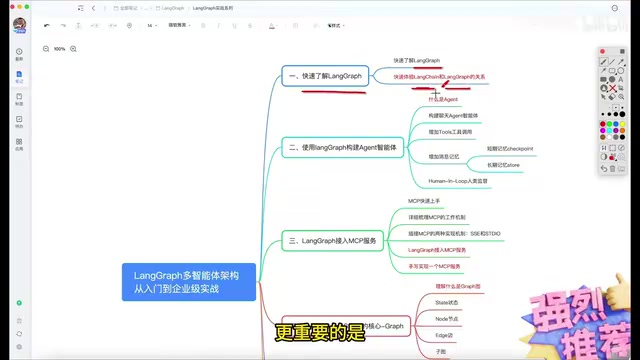
One point deserves special emphasis: discussing LangGraph in isolation from LangChain is incomplete. LangGraph is not a standalone framework — it's an ecosystem component within the broader LangChain system. Many tutorials jump straight into LangGraph implementation details while ignoring its relationship with LangChain, which leaves learners able to run demos but unable to independently build applications.
The Core of LangGraph: The Power of Graph Structures
Understanding the Two Dimensions of the LangGraph Name
The name LangGraph can be broken down into two parts:
- Lang: Represents the interaction with large models — a capability that LangChain has already solved well for us
- Graph: Represents graph structures — this is the true core innovation of LangGraph
Graph structures were not invented by LangGraph. In the big data era, knowledge graphs were a classic application of graph structures.
Graph Structure and Knowledge Graph Background: A Graph is one of the most fundamental data structures in computer science, consisting of Nodes and Edges. Knowledge Graphs are the most widely known application of graph structures — Google launched its Knowledge Graph in 2012, organizing real-world entities and their relationships in graph form, greatly enhancing search engines' semantic understanding capabilities. The core advantage of graph structures lies in their natural ability to express "relationships" and "state transitions": nodes represent states or entities, while edges represent transition conditions or relationships. In AI workflow orchestration, graph structures allow non-linear execution paths — a node can jump to different subsequent nodes based on conditions, or even form loops, which is impossible with traditional Chain structures. LangGraph leverages this property of Directed Graphs to upgrade AI task orchestration from linear processes to complex state machines capable of handling branching, loops, and parallelism.
The value of LangGraph lies in perfectly combining large model interaction capabilities with graph structures, enabling developers to progressively abstract complex tasks into finer-grained nodes, thereby gaining the ability to design complex business scenarios.
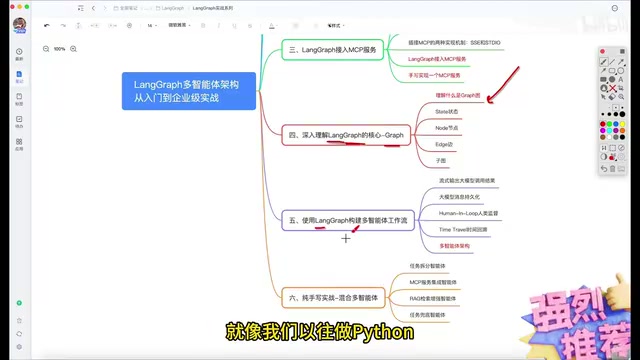
Why Graph Structures Instead of Procedural Approaches
Many developers might ask: calling the large model step by step in a procedural manner can also achieve functionality — so why use graph structures?
This is similar to writing Java or Python programs — you could put all business logic in a single main method, but why do we need Spring Boot or microservices architecture? The answer is: when facing large, complex, or even cross-team projects, procedural approaches fall short. Graph structures provide a well-organized approach that enables us to:
- Break complex business logic into independent nodes
- Load different code in each node (LangChain, LlamaIndex, or even your own business code)
- Combine these nodes into well-architected systems through graphs
Time Travel: A Unique Advantage of Graph Structures
LangGraph provides a highly practical mechanism — Time Travel. In complex multi-agent applications, we may need to interact with large models multiple times and execute different business logic based on different responses. If the large model doesn't follow the prompt well at a certain step, the entire process might need to restart under traditional approaches — an extremely costly outcome.
Technical Principles of Time Travel: LangGraph implements Time Travel through an extended design of Finite State Machines. The entire system maintains a shared State object, and after each node executes, the current state is persisted to Checkpoint storage — with default support for memory, SQLite, PostgreSQL, and other backends. This means every step of graph execution has a complete state snapshot. Developers can precisely rewind to any historical checkpoint through the LangGraph Studio visual interface or API, modify the state, and re-trigger subsequent node execution without running the entire workflow from scratch. This design is useful not only for debugging but is equally critical in Human-in-the-Loop scenarios — human reviewers can intervene at specific nodes, correct AI judgments, and then continue the process.
The Time Travel mechanism allows us to:
- View the complete execution process and results of each step in the graph
- Rewind to the failing node, make manual adjustments, and continue execution
- Avoid the high cost of restarting the entire task from scratch
This feature is particularly critical in enterprise-level applications, directly reducing the complexity of debugging and operations.
From Single Agent to Multi-Agent: A Progressive Learning Path
Step One: Building a Single AI Agent
Although LangGraph's focus is on multi-agent architecture, the foundation is the ability to build individual agents. Just like building a house requires solid bricks first, you must master the approach to constructing a single Agent.
Regarding "intelligent agents"
Related articles
 Tutorials
ChatGPT Plus Subscription Guide: Are GPT-5.5, image-2, and Codex Worth the Upgrade?
A detailed look at ChatGPT Plus features — GPT-5.5, image-2, and Codex — with a Plus vs Pro comparison and a complete step-by-step subscription guide for users outside the US.
 Tutorials
Harness AI Engineering in Practice: Using Claude Code to Master Enterprise-Level E-Commerce Development
Deep dive into Harness AI Engineering: master enterprise e-commerce development with Claude Code using the Rules, Skills, Wiki, and Changes framework.
 Tutorials
Cursor + Codex Dual-IDE Collaboration: A Practical Methodology for Open-Source Project Customization
A complete methodology for open-source project customization based on real-world experience, detailing the Cursor+Codex dual-IDE workflow, seven-stage process, MVP validation, and AI source code reading techniques.