LangGraph vs CrewAI vs PydanticAI: A Guide to Choosing Among Four Major Agent Frameworks
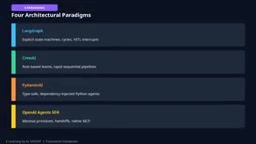
A code-level comparison of four major Agent frameworks: the key to selection is the degree of deterministic control, not superiority.
Based on Module 7 from eLearning by A.L. Sadat, this article provides a code-level architectural comparison of four production-grade Agent frameworks: LangGraph, CrewAI, PydanticAI, and OpenAI Agents SDK. The core point is that the key question in framework selection is not "which is best" but "how much deterministic control does the workflow need." LangGraph offers maximum control, durable execution, and time-travel debugging via directed cyclical graphs, at the cost of the most code; CrewAI abstracts via roles, goals, and backstories, ideal for rapid prototyping and role-based pipelines; PydanticAI treats Agents as strictly typed microservices with validated Pydantic outputs; the OpenAI Agents SDK wins with lightweight primitives like Agent, handoff, guardrail, and MCP. The article also provides a selection decision matrix and combination approaches, emphasizing that MCP tool isolation, durable state, and automated evaluation are constant engineering principles.
Why Framework Selection Matters More Than You Think
Almost every week, a new Agent framework trends on GitHub in the AI engineering space, promising that you can build a team of autonomous AI employees with ten lines of Python. But when you push the prototype into production, hidden prompt abstractions, broken streaming output, missing type safety, and chains that are nearly impossible to debug will surface one after another.
Module 7 from the YouTube channel eLearning by A.L. Sadat offers a code-level architectural comparison of four mainstream production-grade frameworks: LangGraph, CrewAI, PydanticAI, and OpenAI Agents SDK. The core takeaway is worth remembering for every AI architect—rather than asking "which framework is best," ask "how much deterministic control does my workflow need?"
The Architectural Positioning of the Four Frameworks
LangGraph: Directed Cyclical Graphs and State Control
LangGraph models workflows as directed cyclical graphs. According to the course analysis, it excels at complex branching, durable human-in-the-loop interactions, interrupts, and fine-grained state control. If you need explicit edges, retry mechanisms, and time-travel debugging, LangGraph is the corresponding tool. The cost is more code—states, nodes, edges, checkpoints, and interrupt points all need to be explicitly defined—but that is precisely what grants maximum controllability, durable execution, and observability.
A directed cyclical graph is LangGraph's core modeling approach: nodes represent computational steps (such as calling a model or executing a tool), edges define the direction of flow between steps, and "cyclical" means the flow can return to previous nodes, thereby supporting retries, multi-round reasoning, and conditional branching. This graph structure is closely tied to durable execution—the state of each node is saved via checkpoints, so a task that is interrupted can resume from the most recent checkpoint rather than restarting from scratch. So-called time-travel debugging leverages these checkpoints to roll back to historical states, replay, or modify a given step, which is critical for troubleshooting complex Agent chains.
CrewAI: Rapid Prototyping with Role-Based Agents
CrewAI abstracts Agents as personas with roles, goals, and backstories. It is the fastest way to quickly assemble sequential research or content pipelines and is ideal for rapid prototyping. When the problem itself naturally fits the "division of roles" metaphor, CrewAI offers the strongest expressiveness.
PydanticAI: Treating Agents as Microservices
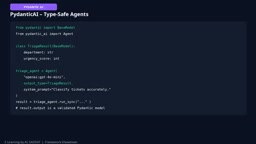
PydanticAI, built by the team behind Pydantic and FastAPI, treats AI Agents as standard dependency-injected, strictly typed Python microservices. If you care about type safety and clean backend code, this framework's design will feel very natural. Runtime output is guaranteed to be validated Pydantic objects, making it suitable for backend services that require strict contracts.
OpenAI Agents SDK: Minimalist Primitives
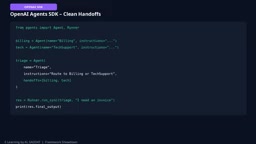
The OpenAI Agents SDK is extremely lightweight, built around a few clean primitives: Agent, handoff, guardrail, and MCP, without heavy framework lock-in. When you want minimal boilerplate and native multi-Agent handoffs, it is the most direct choice.
MCP (Model Context Protocol) is an open protocol for standardizing how AI models connect to external tools and data sources—think of it as the "USB interface for AI applications." It lets Agents discover and invoke tools in a unified way without writing custom adapters for each framework, so frameworks with native MCP support are more portable across the tool ecosystem. Guardrail is a runtime safety mechanism that can intercept violating content, unauthorized operations, or policy-noncompliant responses at either the input or output stage, and is a foundational primitive for ensuring safety and compliance in multi-Agent systems.
Same Task, Four Implementations
The course compares the code style of all four using a structured support triage task:
- PydanticAI: Define a Pydantic model for structured output, create an Agent with a clear system prompt, and call
run_sync. The result is guaranteed to be a runtime-validated Pydantic object—suitable for backend services that require strict contracts. - OpenAI Agents SDK: Create separate Agents for billing and technical support, then have a triage Agent point to both via handoff, with the Runner handling routing. The code is short, and the handoff model is very clear.
- CrewAI: Declare Agents with roles, goals, and backstories, create tasks pointing to those Agents, assemble them into a Crew, and call kickoff to run the entire pipeline. Suitable for creative or research workflows where the role metaphor matches the problem.
- LangGraph: A low-level approach with explicitly defined states, nodes, edges, checkpoints, and interrupt points. Maximum control, but also the most code.
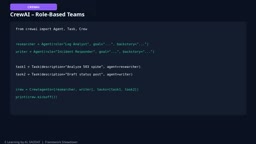
This comparison reveals a frequently overlooked fact: the difference among the four frameworks is not "stronger versus weaker capability" but a spectrum of abstraction level and degree of determinism. PydanticAI and the OpenAI Agents SDK stay close to conventional Python service style, CrewAI provides high-level role orchestration, and LangGraph hands full control to the developer.
Handoff is a routing mechanism in multi-Agent collaboration: when the current Agent determines that another, more suitable Agent should handle the task, it systematically transfers the conversation context and control to the target Agent rather than simply calling a function. Unlike ordinary tool calls, a handoff switches "who is leading the conversation," and the target Agent inherits the history and continues reasoning, which naturally expresses scenarios like support triage and expert transfer. Understanding the difference between handoff and tool calling is key to understanding the OpenAI Agents SDK's multi-Agent design.
The Selection Decision Matrix
The course offers the following practical criteria:
- Choose PydanticAI: You are familiar with FastAPI, need strict Python type checking, and are building single-Agent or tool-heavy backend microservices.
- Choose OpenAI Agents SDK: You want minimal boilerplate, native MCP support, and clean multi-Agent handoffs.
- Choose CrewAI: You are validating an MVP, or need to quickly orchestrate role-based creative or research workflows.
- Choose LangGraph: Enterprise workflows require complex loops, time-travel debugging, durable human-in-the-loop pauses, and strict deterministic control.
The course also proposes a combination approach: use LangGraph for orchestration, paired with local vLLM and FastMCP. This layered approach decouples "deterministic orchestration" from "model/tool integration," avoiding lock-in to a single framework.
Frameworks Change, Engineering Principles Don't
The most valuable judgment from this course is: frameworks will keep evolving, but the underlying engineering principles remain constant—MCP tool isolation, durable state, and automated evaluation. In other words, rather than deciding which framework to pick today, figure out how much determinism your workflow needs, how durable your state must be, and how much isolation your tool calls require. Once you have thought through these three questions, framework selection will naturally converge to one or two candidates.
For teams pushing Agent prototypes into production, this comparison provides a pragmatic starting point: use the decision matrix to narrow the field first, then do code-level validation on real tasks, rather than being led by GitHub star counts.
Related articles

Bilibili Follower Growth in Practice: The Underlying Logic of Daily Posting and Follow-for-Follow
A Bilibili creator shares follower-growth methods: daily login, posting one or two videos a day, and follow-for-follow. This article breaks down the real effects of these basic actions and adds more effective growth ideas like topic selection, thumbnails, and comment-section management.

An African Journey Surrounded by Snakes: A Bilibili Creator's Thrilling Adventure
Bilibili creator shares an African adventure video, claiming to be surrounded by hundreds of snakes, crossing cloud-shrouded mountains, encountering lions, leopards, and hippos on safari, and documenting curious roadside sights, prompting reflection on natural wonders.
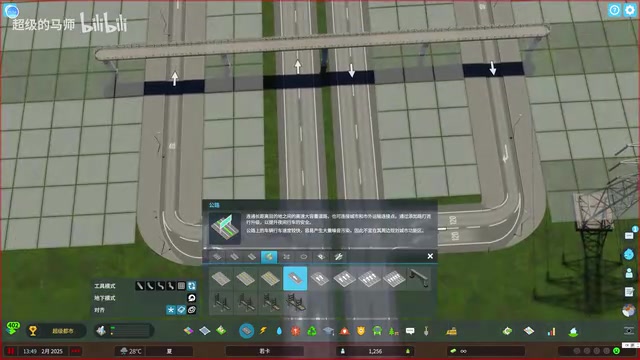
Cities: Skylines 2 Forestry & Industry Road Network Guide
Starting from the design of forestry and industrial small roads in Cities: Skylines 2, this analyzes hierarchical road network planning to help players solve logistics congestion in industrial zones.