LangSmith's New Perspective: More Than Building Agents — Managing the Coding Agents You Use

LangSmith shifts from building Agents to observing coding Agent usage, making observability essential daily development infrastructure.
The LangChain team revealed that LangSmith is expanding from "helping you build Agents" to "helping you observe the Agents you're using," launching a dedicated view for coding Agents. The article notes that when building Agents, developers have control and can troubleshoot layer by layer; but when using coding Agents, they face a black box where file reads, code changes, and tool calls are hard to scrutinize. The multi-step, multi-side-effect nature of coding Agents makes observability more critical than for ordinary conversational AI. This feature is valuable for engineers who deeply use coding Agents and for technical leads concerned about team output — the core is building trust rather than post-mortem accountability. However, the tweet didn't reveal specific feature details, the range of supported Agent products, or whether it covers non-LangChain ecosystems; unified cross-tool observability remains key to landing.
LangChain recently shared a noteworthy signal on Twitter: LangSmith's positioning is expanding from "helping you build Agents" to "helping you observe the Agents you're using." They've built a dedicated view specifically for coding Agents, and the reason is straightforward — everyone is using coding Agents these days, but few people can clearly explain what these Agents are actually doing behind the scenes.
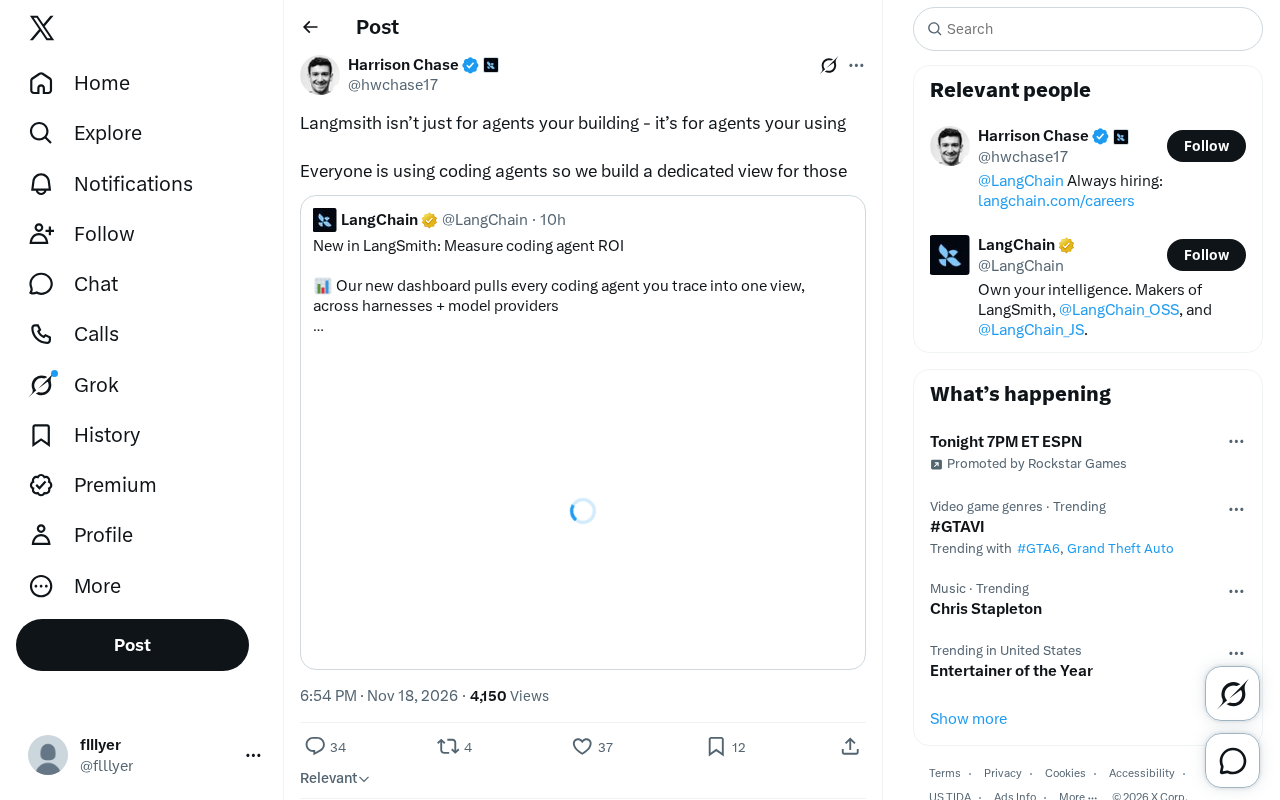
Shifting perspective from "building tools" to "using tools"
In the past, when most developers heard about LangSmith, their first thought was debugging and tracing the LLM application chains they built themselves. It solved problems like "why isn't the Agent I wrote working?" But LangChain's latest statement highlights an overlooked scenario: when you treat Cursor, Copilot, or other coding Agents as everyday tools, you equally need observability.
The difference between these two scenarios lies in control. When building an Agent, you wrote the code, you defined the pipeline, and you can troubleshoot layer by layer when issues arise. When using an Agent, you're facing a black box — which files it read, what code it changed, what tools it called, and at which step it started going off track. If this information isn't recorded, you can only guess. LangSmith building a dedicated view for coding Agents is essentially turning "black-box usage" into "traceable usage."
Coding Agent refers to a class of AI Agents specifically designed to assist software development, with typical examples including Cursor, GitHub Copilot, Devin, Claude Code, and others. They typically have capabilities such as reading and writing files, executing terminal commands, running tests, and installing dependencies, completing development tasks through multi-step autonomous loops. Unlike ordinary conversational AI, coding Agents directly operate on codebases and development environments, and each action may produce persistent side effects (such as modifying files or committing changes). Therefore, behavioral transparency and controllability become critical requirements. The current coding Agent ecosystem is highly fragmented, with each product adopting different underlying models, tool interfaces, and interaction patterns, lacking unified observation standards. If LangSmith wants to cover this scenario, it needs to adapt to multiple Agent frameworks and protocols — a significant technical challenge.
Why observability for coding Agents has become essential
The way coding Agents work makes them harder to scrutinize than ordinary conversational AI. A single task may involve multiple actions such as file reading, code editing, terminal command execution, and dependency installation, each of which may introduce side effects. When an Agent outputs a seemingly reasonable piece of code, developers need to know what context it based its judgment on, rather than just seeing a final result.
Judging from LangChain's wording, this dedicated view is aimed precisely at such needs. Although the tweet didn't elaborate on specific feature details, the phrase "dedicated view" suggests it may aggregate and display typical coding task actions, rather than reusing a generic trace interface. For developers who rely on coding Agents daily, this targeted design is more practical than an all-purpose but cluttered debugging panel.
Observability in the context of AI Agents refers to the ability to infer internal states through external system outputs (such as logs, metrics, and traces). Traditional software observability relies on three pillars: Logs, Metrics, and Traces. For LLM Agents, observability additionally needs to capture prompts, token consumption, tool call sequences, context window contents, and more. LangSmith's core capability is providing distributed trace views, breaking down an Agent run into a tree-structured call chain, where each node corresponds to an LLM call or tool execution. This fine-grained tracing allows developers to pinpoint exactly which step's input and output caused the anomaly, rather than only seeing the final error. For coding Agents, since they involve external side effects such as the file system and terminal, observability also needs to record environment changes — which is more complex than tracing pure text conversations.
Practical implications for developers
This direction has the greatest impact on two types of people. One is engineers who deeply embed coding Agents into their workflows — they need to quickly judge whether a particular change by an Agent is trustworthy, or trace back where a failed task got stuck. The other is technical leads on teams, who care not only about how individual Agents perform, but also about the overall output quality and risk of the team working with Agent assistance.
The value of observability tools often lies not in "post-mortem accountability" but in building trust. When developers can clearly see every action of a coding Agent, they dare to entrust it with more complex tasks. LangSmith extending its perspective from "the Agent you build" to "the Agent you use" is essentially acknowledging a reality: Agents are no longer experiments — they're everyday development infrastructure, and infrastructure needs monitoring.
LangSmith is an LLM application development and observability platform launched by LangChain, with main features including Tracing, Evaluation, Prompt Management, and Monitoring. It was initially deeply integrated with the LangChain framework for debugging chain calls and Agent execution processes. As LLM application forms diversified, LangSmith gradually added support for applications not built with LangChain, receiving trace data through SDKs or APIs. Expanding its perspective to "coding Agents in use" this time means LangSmith may collect runtime data from third-party coding Agents through interception or integration, thereby providing cross-tool observability. This requires LangSmith to have a more general data ingestion layer and to understand the semantic structure of coding tasks, rather than relying solely on LangChain's own execution graph.
An unresolved question
The tweet itself contains limited information, not revealing the specific form of this coding Agent view, which Agent products it supports, or whether it covers tools outside the LangChain ecosystem. Given that the coding Agent market itself is highly fragmented, whether LangSmith can provide unified usage observability across tools will be key to whether this feature can truly land.
But the direction is clear. When everyone is using coding Agents, the tooling layer around "how to use them well" will become as important as "how to build them." LangSmith's adjustment this time is an early footnote to this judgment.
Related articles

Nothing CMF Buds 2A Drops to $17.89 on Black Friday: A New Low for ANC Earbuds
Nothing CMF Buds 2A wireless earbuds Black Friday deal: just $17.89 on Amazon, about $11 off retail and a record low. ANC earbuds at an entry-level price.

When AI Creation Gets Accused of "Spitting": Hacker News Heats Up Over the Glaude Controversy
A Hacker News post, "Spitting in the Face of Glaude," sparks debate on AI creation transparency and attribution ethics. This analysis examines the blurred creator identity behind the controversy and offers practical advice for AI content production.

Akai Embraces Custom Firmware: MPC Sample 1.4 Lets Users AI-Program Their Sampler
Akai embraces the modding community with MPC Sample 1.4 firmware, supporting vibe-coded custom firmware and effects. We analyze the impact of this open strategy on music hardware and AI-assisted programming.