Laplace Intelligence: Red-Teaming Robots and Self-Driving Cars

University of Michigan spin-off Laplace Intelligence uses AI agents and interactive simulation to red-team robots and autonomous driving systems.
Laplace Intelligence, a University of Michigan spin-off, brings red-teaming from cybersecurity and LLMs into the physical world, using AI agents to play adversaries in interactive simulations and proactively create extreme, adversarial scenarios to uncover safety flaws that preset testing misses. Simulation allows infinite replays of dangerous scenarios at lower cost, and AI agents' dynamic behavior mirrors real road users' unpredictability. Already profitable, the company is competing at TechCrunch Disrupt's Startup Battlefield. Red-teaming could become an industry standard for physical-world AI safety validation, though the sim-to-real gap means it can't fully replace road testing.
How can we ensure self-driving cars and robots are safe enough before they hit the road or enter human environments? The University of Michigan spin-off Laplace Intelligence offers one answer: use AI agents and interactive simulations to red-team them in advance.
What Is Red-Teaming in Robotics
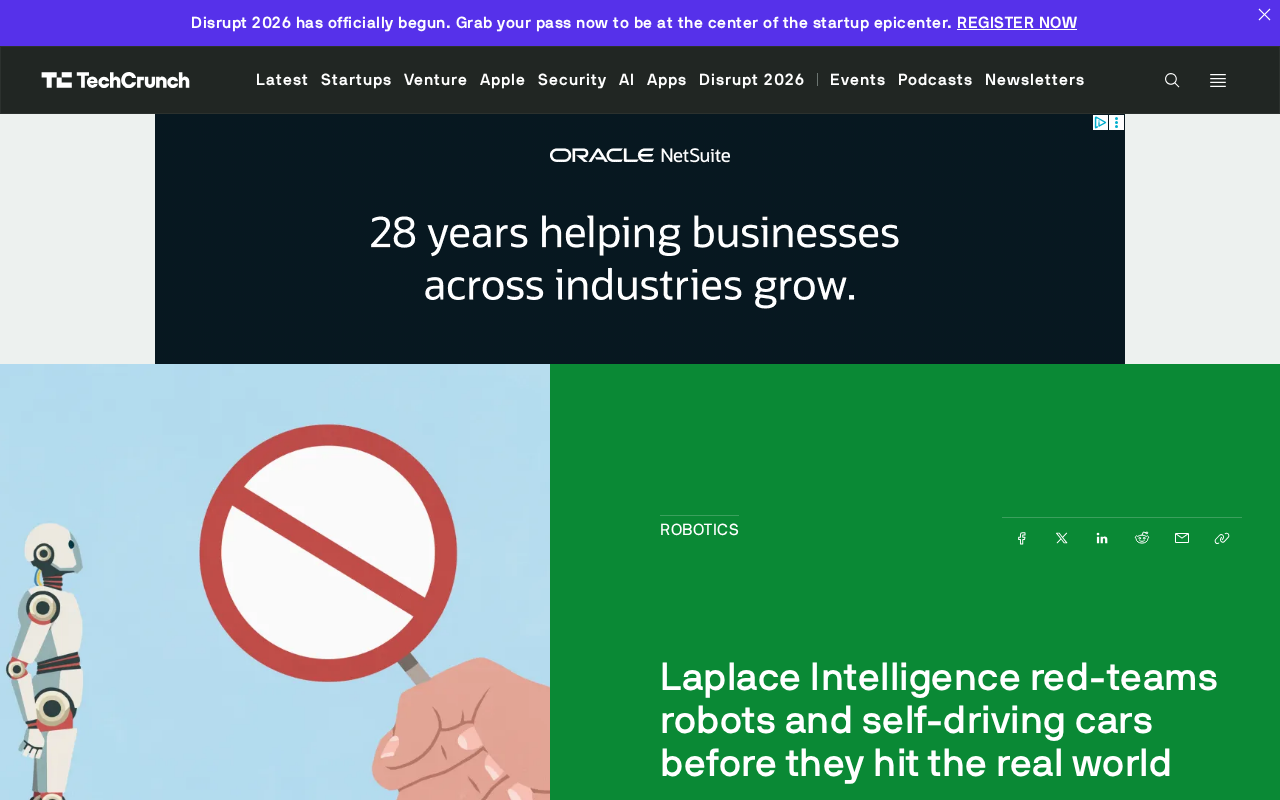
The concept of "red-teaming" is already well known in cybersecurity and LLM circles—actively hunting for system vulnerabilities by simulating an attacker's perspective. Laplace Intelligence has brought this methodology into the physical world: AI agents play "adversaries" in interactive simulation environments, deliberately creating extreme, edge-case, and even adversarial scenarios to observe how robots and autonomous driving systems respond.
The key difference from traditional testing methods lies in "proactivity." Traditional testing typically involves engineers presetting a set of scenarios to verify system behavior, whereas red-teaming lets AI agents autonomously explore conditions that could trigger failures, uncovering vulnerability combinations that human testers might never imagine.
The Historical Roots of Red-Teaming
The term "Red Team" dates back to Cold War-era military exercises. At the time, the U.S. military would set up dedicated "red teams" in war games to play the enemy (usually the Soviet Union), using the opponent's thinking to attack their own (blue team's) defense strategies, thereby exposing blind spots in command chains and tactical assumptions. This approach of "examining your own system from the attacker's perspective" was later inherited by the information security field: penetration testing teams simulate hacker behavior to proactively find network and software vulnerabilities.
Around 2022, as large language models rapidly advanced in capability, red-teaming was introduced into the AI safety field. Researchers use carefully designed adversarial prompts to induce models to output harmful content or bypass safety guardrails, thereby identifying value alignment flaws in models. Companies like OpenAI and Anthropic have established dedicated red teams. Laplace Intelligence's innovation lies in extending this methodology from the digital world to the physical world—the targets are no longer software, but physical machines that drive on roads and carry goods in warehouses, where failure could result in personal injury, demanding even greater rigor in testing.
Why Simulation Is More Efficient Than Real-Vehicle Testing
Testing autonomous driving systems on real roads is costly and carries uncontrollable risks. Reproducing each extreme scenario requires significant manpower and resources, and some dangerous situations cannot even be safely repeated in reality. Simulation environments, on the other hand, allow infinite replays and variations of the same dangerous scenario until the system's weaknesses are fully exposed.
Laplace Intelligence's interactive simulations don't just reproduce scenarios—they also introduce dynamic behavior from AI agents. This means the system under test isn't facing scripted obstacles, but intelligent opponents that react to their environment—closer to the unpredictability of other road users in the real world.
The Sim-to-Real Gap
While simulation testing is efficient, the industry broadly faces a fundamental challenge: the sim-to-real gap. Sensor models, lighting conditions, road friction coefficients, and pedestrian behavior distributions in simulation environments are only approximations of the real world. An autonomous driving policy that performs perfectly in simulation may fail after deployment on a real vehicle due to sensor noise, rare weather conditions, or unmodeled objects.
To narrow this gap, mainstream approaches include domain randomization—randomly perturbing textures, lighting, and physical parameters in simulation to force AI to learn robustness to variation—as well as high-fidelity physics engines and real data replay. Laplace Intelligence's introduction of dynamic AI agent behavior is essentially also about improving the distribution coverage of simulation scenarios to make them closer to the unpredictability of real road users. Even so, simulation cannot exhaustively cover the long tail of real-world scenarios, which is the fundamental reason why red-teaming can only "move the gate forward" rather than "replace road testing."
Academic Background and Commercialization Path
Laplace Intelligence was born out of the University of Michigan, which gives it a solid research foundation. Interestingly, the company is already profitable—uncommon among early-stage robotics and autonomous driving safety startups. The team is competing in the Startup Battlefield at TechCrunch Disrupt, seeking greater industry attention.
From a business logic perspective, Laplace's positioning hits a real pain point: as robots move from factories to warehouses, streets, and homes, the demand for safety validation will continue to grow. Regulators are increasingly cautious about approving autonomous driving, and robot manufacturers need to prove product reliability to customers. An independent third-party red-teaming platform could become infrastructure for the entire industry.
The University of Michigan's Autonomous Driving Research Tradition
The University of Michigan has deep roots in autonomous driving. Its Mcity in Ann Arbor is the world's first closed test city built specifically for connected and autonomous vehicles, featuring simulated city streets, intersections, tunnels, and more, opening in 2015. The university also operates a connected vehicle test corridor spanning dozens of kilometers and maintains long-term partnerships with automakers like Ford and GM.
Laplace Intelligence, born from this research soil, naturally has the ability to engage with academia, automakers, and regulators. Its identity as a spin-off also means it can quickly translate validated adversarial testing methods from the lab into commercializable platform services. For an early-stage startup, being backed by a top university's testing infrastructure and talent pool is an important advantage in the fiercely competitive autonomous driving safety arena.
Can Red-Teaming Become an Industry Standard
Safety validation for AI systems is shifting from "optional" to "mandatory." Red-teaming in the LLM space has gradually become institutionalized, and AI systems in the physical world will likely follow a similar path. However, the challenges are clear: the gap between simulation environments and the real world persists, and no matter how broadly red-teaming covers scenarios, it cannot fully replace real-world road testing.
Laplace Intelligence's value may not lie in replacing traditional testing, but in moving the safety validation gate forward—exposing as many problems as possible before systems come into contact with the real world. For the humanoid robotics and autonomous driving industries that are accelerating toward deployment, this "spar before you hit the road" approach is worth watching.
One-line Summary
University of Michigan spin-off Laplace Intelligence uses AI agents and interactive simulation to red-team robots and autonomous driving systems.
Paragraph Summary
Laplace Intelligence is a University of Michigan spin-off that brings mature red-teaming methodologies from cybersecurity and LLMs into the physical world, using AI agents to play adversaries in interactive simulation environments and proactively create extreme and adversarial scenarios to uncover safety vulnerabilities that traditional preset testing misses. Compared to real-vehicle testing, simulation can replay dangerous scenarios infinitely at lower cost and with controllable risk, while AI agents' dynamic behavior makes the system under test face unpredictability closer to real road users. The company is already profitable and is competing in the Startup Battlefield at TechCrunch Disrupt. The article argues that red-teaming is poised to become an industry standard for safety validation of physical-world AI systems, but the sim-to-real gap means it cannot fully replace real-world road testing.
Related articles

Agent Skills Beginner's Guide: From Concepts to Multi-Agent Collaboration in Practice
A comprehensive guide to Agent Skills: core concepts, components, the importance of Description, standardization, beginner learning paths, and multi-agent collaboration.

One Neuron Detects Both Cats and Cars? We Reproduced It and Found a New Explanation
The cat-car neuron reinterpreted: researcher Cammarata argues it distinguishes pointy from round, not cats from cars. We reproduced the experiment and found the new explanation holds on most inputs—but cars are the exception. The interpretability debate continues on language models.

MCP Server + Python Assistant: A MicroStation Design Efficiency Revolution
Explore the early preview of the MCP Server and Python Assistant in MicroStation 2026: custom tools in five minutes, intelligent sheet index checks, and how AI is reshaping drawing workflows to unleash design creativity.