LARC: Latent Reasoning in Continuous Space to Crack Multimodal Generation Challenges
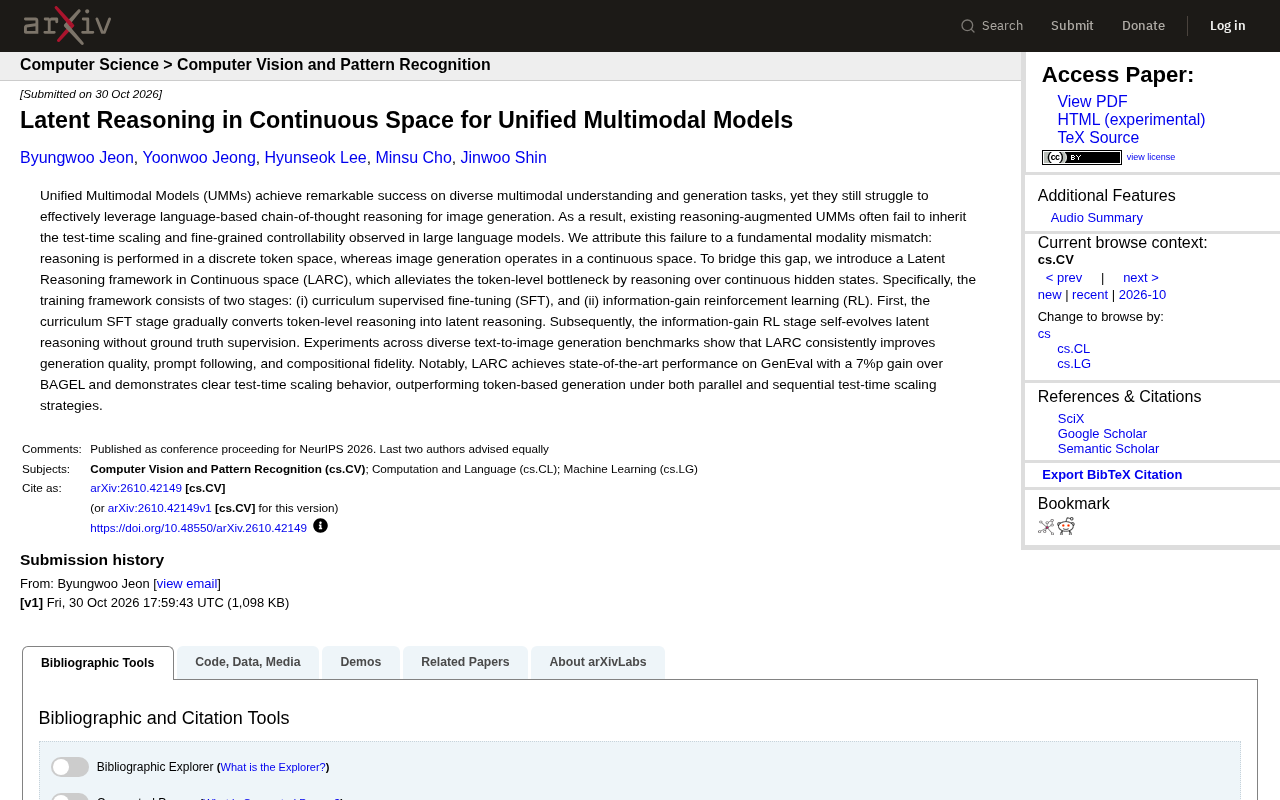
LARC moves reasoning from discrete token space to continuous hidden state space, solving the modality mismatch in multimodal generation.
The article introduces the bottleneck unified multimodal models face when using language chain-of-thought to assist image generation, attributing it to the modality mismatch between discrete token reasoning and continuous image generation. The proposed LARC framework performs latent reasoning over high-dimensional hidden states, using curriculum supervised fine-tuning for a smooth transition from token reasoning to latent reasoning, then information-gain reinforcement learning to drive unsupervised self-evolution. Experiments show LARC improves generation quality, prompt following, and compositional fidelity across multiple text-to-image benchmarks, achieves a 7-percentage-point improvement over BAGEL and state-of-the-art on GenEval, and exhibits clear test-time scaling behavior, providing a reusable paradigm for reasoning enhancement in multimodal generation models.
Unified Multimodal Models (UMMs) shine in multimodal understanding and generation tasks, yet they repeatedly stumble when leveraging language Chain-of-Thought (CoT) to assist image generation. Existing reasoning-enhanced UMMs fail to inherit the test-time scaling and fine-grained controllability observed in Large Language Models (LLMs). Researchers attribute the failure to a fundamental modality mismatch: reasoning occurs in discrete token space, while image generation operates in continuous space. To address this, the paper proposes LARC (Latent Reasoning in Continuous space), a framework that mitigates token-level bottlenecks by performing reasoning over high-dimensional hidden states. Experiments show that LARC consistently improves generation quality, prompt following, and compositional fidelity across multiple text-to-image benchmarks, achieving state-of-the-art results on GenEval.
Modality Mismatch: The Gap Between CoT Reasoning and Image Generation
UMMs attempt to unify text understanding and image generation within a single architecture, but a natural divide exists between the discrete token sequences of language reasoning and the continuous representations of image generation. When a model performs CoT reasoning in token space, each reasoning step is compressed into discrete symbols, losing the rich semantic gradient information available in continuous space. This information loss makes it difficult for the reasoning chain to precisely guide pixel-level generation, and the model cannot steadily improve output quality by increasing reasoning steps as LLMs do.
The paper points out that this modality mismatch is precisely what causes reasoning-enhanced UMMs to underperform in test-time scaling and fine-grained control. Traditional methods treat reasoning as discrete symbolic operations, whereas image generation requires smooth regulation in continuous space—the two are hard to align. LARC is proposed precisely to complete reasoning in continuous latent state space, thereby preserving more semantic detail.
Chain-of-Thought (CoT) was originally a prompting and reasoning paradigm in large language models: before giving a final answer, the model explicitly generates a series of intermediate reasoning steps, decomposing complex problems into manageable sub-problems. In LLMs, the key benefit of CoT is test-time scaling—the more reasoning steps or sampling iterations, the higher the accuracy typically becomes. However, in unified multimodal models, CoT intermediate steps exist as discrete tokens, each requiring vocabulary mapping, which is incompatible in representational form with the continuous latent variable sequences relied upon by image generators such as diffusion models. Directly applying CoT therefore often fails to transfer the benefits of semantic reasoning to the pixel generation stage.
LARC's Two-Stage Training Framework
LARC's training pipeline is divided into two stages: curriculum supervised fine-tuning (curriculum SFT) and information-gain reinforcement learning (information-gain RL). The first stage gradually converts token-level reasoning into latent reasoning through curriculum-style SFT, teaching the model to complete reasoning steps in continuous hidden states. The second stage uses information-gain RL to let latent reasoning self-evolve without ground-truth annotation supervision.
The key to this design is that curriculum SFT provides a smooth transition from discrete to continuous, preventing the model from jumping directly into latent space and causing training instability; meanwhile, information-gain RL rewards the information increment brought by the reasoning process, driving the model to explore more effective latent reasoning paths. Combined, the two stages enable LARC to inherit the stability of SFT while possessing the self-evolution capability of RL.
Curriculum SFT borrows the idea of curriculum learning: training samples are arranged from easy to hard in terms of difficulty or form. In LARC, this means starting with samples close to original token reasoning, then gradually transitioning to latent reasoning targets, so that model parameters do not suffer catastrophic drift due to abrupt target distribution shifts. Information-gain reinforcement learning refers to using the information increment brought by the reasoning process as the reward signal—for example, the uncertainty reduced or predicted likelihood improved by latent-state reasoning compared to a no-reasoning baseline—rather than relying on manually annotated final answers. This reward design allows the model to self-improve on image generation tasks lacking paired supervision, and is the key mechanism by which LARC achieves unsupervised self-evolution.
Experimental Results: A Win-Win in Generation Quality and Test-Time Scaling
Across multiple text-to-image benchmarks, LARC consistently improves generation quality, prompt following, and compositional fidelity. Particularly interesting is that on the GenEval benchmark, LARC achieves a 7-percentage-point improvement over BAGEL, reaching state-of-the-art performance. This result validates the effectiveness of latent reasoning in continuous space.
More critically, LARC exhibits clear test-time scaling behavior: under both parallel and sequential test-time scaling strategies, LARC outperforms token-based generation methods. This means that by increasing inference compute, LARC can continuously improve generation results, whereas traditional token-level methods struggle to enjoy such scaling dividends. This property is quite important for real-world deployment, as it allows the system to flexibly adjust compute budgets at inference time to balance quality and efficiency.
GenEval is a commonly used compositional evaluation benchmark in the text-to-image field, testing through fine-grained subtasks such as object counts, colors, spatial relationships, and attribute binding whether a model truly understands the structured semantics of prompts rather than merely generating visually plausible images. BAGEL, on the other hand, is a representative open-source unified multimodal model with both understanding and generation capabilities, often used as a comparison baseline for reasoning-enhanced UMMs. LARC's 7-percentage-point improvement over BAGEL on GenEval indicates that the benefits of continuous latent reasoning are mainly reflected in dimensions requiring precise semantic alignment, such as compositional fidelity, rather than merely overall image aesthetics.
Implications for the Multimodal Generation Field
LARC's success reveals several important directions. Continuous-space reasoning is poised to become a new paradigm for multimodal generation, breaking free from the shackles of discrete tokens. The combination of curriculum SFT and information-gain RL provides a reusable framework for training latent reasoning models. The reproduction of test-time scaling behavior in continuous space means that multimodal generation models can improve performance by increasing reasoning steps like LLMs, opening a new path for building more controllable and reliable generation systems.
Although LARC is still in the research stage, its approach has general reference value for reasoning enhancement of unified multimodal models. Future work may explore more complex latent reasoning structures and extend LARC to more continuous modality generation tasks such as video and 3D.
Related articles

DSH + Ollama Local LLM Deployment in Practice: Free Chat with Da Fei Yu
Bilibili creator tests DSH + Ollama local LLM deployment end to end: Ollama install, Xunlei-accelerated downloads, ModelScope GGUF model import, DSH custom API address setup, and a comparison of Qwen 3.5 4B, 8B, Gemma, and other models on 8GB VRAM, with advice on choosing local deployment vs. API calls.

Tested: A $899 Mac Mini vs. a $200/Month AI Subscription
Real-world test of whether an M4 Mac mini can replace a $200 AI subscription: 16GB can't fit large models, and both speed and quality fall short—but privacy, no caps, and near-zero running costs make it an ideal host for an always-on agent. Includes buying advice per configuration and money-saving strategies.

RSTGameTranslation: Real-Time OCR Localization + Offline Translation with Local LLMs
RSTGameTranslation is an open-source real-time Windows game translation tool: OCR for English, Japanese, and Korean with Chinese overlays in place, plus Ollama or LM Studio local LLM offline translation and Whisper speech transcription for games, manga, and visual novels.