Latch.ai: No Prompts Needed — Automating Complex Reconciliations for Accountants

Latch.ai captures accountants' tacit knowledge via demonstration and narration to build repeatable automation workflows.
Latch.ai is an automation tool for accounting close scenarios that abandons traditional prompt writing, letting users demonstrate tasks on screen and narrate the process to generate a repeatable "sidekick." It aims to capture tacit knowledge beyond the SOP, such as matching windows and exchange rate override habits. When exceptions occur, Latch asks the user rather than guessing, and every step is logged. Unlike traditional RPA requiring explicit rules or prompt tools relying on model judgment, Latch balances efficiency and controllability, and its workflows run within existing tools. It has 103 votes and ranks 3rd on Product Hunt but has only 5 comments, so it's still early. Generalization, audit compliance, and exception inquiry costs are key watch points.
From "Writing Prompts" to "Showing It Once"
Most AI tools work like this: you write a prompt, the AI generates a result, and if you're not satisfied, you revise the prompt. But Latch.ai takes a completely different approach — it lets you perform a task directly on screen while narrating the process, and then automatically builds a "sidekick" that can repeatedly execute that task.
According to its Product Hunt page, Latch is positioned to help accountants overwhelmed by "click-intensive close work." It doesn't target general office automation, but rather the hardest-to-standardize parts of the accounting close process.
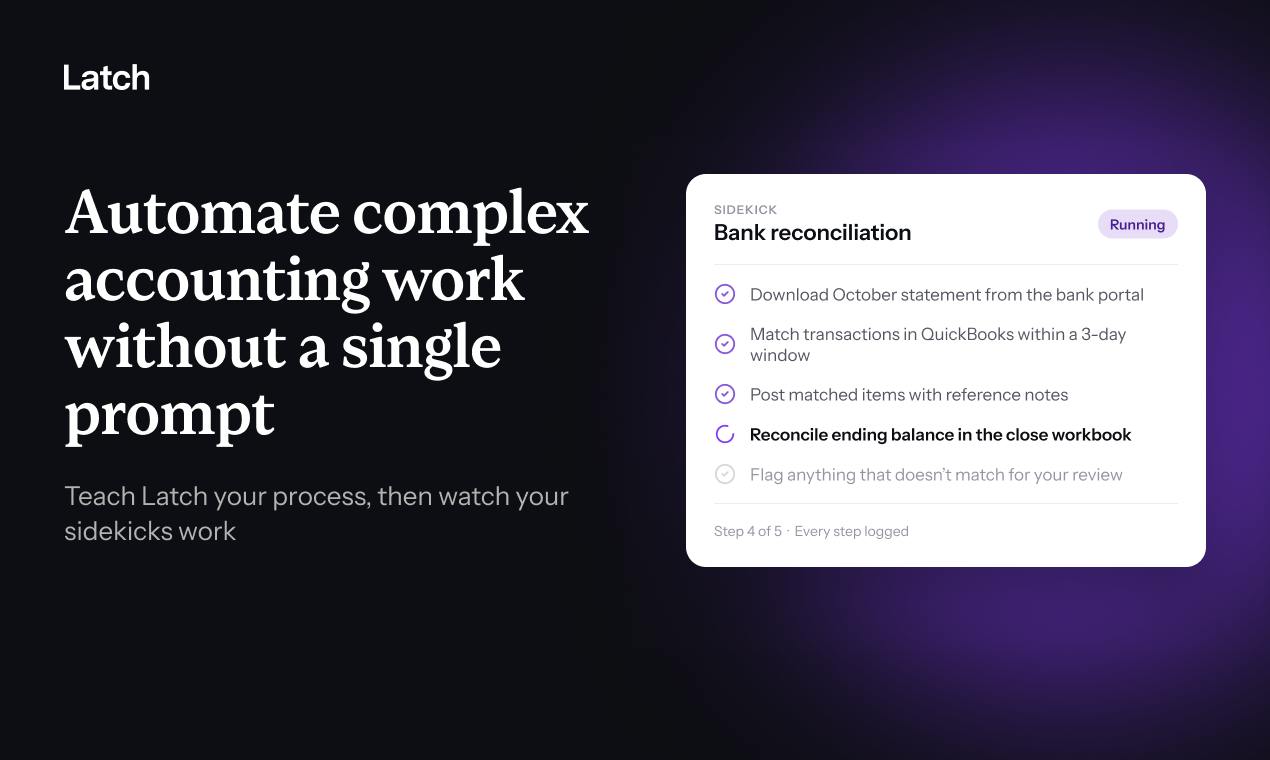
The key difference here is this: in accounting work, what really takes time often isn't the part with clear-cut rules, but the exception handling that "can't be written into the SOP" — for example, how to set a three-day matching window, or which exchange rate you always override manually. Traditional RPA requires these rules to be explicitly encoded, while prompt engineering struggles to carry this kind of tacit knowledge. Latch tries to capture this experience through "demonstration + narration."
Why Accounting Scenarios Need "Non-Prompt" Automation
The Tacit Knowledge Dilemma of Close Work
Accounting close is a highly experience-dependent process. Even for bank reconciliation, different companies and different periods may have completely different processing logic. The two examples mentioned in the product description illustrate this well: a three-day matching time window and a certain exchange rate you always override — these details won't appear in any standard operating manual, yet they are the key to whether automation can actually work.
Asking accountants to write these into prompts is neither realistic nor natural. Their knowledge lives in operating habits, not in natural language descriptions. Latch's approach is the reverse: first observe how you do it, then ask about exceptions during the process, and finally solidify it into a repeatable workflow.
Tacit Knowledge is an epistemological concept proposed by Michael Polanyi, referring to knowledge that is difficult to fully express through language, text, or symbolic systems — such as personal experience, intuition, and operational know-how. Its counterpart is Explicit Knowledge, which is codifiable and transferable. In accounting close scenarios, tacit knowledge manifests as habits for handling specific anomalies, intuitive judgments about exchange rate fluctuations, and flexible adjustments to matching windows. Traditional automation tools (such as RPA) require processes to be fully made explicit, yet tacit knowledge is precisely what's hard to enumerate as rules. Latch.ai's "demonstration + narration" method essentially captures tacit knowledge indirectly by observing behavior, then converts it into executable explicit rules — offering a new way to automate tacit knowledge.
Stop and Ask When Something Doesn't Match
The product emphasizes an important mechanism: when it encounters a situation that doesn't fit the established pattern, Latch stops to ask the user rather than guessing on its own. Every step is logged for review.
This is crucial for accounting scenarios. Errors in financial data are extremely costly, and an automation flow that "thinks it's smart" could create audit risk. Handing exception handling back to humans while preserving a complete operational trail is a pragmatic trade-off between efficiency and controllability.
Differences from Traditional RPA and Prompt-Based Tools
| Dimension | Traditional RPA | Prompt-Based AI Tools | Latch.ai |
|---|---|---|---|
| Configuration | Drag-and-drop flows, write rules | Write prompts | Demonstrate + narrate |
| Exception handling | Must be enumerated in advance | Relies on model judgment | Proactively stops to ask |
| Tacit knowledge | Hard to capture | Hard to express | Captured through dialogue |
| Runtime environment | Standalone client | Chat interface | Within existing tools |
Based on the product description, the "sidekick" Latch generates runs within the user's existing tools, rather than requiring users to migrate to a new platform. This lowers the psychological barrier to adoption and avoids the hassle of moving data between multiple systems.
RPA (Robotic Process Automation) is a technology that uses software robots to simulate human operations on graphical user interfaces and automate repetitive tasks. Traditional RPA typically requires developers or business users to configure rules by dragging flowcharts or writing scripts, with exception handling enumerated in advance, resulting in high maintenance costs when scenarios change frequently. In contrast, Latch.ai emphasizes generating automation flows directly through demonstration, with built-in exception inquiry. In addition, Prompt Engineering is the technique of designing input prompts to guide large language models toward desired outputs; its strength is flexible handling of unstructured information, but it struggles to precisely control multi-step business processes. Latch.ai attempts to combine the strengths of both: preserving the intuitiveness of demonstration while capturing exception rules through dialogue, thereby achieving balance in high-compliance scenarios like accounting.
Signals Worth Noting and Questions to Be Verified
On Product Hunt, Latch received 103 votes and ranked 3rd — a moderate-to-above-average level of attention. With only 5 comments, it's clearly still in an early stage, and community discussion remains limited.
A few points to watch going forward:
- Generalization to complex tasks: Does a single demonstration reliably reproduce multi-step, cross-system close workflows?
- Audit compliance: Is the granularity of operation logs sufficient to meet internal control and audit requirements?
- Tool ecosystem coverage: Which accounting software and ERP systems are currently supported determines its practical scope.
- The cost of exception inquiries: If exceptions frequently trigger questions, how much of the efficiency gain from automation will be offset by dialogue costs?
Audit compliance is critical in accounting automation, typically requiring operation logs to be tamper-proof, complete, and traceable. Specifically, logs need to record granular information such as operation time, operator, operation content, and values before and after data changes, and must prevent after-the-fact modification. In addition, automation tools compliant with regulations such as SOX (Sarbanes-Oxley Act) must support internal control mechanisms like segregation of duties and access control. Latch.ai claims that every step is logged, but whether its log granularity meets audit requirements (e.g., whether it records raw data snapshots, whether it supports third-party verification) remains to be verified. If logs only record high-level actions without details, they may fail internal and external audits, limiting adoption in strictly regulated environments.
Conclusion
Latch.ai's value proposition is clear: it doesn't require accountants to learn prompt engineering, but instead turns the "hand-holding" process they're most familiar with into executable automation. This direction hits the real pain point of accounting automation — the hard part isn't executing rules, but capturing the rules themselves. Whether the product can find a balance between complexity and controllability will determine whether it can move from "impressive demo" to "daily usable."
One-line Summary
Latch.ai captures accountants' tacit knowledge through demonstrated operations and narration to build repeatable automation workflows.
Paragraph Summary
Latch.ai is an automation tool for accounting close scenarios that abandons traditional prompt writing, allowing users to demonstrate tasks directly on screen and narrate the process to generate a repeatable "sidekick." The approach aims to capture tacit knowledge beyond the SOP, such as matching time windows and exchange rate override habits. When exceptions occur, Latch proactively asks the user rather than guessing, and every step is logged for review. Compared with traditional RPA that requires explicitly encoded rules and prompt-based tools that rely on model judgment, Latch seeks a balance between efficiency and controllability, and the generated workflows run within the user's existing tools, reducing migration costs. The product currently has 103 votes and ranks 3rd on Product Hunt, but with only 5 comments, it's still in an early stage. Its generalization to complex tasks, audit compliance, and the cost of exception inquiries are key areas to watch.
Related articles

OpenAI to Shut Down Agent Builder and Two Other Services on November 30, Developers Must Migrate Urgently
OpenAI will shut down Agent Builder, the evals dashboard, and reusable prompts on November 30; evals is already read-only. Here's the scope, OpenAI's migration paths (Agent SDK, PromptFu, your own code), and what developers should export and rebuild this week.
RankSpot: A Pay-Per-Use SEO & AI Search Execution Layer That Lets Agents Write, Publish, and Build Backlinks for You
RankSpot is an SEO & AI search execution layer for AI Agents. Connect via MCP to Claude or ChatGPT to write, publish & build backlinks. Pay-per-use, $3/article.

Appxiom: Giving AI Coding Assistants Production Context
Appxiom gives AI coding agents production context—crashes, jank, memory leaks, failed network calls—across Android, iOS, Flutter, KMP, and Web, ranking bugs by Goal Friction Impact.