Lathoa: The Children's Math App That Makes AI Deliberately Wrong — Teaching Kids Critical Thinking

Lathoa makes AI deliberately wrong to teach children critical thinking through active error-correction.
Lathoa is a children's math learning app whose core design casts AI as a fallible "companion" rather than an authoritative teacher, forcing kids into a "checker" role where they actively construct knowledge by catching mistakes. This approach aligns with the "learning by teaching" effect and the theory of "desirable difficulties" — showing that appropriate cognitive friction enhances long-term retention. The product also addresses a deeper competency for the AI age: helping children develop the critical awareness that AI isn't always right and needs independent verification. Its key technical challenge lies in calibrating error difficulty precisely enough to spark thinking without causing confusion. The product remains in early stages, with its interaction mechanics and real-world learning outcomes still to be validated.
A Counterintuitive Educational Product: AI That Deliberately Makes Mistakes
At a time when most edtech products chase the ideal of "AI that is always right and always delivers the correct answer," a children's math app called Lathoa takes the opposite approach — its core design is to make AI deliberately make mistakes. The product recently appeared on the Show HN section of Hacker News, and while discussion remains modest (11 upvotes, 1 comment), the educational philosophy behind it is well worth unpacking.
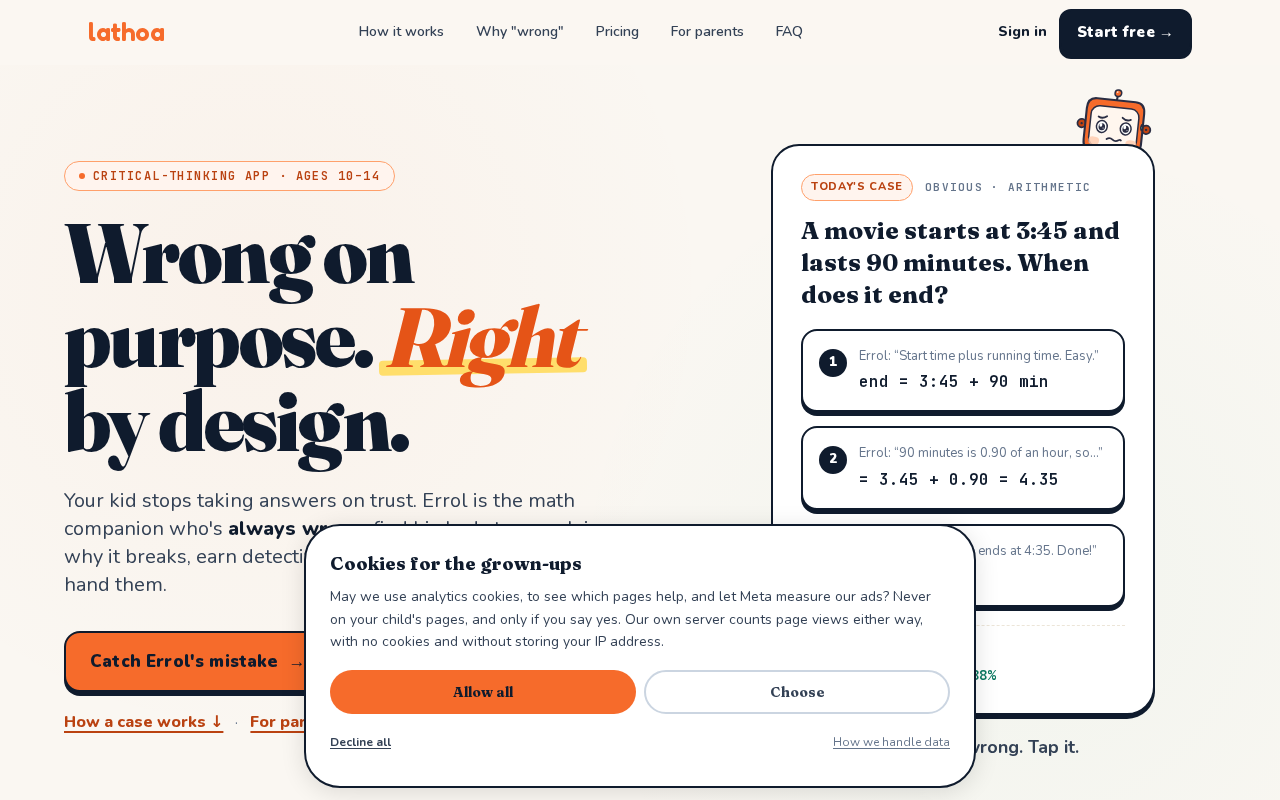
Lathoa positions itself as a math learning tool for children. Unlike traditional tutoring software that casts AI as an "all-knowing teacher," it shapes AI into a fallible "companion" — one that makes mistakes. Children are expected to catch those errors through active thinking and answer verification, thereby building critical thinking skills.
Why Make AI "Deliberately Wrong"?
This design isn't a gimmick. It strikes at a fundamental question in educational psychology: passive reception of answers vs. active construction of knowledge.
When children grow accustomed to asking AI questions and receiving correct answers immediately, learning tends to degrade into "copy-paste" memorization rather than genuine understanding. But when AI can be wrong, the child is forced into the role of "checker" — they must work out the problem themselves, evaluate whether the AI's result is reasonable, and then decide whether to accept it. This process of "teaching or correcting someone else" happens to be one of the most effective modes of learning (the so-called "learning by teaching" effect).
From a broader perspective, this also addresses a core competency for the AI era: how to collaborate with AI that may be wrong. It's well established that large language models can "hallucinate" — confidently producing incorrect information. Helping children develop the awareness that "AI isn't always right and needs to be verified" may carry more long-term value than simply learning to solve arithmetic problems.
The "learning by teaching" effect has a solid empirical foundation in cognitive science. Educational psychologist Edgar Dale's "Learning Pyramid" model suggests that retention from passive listening is around 5%, while "teaching others" yields retention as high as 90%. The mechanism behind this is that when learners must explain or correct errors for someone else, they are compelled to reorganize fragmented knowledge into a coherent logical chain. This metacognitive process forces the brain to process and encode knowledge at a deeper level. Lathoa's design embeds this principle directly into human-computer interaction — the act of a child correcting an AI's mistake is functionally equivalent to "explaining a problem to a peer," with the human peer replaced by a controllable, error-prone AI agent.
A Different Vision for Educational Technology
Lathoa's emergence reflects a growing divergence in how AI-powered educational products are designed.
The mainstream approach pursues "precision Q&A": whether it's photo-based problem search or AI tutoring, the goal is to deliver answers to students as quickly and accurately as possible. These products solve for "efficiency," but come with a widely criticized side effect — students become dependent and lose the ability to solve problems independently.
Lathoa represents a different path: turning AI's "imperfection" into a teaching resource. By deliberately introducing errors, the product keeps learners alert and engaged. This aligns closely with the "desirable difficulties" theory gaining traction in education circles — appropriate challenge and cognitive friction can actually deepen memory and understanding.
That said, this design requires careful calibration. The difficulty and frequency of errors must be precisely tuned. If the AI's mistakes are too obvious, children will spot them instantly and the exercise loses its value. If the mistakes are too subtle, they risk misleading beginners who haven't yet built a solid foundation. Designing "just-right errors" will be the core technical challenge — and competitive moat — for products like this.
The concept of "Desirable Difficulties" was introduced by cognitive psychologist Robert Bjork in the 1990s. His central argument is that certain obstacles that appear to slow learning actually produce significant improvements in long-term retention and knowledge transfer. Common examples include spaced repetition (instead of massed practice), interleaved practice (mixing problem types rather than drilling by category), and the testing effect (using recall instead of re-reading). What these methods share is that they create cognitive friction during learning, forcing the brain to actively retrieve and process information rather than passively receive it. Lathoa's use of deliberate errors essentially leverages the "generation effect" — producing the correct answer oneself leads to more durable memory than simply receiving it. This theoretical framework also explains why error difficulty must be carefully calibrated: errors that are too easy fail to activate deep processing, while errors that are too hard exceed cognitive load and create confusion instead.
A Product With Potential Yet to Be Proven
To be clear, Lathoa is still in its early stages and public information is limited. The discussion on Hacker News is small in scale, and there is little detailed disclosure about its specific interaction model, error-generation mechanism, or actual learning outcomes. Whether it relies on a preset library of erroneous problems or uses a large language model to dynamically generate flawed solutions remains unclear.
Nevertheless, the question this product raises is genuinely important: in an era where AI is growing ever more "intelligent," should we be teaching children how to work alongside an "agent that can be wrong"? The answer may lie not in making AI more perfect, but in keeping humans capable of independent judgment.
For practitioners following edtech and AI applications, Lathoa is an experiment worth watching. It reminds us that AI's optimal role in education may not always be "the provider of correct answers" — it can also be "a sparring partner that sparks thinking."
Related articles

OpenAI Reportedly Raising $30B at $1.25T Valuation Ahead of IPO
OpenAI is planning a $30B funding round at a possible $1.25T valuation, paving the way for an IPO. If completed, it would set a private company valuation record. This article analyzes the funding size, pre-IPO logic, and industry signals.

a16z Crypto Rebrands as a16z Frontier: Pivoting to Frontier Tech as Blockchain Investment Retreats
a16z's Chris Dixon-led crypto division rebrands from a16z Crypto to a16z Frontier, expanding into broader frontier tech. We analyze the blockchain investment retreat behind the rebrand and its impact on the crypto VC industry.

Next-Gen Xbox Could Cost Up to $1,800? The High-Price Strategy's All-In Gamble
Fortune reports the next-gen Xbox may launch in 2028 priced at $1,200–1,800. We analyze the market logic, competitive risks, and Microsoft's possible strategic pivot.