Next-Gen Xbox Could Cost Up to $1,800? The High-Price Strategy's All-In Gamble

Fortune says the next-gen Xbox may cost $1,200–1,800, sparking debate over the console business model.
Fortune reports that Microsoft insiders say the next-gen Xbox will arrive in 2028, possibly priced at $1,200–1,800, quickly sparking heated discussion. The console industry has long followed the 'razor and blades' model—hardware near cost, profits from software and subscriptions—and a sky-high console would break that convention. Most argue such a price is doomed due to competitor price anchoring, PC and cloud gaming alternatives, and historical lessons. Alternatively, Microsoft may no longer prioritize hardware sales, turning Xbox into a cross-platform service and ecosystem entry point.
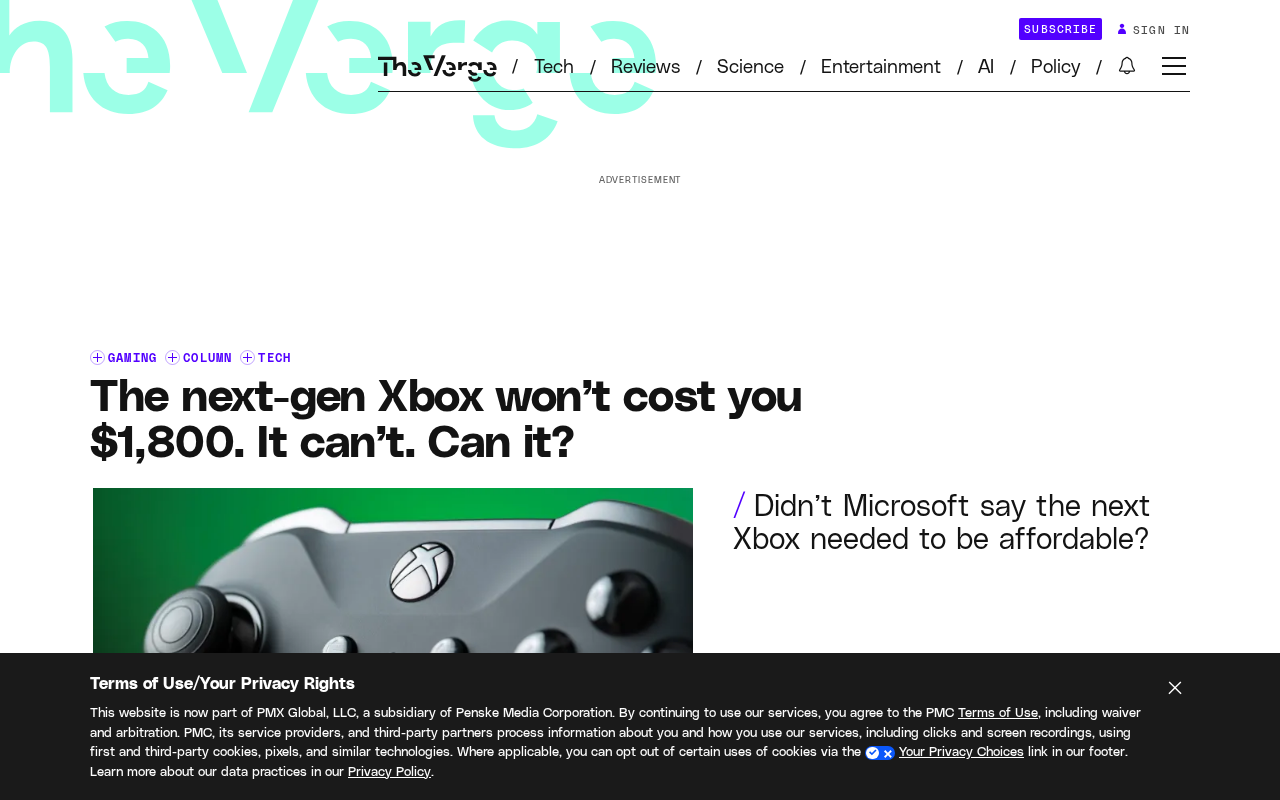
According to a blockbuster report published by Fortune this week, Microsoft insiders say the next-generation Xbox is expected to arrive in 2028, with a price tag possibly ranging from $1,200 to $1,800. That figure has left many gamers and analysts gasping—if true, the next-gen Xbox may well be "dead on arrival." But then again, doesn't Microsoft understand this better than anyone?
The Market Logic Behind a Sky-High Console
The console market has long followed the "razor and blades" model: hardware is sold at or near cost—sometimes even at a loss—with profits recouped through software and services. Sony's PS5 and Microsoft's Xbox Series X|S have both carried on this strategy. If the next-gen Xbox is priced starting at $1,200, it would completely upend industry convention.
But viewed from another angle, Microsoft may be playing a different game altogether. Game Pass has become the core of Microsoft's gaming business, while cloud gaming and cross-platform strategies continue to advance. Hardware may no longer be a profit center but rather an entry point into the ecosystem. Premium-priced hardware filters for high-net-worth users, who are then monetized over the long term through subscriptions and services—a model with precedent in the smartphone industry, but a first for consoles.
The "Razor and Blades" model is one of the most classic pricing strategies in the hardware industry. Its core logic: sell the "razor" (console hardware) at or below cost, then earn long-term profits by continuously selling "blades" (game software, online subscriptions, accessories, and platform cuts). Game consoles are a textbook example of this model—Sony and Microsoft have historically launched consoles with extremely low or even negative hardware margins, with real profits coming from the roughly 30% platform cut on each game sold plus subscription services like PlayStation Plus and Game Pass. This model only works when install base is large enough, because only a massive user base can spread out hardware losses and generate sustained software revenue. Once hardware pricing is too high and the install base falls short, the entire "blades" revenue model collapses. A console priced above $1,200 therefore not only breaks with pricing convention but fundamentally undermines the mathematical foundation of this business model.
Why It "Can't" Be That Expensive
Most analyses conclude that a console priced above $1,200 is doomed to fail. There are three reasons:
Competitor price anchoring: Sony's PS6 will most likely stay in the $500–600 range, and Nintendo's Switch 2 will be cheaper still. With such a wide price gap, consumers will make their choice quickly.
Substitutability of PC and cloud gaming: The same budget could build a respectable gaming PC or pay for a cloud gaming subscription. Once the console loses its "value for money" label, its core player base will drift away.
Historical lessons: The PS3's $599 launch price was once regarded as a disaster, and the Xbox One's $499 price tag put it on the back foot early on. $1,200 is more than double these "failure prices."
Price anchoring is a cognitive bias concept from behavioral economics: when making price judgments, consumers unconsciously use the first reference price they encounter as a benchmark. In the console market, this "anchor" is set jointly by competitors and previous-generation products: the PS5 launched at $399 for the digital edition and $499 for the disc edition, the Xbox Series X at $499, and the Switch 2 is expected to land around $400. When players' minds have already anchored "a console" in the $400–500 range, a $1,200 price tag produces a strong perception of "not worth it"—even if the hardware specs are superior. This is also why the PS3's $599 price was seen as a disaster at the time—it sat a full tier above consumers' psychological anchor, causing early sales to lag badly. The price anchoring effect means a sky-high console's failure may not stem from insufficient product strength, but from a cognitive framework already locked in by competitors.
Microsoft's Hidden Card: Maybe It Never Intended to Sell Hardware
Another possibility is that Microsoft's internal positioning of the next-gen Xbox has fundamentally changed. If hardware sales are no longer a KPI, Microsoft could launch a high-priced premium model while keeping cloud gaming and PC as the primary entry points. It's even possible Microsoft gradually exits the hardware race altogether, transforming the Xbox brand into a cross-platform service.
The Fortune report also noted that Microsoft declined to comment. Given that Xbox Series X|S sales trail the PS5, Microsoft does have motivation to change strategy. But a $1,200–1,800 price range is steep even for high-end PC handhelds like the ROG Ally—let alone a traditional console.
Cloud gaming refers to a service model in which game computation happens on remote servers and the visuals are streamed as video to the player's device. Representative products include Microsoft's Xbox Cloud Gaming (formerly xCloud), Nvidia GeForce Now, and Sony's PlayStation Plus cloud gaming. Its key significance lies in decoupling hardware from the gaming experience: players no longer need to buy an expensive console—just a controller, a TV or phone, and a stable connection. For Microsoft, cloud gaming is the technical foundation of its "play anywhere" strategy—if the experience can be detached from local hardware, the strategic necessity of expensive consoles drops substantially. This also lends technical plausibility to speculation that "Microsoft may deemphasize hardware and pivot to cross-platform services": once cloud streaming matures, the Xbox brand could exist as a service layer on TVs, PCs, phones, and even competitor platforms, no longer dependent on a single hardware box.
Player Reactions and Industry Impact
On social media, reactions have been almost unanimously skeptical. Some believe Microsoft is testing public opinion; others suspect the reported price may refer to dev kits or enterprise editions. Some also note that if inflation and supply chain costs keep rising through 2028, a console price hike isn't impossible—but not to this exaggerated degree.
Regardless of the truth, the report has already sparked discussion about the future of the console business model. As hardware performance gains hit diminishing marginal returns and subscriptions become mainstream, the traditional console pricing logic is bound to face challenges. Microsoft's next move may well set new rules for the entire industry.
One-line Summary
Fortune reports the next-gen Xbox may cost $1,200–1,800, sparking a major debate over the console business model.
Paragraph Summary
Fortune magazine reports that Microsoft insiders say the next-gen Xbox is expected in 2028, possibly priced at $1,200 to $1,800—a figure that has quickly ignited discussion among gamers and analysts. The article notes that the console industry has long followed the "razor and blades" model, selling hardware near cost and profiting from software and subscriptions, and that a sky-high console would completely break this convention. Most views hold that a console above $1,200 is doomed, citing price anchoring from Sony's PS6 and Switch 2, the substitutability of PC and cloud gaming, and historical lessons from the PS3 and Xbox One. But another possibility is that Microsoft no longer treats hardware sales as a core KPI, instead transforming Xbox into a cross-platform service and ecosystem entry point, with hardware merely filtering for high-net-worth users. Whatever the truth, the report has pushed the industry to rethink the future of the console business model.
Related articles

REA: Reverse Engineer Any App with AI, No Coding Required
REA is a viral open-source AI reverse-engineering tool that lets Claude, Codex, and other AI agents analyze any app and generate functional clones—no coding required. This article covers how it works, installation, a hands-on test, and legal risks.
2026 AI Coding Tools Comparison: Claude, ChatGPT, Gemini — Which Is the Best?
A 2026 comparison of five mainstream AI coding tools — Claude Code, ChatGPT Codex, Gemini, DeepSeek, and GitHub Copilot — on real projects, pricing, and code quality, to help you decide where that $20/month should go.

ChatGPT Codex Can Clone Any Software? Testing the Risks and the Truth
YouTube shorts claim ChatGPT Codex or Claude Code can clone Adobe, Excel, and Figma for lifelong free use. We break down the feasibility, legal risks, and DM-funnel tactics—and explain what AI coding tools are truly good for.