Laya Open-Source Decision Model: How 421M Parameters Beat Jev Benchmarks
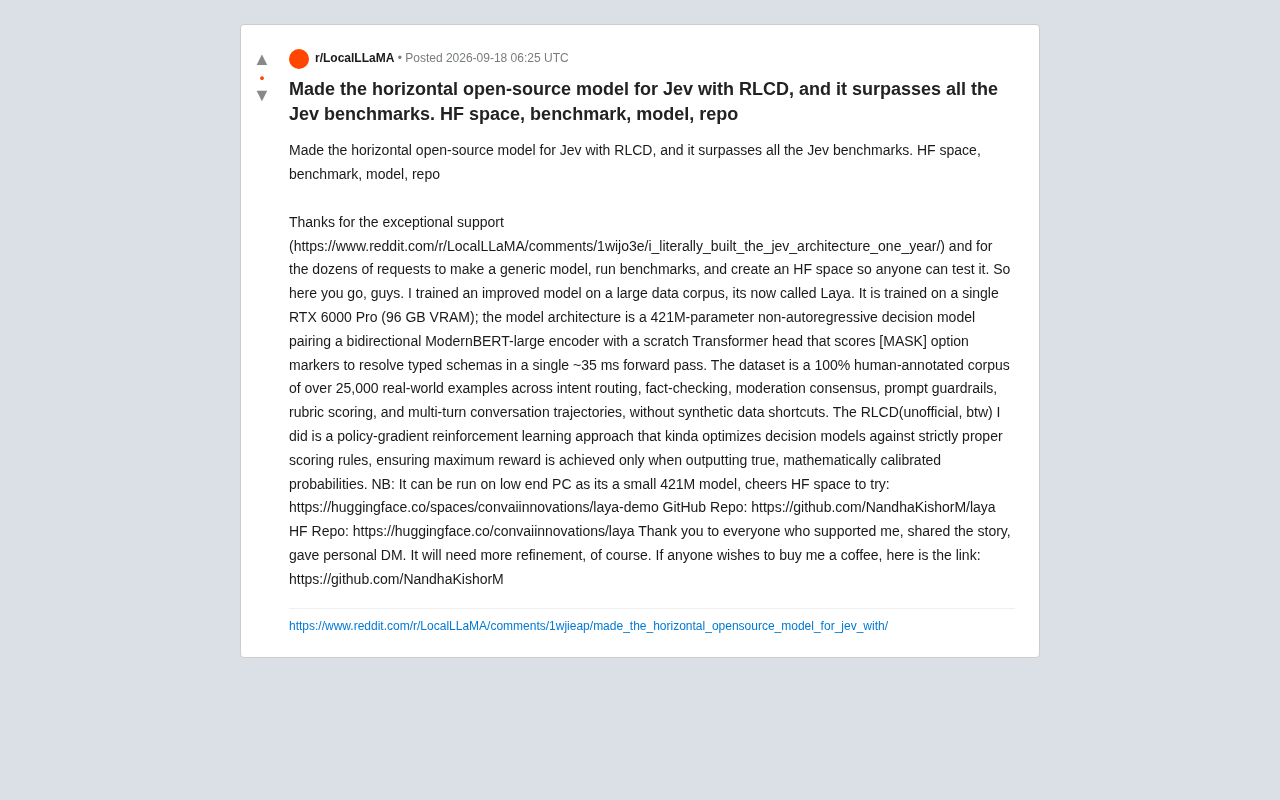
Laya is a 421M open-source decision model that beats Jev benchmarks using RLCD and 25K human-annotated samples on a single GPU.
Laya is a 421M-parameter non-autoregressive decision model developed by a solo developer, iterating on the Jev architecture and trained entirely on a single RTX 6000 Pro (96GB VRAM). It pairs a bidirectional ModernBERT-large encoder with a from-scratch Transformer head to score `[MASK]` option tokens in ~35ms per forward pass, enabling deployment on low-end hardware. Training data consists of over 25,000 fully human-annotated real-world samples across intent routing, fact-checking, and content moderation tasks. The RLCD training method uses policy-gradient RL against strictly proper scoring rules to produce mathematically calibrated probabilities rather than hard labels. Laya is fully open source and serves as a practical reference for lightweight decision model deployment.
A developer shared an open-source decision model called Laya in Reddit's LocalLLaMA community. Built on the Jev architecture that previously attracted significant attention, this model surpasses several Jev benchmarks through the RLCD training method while maintaining an extremely small footprint and low hardware requirements. For developers interested in lightweight AI deployment, this is a practical case study worth exploring.
From the Jev Architecture to Laya
This model traces its origins to the Jev architecture the author built a year ago. The earlier post generated strong community interest, with many users requesting a general-purpose model, benchmark results, and a HuggingFace Space anyone could try. In response, the author trained an improved model on a larger corpus of data and named it Laya.
Notably, the entire training process was completed using a single RTX 6000 Pro (96GB VRAM). Compared to large model training that typically demands clusters of dozens or even hundreds of GPUs, Laya demonstrates a viable path under resource-constrained conditions.
Non-Autoregressive Architecture Design
At its core, Laya is a 421M-parameter non-autoregressive decision model. Its architecture pairs a bidirectional ModernBERT-large encoder with a Transformer head trained from scratch, scoring [MASK] option tokens to parse typed schemas — all within a single forward pass of approximately 35 milliseconds.
This design differs fundamentally from mainstream autoregressive generative models. Autoregressive models generate output token by token, whereas Laya completes decision scoring directly in a single forward pass. This is the key reason it can run on a low-end PC — the 421M parameter count combined with non-autoregressive inference makes edge deployment feasible.
Use Cases for Decision Models
Laya is positioned as a "decision model" rather than a general-purpose generative model, which defines its scope of applicability. According to the author, the model focuses on structured decision tasks including intent routing, fact-checking, content moderation consensus, prompt guardrails, rubric scoring, and multi-turn dialogue trajectory analysis. These tasks typically require fast, calibrated judgments rather than open-ended text generation.
ModernBERT is an encoder architecture released in late 2024 — a modernized evolution of classic BERT that introduces Rotary Position Embeddings (RoPE), Flash Attention, and other techniques. It dramatically improves inference efficiency and long-context handling while retaining the bidirectional attention mechanism. Bidirectional attention means the model can see context on both sides of each token simultaneously, in stark contrast to GPT-style unidirectional (left-only) autoregressive designs. For classification and scoring tasks, bidirectional encoders are naturally better suited to understanding the full semantic content of an input without needing to "predict" the next word step by step. Laya leverages this property by combining the encoder output with a lightweight Transformer head, specifically designed to score and rank
[MASK]positions among candidate options rather than generating free-form text.
25,000 Samples of Purely Human-Annotated Data
One of Laya's distinguishing features is the composition of its training data. The entire corpus contains over 25,000 real-world samples, 100% human-annotated, spanning multiple dimensions including intent routing, fact-checking, moderation consensus, prompt guardrails, rubrics, and multi-turn dialogue trajectories.
The author explicitly emphasizes that no synthetic data shortcuts were taken. Against a backdrop where many models rely on synthetic data to expand training sets, purely human-annotated data tends to be of higher quality — especially for decision tasks, where annotation accuracy directly impacts the reliability of the model's judgments. This may also be one of the key factors behind Laya's ability to surpass Jev benchmarks.
The RLCD Training Method Explained
Laya uses what the author calls an "unofficial" RLCD training method — a policy-gradient reinforcement learning approach designed to optimize decision models against strictly proper scoring rules.
The core idea is that the model only receives maximum reward when it outputs genuine, mathematically calibrated probabilities. This design ensures the model not only makes correct decisions but also produces trustworthy confidence estimates. For tasks like fact-checking and content moderation that require probability calibration, this property is especially valuable — a model that can accurately express "how certain I am" is far more practically useful than one that only delivers black-or-white conclusions.
Strictly Proper Scoring Rules are a classical concept in probabilistic forecasting. They refer to a class of scoring functions where a forecaster can only expect to achieve the maximum score by reporting their true subjective probability. Common examples include the Log Score and the Brier Score. "Strictly proper" ensures the model has no incentive to inflate or deflate its confidence — deliberately reporting distorted probabilities only lowers expected score. RLCD incorporates this mathematical property into the reinforcement learning training loop as a reward signal to shape model behavior, causing the model to learn to output probability calibrations that "mean what they say," rather than simply chasing hard-label classification accuracy. The difference from traditional cross-entropy loss training is that cross-entropy encourages the model to push the correct class probability toward 1, but does not guarantee that the output probabilities statistically align with true empirical frequencies.
Open-Source Resources and Demo
The author released this project as fully open source, providing multiple entry points for the community to explore and experiment:
- HF Space demo: huggingface.co/spaces/convaiinnovations/laya-demo
- GitHub repository: github.com/NandhaKishorM/laya
- HuggingFace model hub: huggingface.co/convaiinnovations/laya
The author also candidly acknowledges that the model still needs further refinement. As a project completed by a solo developer with limited hardware resources, Laya demonstrates what's possible with lightweight decision models — not chasing an arms race of parameter counts, but achieving efficiency and reliability on targeted tasks through thoughtful architecture design, high-quality human-annotated data, and innovative training methods.
For developers who need to deploy decision logic on edge devices or in low-cost environments, Laya offers a compelling open-source reference worth studying.
Related articles
OpenCode Complete Guide: Installation, Configuration & Practical Usage
A complete guide to OpenCode, an open-source AI coding tool: desktop and WSL installation, model and rule configuration, agent types, custom commands, MCP integration, and Agent SQL reuse.
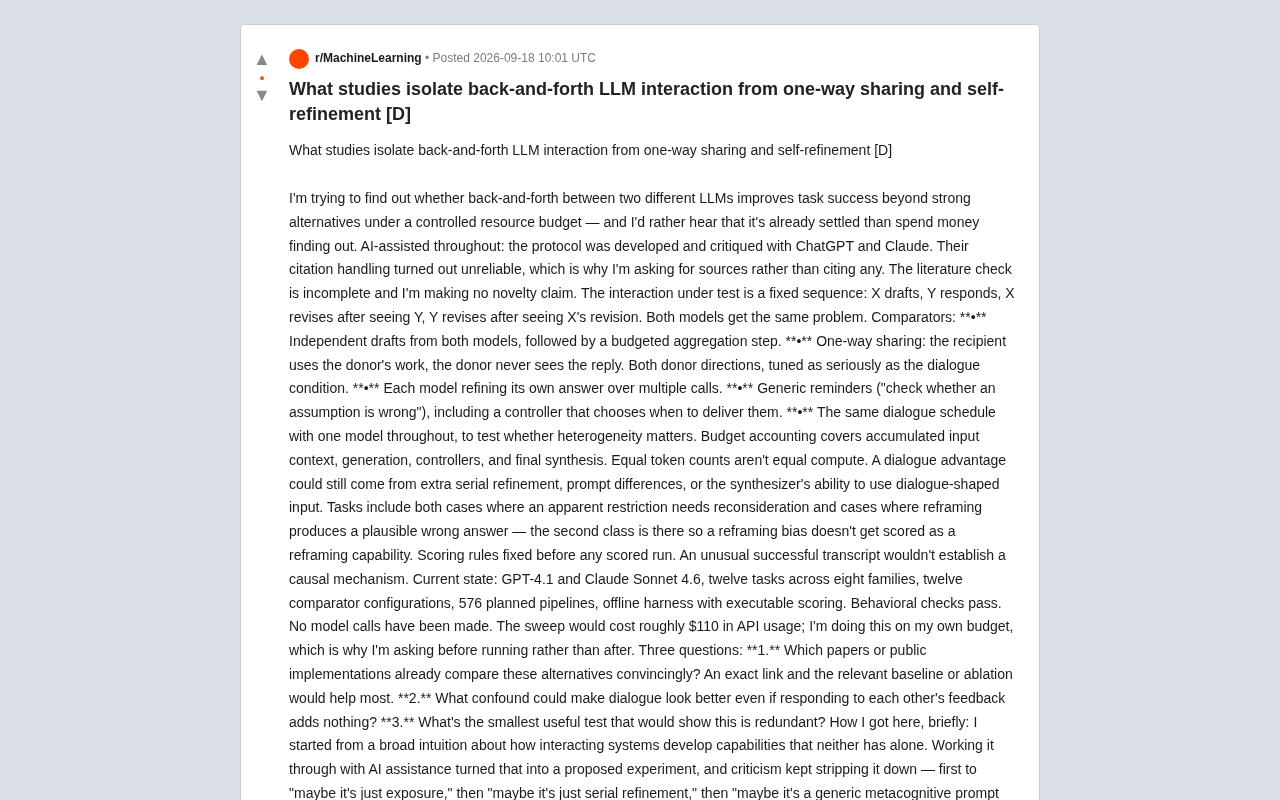
Can Multi-LLM Dialogue Really Improve Task Performance? Lessons from a Rigorous Experimental Design
A researcher designed rigorous controlled experiments to isolate whether multi-LLM back-and-forth dialogue genuinely outperforms simpler baselines like self-refinement and one-way sharing.

Which $10 AI Coding Plan Should You Choose? Go vs. Code Credit Breakdown
After DeepSeek's price hike, should you pick Go or Code for your $10 AI coding plan? We break down credit allocations for Mimo, Qwen, DeepSeek V4, Kimi, and more.