Laytr: The All-in-One Read-Later App That Goes Beyond Articles

Laytr expands read-later into a unified, multi-format content archive for the Apple ecosystem.
Laytr is a content-saving app built for Apple devices, designed to fix the fragmentation of digital collecting. Unlike traditional read-later apps like Pocket and Instapaper, it supports articles, recipes, screenshots, videos, and PDFs in one unified inbox. Its two core principles are privacy — archives stay private and aren't used for data monetization — and seamless sync across all Apple devices. Laytr targets heavy Apple users who consume diverse content and value privacy, representing the evolution of read-later from "articles only" to "everything" — though it currently remains Apple-exclusive.
Redefining "Save for Later"
Many people share a familiar habit: while browsing the web, they stumble across a long-form article worth reading carefully, a recipe they want to try, or a valuable video — and they save it with the intention of coming back later. But reality rarely cooperates. These items end up scattered across browser bookmarks, note-taking apps, and chat histories, eventually sinking without a trace.
Laytr was built to solve exactly this problem of fragmented digital collecting. It's a content-saving app for the Apple ecosystem, designed to give users one unified place to archive anything they discover online — ready to revisit whenever they have time.
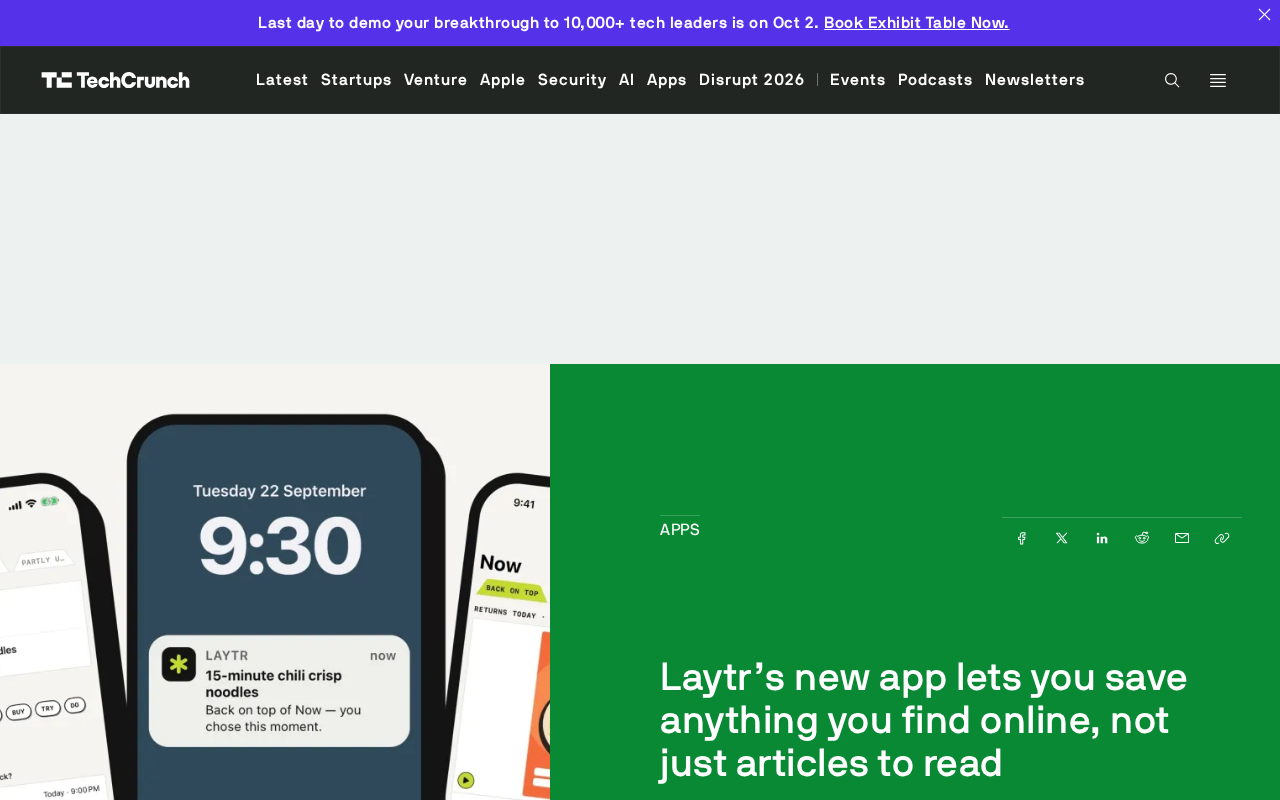
Not Just Articles — "Any Content"
Compared to traditional read-later tools like Pocket and Instapaper, Laytr's biggest differentiator is how far it extends the boundaries of what you can save. Those earlier apps were designed primarily around reading articles. Laytr supports a much broader range of content types:
- Articles: Still a core use case — long reads, news, and blog posts can all be archived in one tap
- Recipes: Save cooking ideas to browse whenever you need them
- Screenshots: Archive image-based information instead of letting it get lost in your photo library
- Videos: Bookmark video content you want to watch later
- PDFs: Centralize documents and reference materials
- And more
This "broad and comprehensive" design philosophy positions Laytr as a universal inbox for everything users discover online, rather than just a reading app. For people who habitually collect information across different media formats, this kind of consolidation can significantly reduce the overhead of managing it all.
Pocket and Instapaper are the defining products of the read-later category, both launching in the late 2000s to early 2010s. Their core capability was "parsing and reformatting article text" — stripping away ads, navigation bars, and other distractions from web pages to present clean, readable content ideal for focused reading. This design is inherently text-centric, and support for non-text content like images, video, and PDFs has always been limited. After Mozilla acquired Pocket in 2017, its feature development became more conservative; Instapaper has long catered to a niche audience. This structural gap is precisely the opening that "generalist content-saving" tools like Laytr are moving into.
Privacy-First and Cross-Device Sync
Laytr emphasizes two key product principles: privacy and sync.
User archives are private — a feature that matters more than ever as data privacy concerns continue to grow. Many free read-later services monetize by analyzing user reading data. Laytr's commitment to keeping archives private signals a greater respect for users' control over their personal data.
At the same time, Laytr keeps content synchronized across all of a user's Apple devices. Whether you save something quickly on iPhone and want to revisit it later on iPad or Mac, everything stays in sync seamlessly. This deep integration with the Apple ecosystem ensures a smooth, consistent experience — but it also means Android and Windows users are currently left out.
Laytr's sync infrastructure is almost certainly built on iCloud as its underlying storage and sync backbone. iCloud's advantage lies in its native, deep integration with iOS, iPadOS, and macOS — offering low-latency sync with virtually zero setup friction. Its end-to-end encryption also aligns well with Laytr's privacy-forward positioning. For developers, relying on iCloud means no need to build and maintain custom servers or sync protocols, freeing them to focus on product features — though it also inherits iCloud's regional limitations, such as restricted access on the Chinese mainland. This is the classic trade-off of committing deeply to the Apple ecosystem.
Who Is It For?
Laytr's target user is fairly well-defined: people who rely heavily on Apple devices, consume large amounts of information, and care about privacy.
If you regularly encounter content worth saving across different contexts — a deep-dive article during your commute, a video a friend shared, a PDF someone sent over — but struggle because there's no single place to manage it all, then Laytr's combination of multi-format archiving + cross-device sync + private storage is a compelling proposition.
That said, if you only need to save plain text articles, there are already plenty of mature, free options available. And if your devices span multiple operating systems, Laytr's current focus on Apple platforms may be a dealbreaker.
A New Variable in the Read-Later Space
The read-later category is nothing new — Pocket, Instapaper, and others have been around for years. But as content formats have grown increasingly diverse — short videos, photo essays, documents, and audio all intermingled — users' saving needs have long outgrown the "read an article" paradigm.
Laytr's approach represents the natural evolution of this category: upgrading from "read later" to "handle everything later." It's a bet on users' desire for a unified, cross-format, privacy-respecting, strongly synced collection hub. Whether it can carve out a lasting place in a competitive tools market will depend on future feature development and user adoption — but the product thinking behind it is worth watching.
Related articles

Gaussian Process Bandit Optimization: Exploration Strategies and Inference Regret Guarantees
Cumulative regret guarantees in Bayesian optimization fail to reflect final recommendation quality. This article examines a new study that provides inference regret guarantees for Gaussian process bandit optimization through exploration query strategies and fill distance analysis, validated on hyperparameter optimization and control tasks.

The Most Detailed Codex Guide on Bilibili: From Installation to Real-World Practice
The most detailed Codex guide on Bilibili: from app store installation to daily work mode configuration, with a real coffee shop project demonstrating file organization, data extraction, dashboard creation, and other practical tasks. Learn to use Plan Mode and desktop pets to leverage Codex efficiently.

Appearance Compensation in Volume Rendering: Why RGB Accuracy Cannot Guarantee Density Correctness
Volume rendering research reveals that volumetric data perfectly reproducing external RGB views may still contain density errors: appearance compensation can double central density and keep external rays unchanged even when L2 error exceeds 14.52%. Density recovery depends on appearance capacity, spatial resolution, and measurement design.