Learning Calculus with Julia: A New Open-Source Math Textbook Option
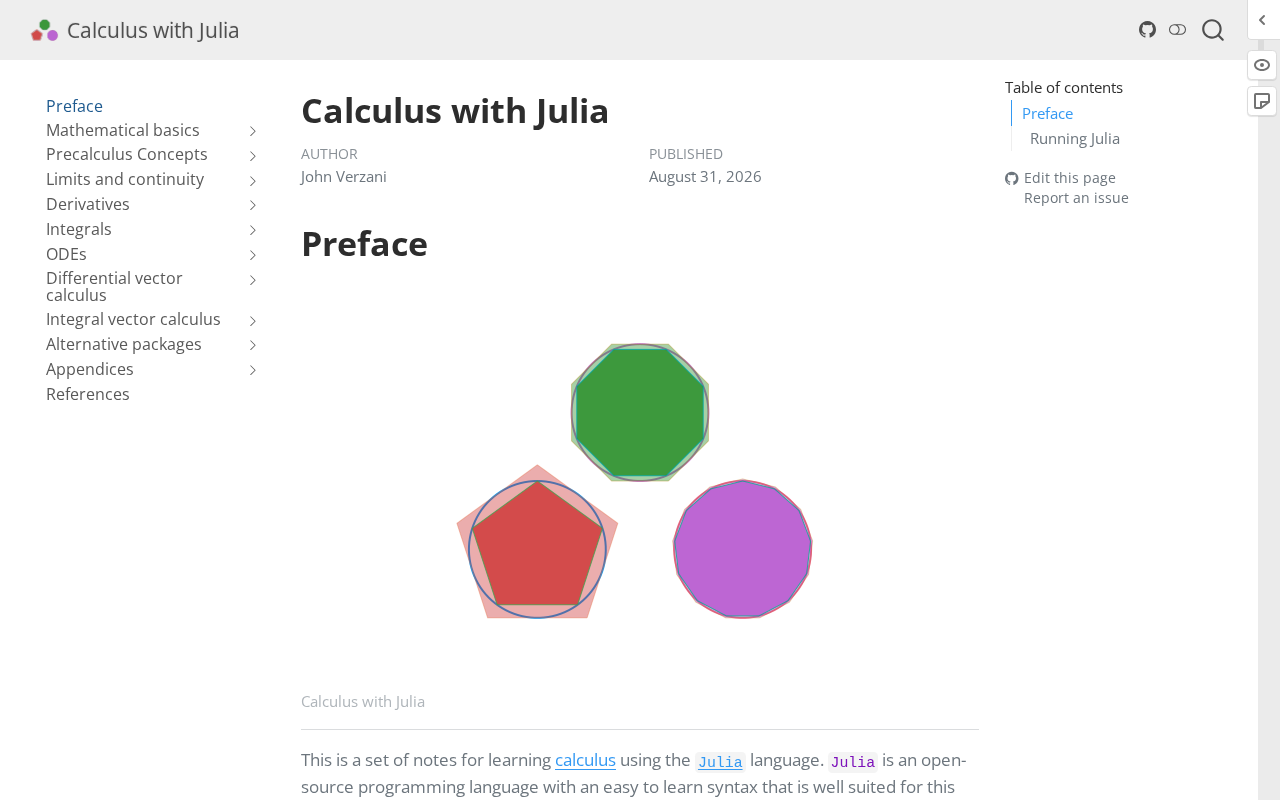
"Calculus with Julia" is an open-source interactive calculus textbook that blends Julia code with mathematical concepts.
"Calculus with Julia" is an open-source project that integrates the high-performance Julia language into calculus instruction, bridging the gap between symbolic derivation and computational practice. Julia's near-C speed and math-like syntax, paired with libraries like SymPy.jl and Plots.jl, make it a stronger fit than Python's multi-library stack for symbolic computation, numerical integration, and visualization. Released as a free, open-source resource, the textbook supports interactive learning in Jupyter or Pluto notebooks and is ideal for students, instructors, and developers seeking to strengthen their math foundations — with a learning path that scales seamlessly from introductory calculus to research-grade numerical computing.
Julia Enters the Calculus Classroom
In the world of scientific computing, Julia has been gaining traction as a popular tool for numerical computation and education — offering performance close to C with usability approaching Python. An open-source project called "Calculus with Julia" is attempting to bring this high-performance language into calculus instruction, providing students and self-learners with a math learning resource deeply integrated with hands-on coding.
The significance of such a project lies in a common limitation of traditional calculus textbooks: they tend to focus purely on symbolic derivation, requiring learners to turn to separate computational tools to visualize abstract concepts. By tightly coupling the textbook with Julia, readers can run code as they read — directly observing function plots, differentiation results, and the convergence behavior of numerical integration.
Why Julia Instead of Python
Calculus instruction heavily involves symbolic computation, numerical approximation, and visualization. Julia has a mature ecosystem for all of these: SymPy.jl supports symbolic calculus, Plots.jl provides a unified plotting interface, and libraries like QuadGK.jl handle numerical integration efficiently. Compared to assembling NumPy, SciPy, Matplotlib, and SymPy in Python, Julia's syntax reads far more like mathematical notation.
For example, defining a function and computing its derivative in Julia can be written in a way that closely mirrors what you'd write on a blackboard. This "what you see is what you write" quality reduces the cognitive load that beginners spend on programming syntax, freeing them to focus on the math itself.
The Teaching Advantage of Performance
Julia's JIT compilation means that numerically intensive tasks — such as high-resolution sampling for plots or iterative approximation — run quickly, without language performance slowing down a classroom demonstration. For students who want to go further into numerical methods or differential equation solvers, the same toolchain scales from introductory coursework all the way to research-grade computation, creating a coherent learning path.
The core difference between Julia and Python comes down to design philosophy: Python is a general-purpose scripting language that relies on C/Fortran extension libraries (NumPy, SciPy) to compensate for performance limitations; Julia, by contrast, was designed from the ground up with "high-performance numerical computing" as its primary goal. Code written in pure Julia can approach C-level execution speed, eliminating the need to choose between "readable but slow" and "fast but cryptic" — a challenge commonly known as the "two-language problem." For calculus instruction, this means there is no stylistic gap between example code in the textbook and real-world research code. Students won't learn a "slow pedagogical style" only to have to relearn everything later.
JIT (Just-In-Time Compilation) is central to Julia's performance. Unlike Python, which interprets code line by line, Julia compiles a function into machine code optimized for the current data types on its first call; subsequent calls execute the compiled result directly. This means Julia programs typically experience a brief "warm-up" delay on first run, but repeated computations afterward significantly outpace interpreted languages. In a teaching context, this makes it practical to render high-resolution function plots or demonstrate Monte Carlo integration in a matter of seconds — without breaking the flow of thought while waiting for results. Reactive notebook environments like Pluto.jl can even redraw plots in real time as you drag a parameter slider, making abstract concepts like limits and convergence intuitively tangible.
The Value of Open-Source Textbooks
"Calculus with Julia," as an open-source project, is freely available for anyone to access, modify, and contribute to. This model allows the textbook to stay continuously updated alongside the evolving Julia ecosystem, and makes it easy for instructors to adapt and remix the content for their own courses.
For universities and self-study communities alike, free and executable interactive textbooks are becoming an increasing trend. They lower the cost of education while naturally blending the study of mathematics with the study of programming — cultivating a combined ability to solve mathematical problems through computational thinking.
Who It's For, and How to Get Started
This resource is well-suited for three groups: students currently studying calculus who want to deepen their understanding through code; instructors looking to incorporate computational tools into their courses; and developers with some programming background who want to strengthen their mathematical foundations.
The barrier to entry is low. Simply install Julia, follow the textbook's instructions to set up the relevant packages, and you can read and experiment locally or inside a Jupyter or Pluto notebook. As you grow more comfortable with the language and libraries, you can progressively move from foundational topics — limits, derivatives, integrals — into more advanced territory like multivariable calculus and numerical analysis.
Jupyter and Pluto are two common interactive notebook environments, but they serve slightly different purposes. Jupyter Notebook supports Julia via the IJulia.jl kernel, with an interface identical to what Python users already know, making it a natural choice for anyone already familiar with Jupyter. Pluto.jl, developed specifically within the Julia community, is a reactive notebook: it tracks dependencies between cells, so modifying a variable automatically re-executes all cells that depend on it. This makes it ideally suited for the kind of calculus intuition-building that involves "change a parameter, observe the effect." For learners new to Julia, Pluto's immediate feedback often provides a smoother and more exploratory experience.
Closing Thoughts
"Calculus with Julia" represents an effort to integrate a high-performance scientific computing language into foundational mathematics education. It is more than just a textbook — it is a bridge connecting mathematical concepts with programming practice. For learners who value both efficiency and depth, this is an open-source resource worth exploring.
(Note: This article is based on publicly available information about the open-source project. For specific content, please refer to the project's official documentation.)
Related articles

Random Pruning of the DPO Computation Graph: 1.4x Training Speedup and Lower Peak Memory
DPO training too slow and memory-hungry? This paper proposes a random pruning framework for the DPO computation graph, sampling independently across position, sequence, and branch dimensions; branch pruning achieves a 1.426x step-time speedup and cuts training time by about 30%, with in-depth attribution of memory and time gains.

Why Does JEPA Underperform MLM in Longitudinal EHR Representation Learning?
New study compares JEPA and MLM for longitudinal EHR representation learning on MIMIC-IV: three JEPA variants train stably without collapse but underperform MLM; target size, not heterogeneity, drives prediction error.

Transfer Learning + Visible Light Communication: A New Approach to Energy-Efficient Indoor Positioning
A study proposes a transfer learning-based visible light communication indoor positioning method, achieving 47% accuracy improvement on the BOSCH factory dataset, 67.5% model efficiency under high noise, and introducing the ME composite metric for energy-efficient positioning in energy-constrained industrial IoT scenarios.