Learning When to Commit from Partial Speech: A Breakthrough in End-to-End Simultaneous Speech Translation

Prefix supervision teaches speech LLMs when to commit in simultaneous translation, cutting calibration error up to 80%.
This paper addresses the core challenge in Simultaneous Speech Translation (SimulST) — when to commit translated output — via self-supervised prefix supervision fine-tuning that requires no human transcriptions or translations. Comparing single-turn forced-prefix and multi-turn append-only decoding, the latter proves superior in low-latency settings, reducing overall commit-calibration error by 63–68% and up to 80% on the hardest early-prefix stage. Confidence thresholds emerge as the most versatile quality-latency tuning lever at inference time, while training prefix synthesis density exhibits non-monotonic trade-offs requiring careful calibration. Results are validated across three language directions on FLEURS and CoVoST2.
The Core Challenge of Simultaneous Speech Translation: When Should You Speak Up?
Simultaneous interpretation has an inherent contradiction — you must produce useful target-language text before the speaker has finished talking, while being unable to take back anything you've already committed. This is the fundamental challenge of Simultaneous Speech Translation (SimulST): racing against time to minimize latency while ensuring every committed word is accurate.
A new study published on arXiv (arXiv:2610.02612v1) tackles this problem head-on. The researchers propose a prefix supervision-based approach that teaches a speech language model — originally designed to handle complete utterances — to determine "when to commit output" from incomplete speech waveforms. Crucially, the entire method requires neither text transcriptions nor human translations; the training signal comes entirely from the model's own translations of complete versus partial waveforms.
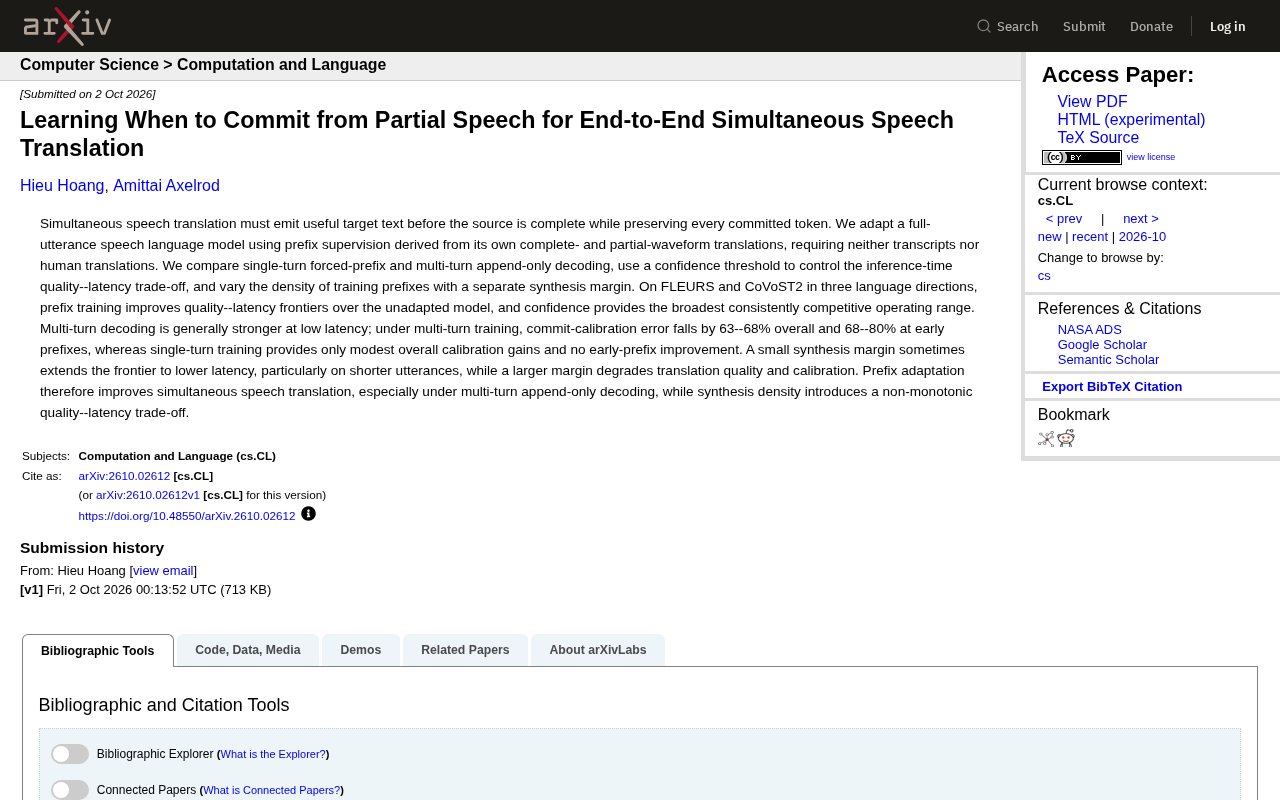
Simultaneous Speech Translation (SimulST) is a subfield of speech translation, distinct from offline speech translation (Offline ST) — the latter waits for a complete sentence before translating, while the former must produce real-time output as the speaker continues talking. SimulST system performance is typically measured along two dimensions: translation quality (commonly using BLEU scores) and latency (commonly using Average Lagging (AL), Differentiable AL, and similar metrics). These two naturally conflict, forming a quality-latency frontier curve. Traditional SimulST systems rely on explicit "read/write" policies to determine when to commit output — classic mechanisms like CIF and MMA being prime examples. This paper takes a different approach, embedding the learning of "commit timing" into the fine-tuning process of a Speech-LLM through prefix supervision, allowing the model to internalize this decision rather than depending on external rules.
The Method's Core: Using the Model's Own Output as a Teacher
The elegance of this work lies in its data sourcing. Traditional translation model training depends on large parallel corpora and human annotations, whereas this study employs self-supervised prefix supervision: the speech language model first translates both the "complete waveform" and "partial waveforms" separately, then uses these self-generated translations as training targets to fine-tune the model.
This means the model learns one thing — when faced with speech that hasn't finished yet, which words should it commit and which judgments should it hold back? This approach significantly reduces data acquisition costs and makes the method more transferable to language directions that lack annotated resources.
Two Decoding Strategies Go Head-to-Head
The study compares two key decoding approaches:
- Single-turn forced-prefix: A prefix is forced during a single decoding pass.
- Multi-turn append-only: Output is incrementally appended across multiple turns, with previously committed content unchanged.
Experimental results show that multi-turn append-only decoding performs better overall in low-latency scenarios. This is intuitive — the incremental append approach more closely mirrors the actual rhythm of simultaneous interpreting, allowing the model to robustly extend its output as information gradually accumulates.
The core idea of prefix supervision comes from how prefixes are handled in sequence-to-sequence models. Given a complete translation $Y$ of length $n$ words corresponding to complete speech, all prefixes of that translation ($Y_{1:1}, Y_{1:2}, \ldots, Y_{1:n}$) can serve as training targets with varying amounts of information. When the model sees only partial speech (a speech prefix), the ideal output should be the segment of the complete translation that "aligns" with the current information level. The self-supervised trick: use the same model to infer from both complete and partial waveforms, using the complete waveform's translation as a reference, thereby automatically constructing "partial input → partial output" training pairs without requiring human annotation of which words should be committed at which time points. This approach resembles knowledge distillation — a "teacher" model (complete waveform translation) guiding a "student" model (partial waveform translation).
Confidence Threshold: The Lever for Balancing Quality and Latency
Simultaneous translation can never escape the quality-latency trade-off. The longer you wait with more complete information, the better the translation quality — but latency grows. The reverse risks errors from insufficient information.
The study introduces a confidence threshold to dynamically adjust this trade-off at inference time. Experiments show that the confidence mechanism provides "the widest and most consistently competitive operating range" — in other words, whether you favor low latency or high quality, confidence-based control delivers relatively stable performance. This makes it the most practical tuning lever for real-world deployment.
Key Numbers: Commit-Calibration Error Drops Substantially
The most compelling numbers in this study come from improvements in commit-calibration error.
Under the multi-turn training mode:
- Overall commit-calibration error drops by 63%–68%;
- For early prefixes (the phase where speech has just begun and information is most scarce), the drop reaches 68%–80%.
By contrast, single-turn training only yields "moderate" overall calibration improvement and no improvement whatsoever on early prefixes. This contrast is significant: the hardest, most error-prone moments in simultaneous translation are precisely at the beginning — and multi-turn training achieves its largest gains at exactly this most critical juncture.
The study validates these findings across FLEURS and CoVoST2 datasets in three language directions, demonstrating that the method has meaningful cross-lingual generalization capability.
Commit-calibration error is an evaluation metric introduced in this paper to measure the degree to which a model commits translation words too early or too late. Specifically, if the model outputs a large amount of translated text after receiving only a small amount of speech (overly aggressive), it may later produce errors it cannot retract due to insufficient information; if the model consistently waits for more speech before outputting (overly conservative), latency becomes excessive. Lower calibration error means the model's commit timing more precisely matches the actual available information. FLEURS is a multilingual speech dataset released by Google covering 102 languages, commonly used to evaluate cross-lingual generalization in speech recognition and translation; CoVoST2 is a large-scale speech translation dataset built on Mozilla Common Voice, covering multiple language pair translation directions. Together, they provide a fairly comprehensive picture of a method's robustness.
Synthesis Density: A Double-Edged Sword
The study also examines the impact of training prefix density, introducing an independent synthesis margin parameter.
The findings exhibit clear non-monotonic behavior:
- Smaller synthesis margins can sometimes push the quality-latency frontier toward lower latency, especially for shorter sentences;
- Larger synthesis margins simultaneously hurt both translation quality and calibration performance.
This reminds practitioners that more synthetic data is not always better — density requires careful tuning, or it will backfire.
Synthesis margin controls the size of the "buffer zone" preserved between the truncation point and actual word boundaries when generating training prefixes. Intuitively, a larger synthesis margin means the model requires more subsequent speech as evidence before committing each word, generating more conservative, higher-confidence training samples; a smaller synthesis margin encourages the model to commit words more aggressively at earlier stages. The non-monotonic behavior arises from two opposing pressures: too-small margins introduce noisy labels (the model is forced to commit with insufficient information, making the training signal itself flawed), while too-large margins shift the training distribution toward high-latency scenarios, compressing the optimization space for the low-latency regime. The takeaway for practitioners: the quality of synthetic data matters more than the quantity, and the margin hyperparameter needs to be tuned separately for the target latency range.
Conclusions and Significance
This research delivers several solid contributions to the SimulST field: prefix adaptation genuinely improves the quality-latency frontier, especially when combined with multi-turn append-only decoding; confidence thresholds provide the most general inference-time control capability; and synthesis density introduces a non-monotonic trade-off that demands careful handling.
For developers looking to build low-latency, high-reliability simultaneous translation systems, "multi-turn training + confidence control + moderate synthesis margin" constitutes a combination worth adopting. The self-supervised approach that bypasses transcription and human translation also opens new possibilities for deploying simultaneous translation in low-resource languages.
Related articles

Random Pruning of the DPO Computation Graph: 1.4x Training Speedup and Lower Peak Memory
DPO training too slow and memory-hungry? This paper proposes a random pruning framework for the DPO computation graph, sampling independently across position, sequence, and branch dimensions; branch pruning achieves a 1.426x step-time speedup and cuts training time by about 30%, with in-depth attribution of memory and time gains.

Why Does JEPA Underperform MLM in Longitudinal EHR Representation Learning?
New study compares JEPA and MLM for longitudinal EHR representation learning on MIMIC-IV: three JEPA variants train stably without collapse but underperform MLM; target size, not heterogeneity, drives prediction error.

Transfer Learning + Visible Light Communication: A New Approach to Energy-Efficient Indoor Positioning
A study proposes a transfer learning-based visible light communication indoor positioning method, achieving 47% accuracy improvement on the BOSCH factory dataset, 67.5% model efficiency under high noise, and introducing the ME composite metric for energy-efficient positioning in energy-constrained industrial IoT scenarios.