Ledoit-Wolf Covariance Shrinkage in Practice: 57% Lower Turnover + 10x GPU Acceleration
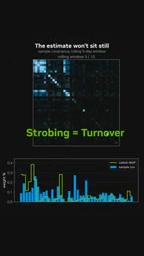
Ledoit-Wolf shrinkage cuts turnover by 57% while cuML GPU acceleration delivers 10x faster backtests.
This article demonstrates how Ledoit-Wolf covariance shrinkage addresses noisy high-dimensional covariance estimation in quantitative portfolio optimization. Across six backtests covering min-variance, mean-variance, and risk parity strategies on 3,000 stocks, turnover was reduced by up to 57%. Additionally, using NVIDIA's cuML library with a single line of code enabled GPU acceleration that cut backtest time from 1.5 hours to under 9 minutes.
High Turnover Is Quietly Eating Your Returns
In quantitative investing, high portfolio turnover is an underestimated return killer. Turnover measures the proportion of assets replaced in a portfolio over a given period — for example, 100% annual turnover means the entire portfolio was completely replaced once during the year. Every rebalance stacks up transaction fees, tax liabilities, and slippage costs. These seemingly minor expenses can significantly erode final returns through long-term compounding.
Transaction friction costs actually consist of three main components: explicit brokerage commissions and exchange fees; the implicit bid-ask spread, which is the liquidity premium charged by market makers; and slippage — the deviation between the order price and actual execution price, especially pronounced with large orders or in less liquid markets. Research shows that for institutional-grade quantitative strategies, the comprehensive friction cost per trade can reach 5–50 basis points, which compounds dramatically under high-frequency rebalancing.
The deeper problem lies in covariance matrix estimation. The covariance matrix describes the co-movement relationships between asset returns and is the core input to Modern Portfolio Theory (MPT). For N stocks, the covariance matrix contains N×(N+1)/2 independent parameters that need to be estimated. When the number of stocks exceeds the number of observation samples (the high-dimensional, small-sample scenario), covariance-based optimizers struggle to accurately estimate co-movements between stocks. Mathematically, this means the matrix's condition number becomes extremely large — the largest eigenvalues are overestimated and the smallest are underestimated, leading to so-called "eigenvalue spreading." The Marčenko-Pastur law, from Random Matrix Theory, precisely describes the distribution of these noisy eigenvalues, proving that in high-dimensional settings, much of the information in the sample covariance matrix is actually pure statistical noise rather than genuine market structure. This fills the covariance matrix with noise, causing the optimizer to output highly unstable weights — with weights swinging wildly at each rebalance, turnover naturally stays elevated.
Ledoit-Wolf Shrinkage: Stabilizing Noisy Estimates
The Ledoit-Wolf shrinkage method was designed precisely to solve the covariance estimation noise problem. Its core idea is intuitive and elegant: "shrink" the noisy sample covariance estimate toward a stable shrinkage target.
Mathematical Formulation and Mechanism
The mathematical expression for Ledoit-Wolf shrinkage is: Σ_shrunk = δ·F + (1-δ)·S, where S is the sample covariance matrix, F is the shrinkage target, and δ∈[0,1] is the shrinkage intensity. While the sample covariance matrix is an unbiased estimator, it has extremely high variance and is unreliable in high-dimensional settings. The shrinkage target (typically a structurally simplified matrix, such as a diagonal matrix or constant correlation matrix) is biased but very stable.
The choice of shrinkage target F is critical: the simplest option is a scaled identity matrix (assuming all assets have equal variance and are uncorrelated); more refined choices include the Constant Correlation Model (assuming all asset pairs share the same correlation coefficient) and single-factor model covariance matrices. In their seminal 2004 paper, Ledoit and Wolf derived an analytical optimal solution for δ that minimizes the Frobenius norm between the estimated and true covariance matrices. In 2020, they further proposed the Analytical Nonlinear Shrinkage method, which performs optimal shrinkage on each eigenvalue individually rather than through linear interpolation, achieving theoretically superior estimation accuracy.
Shrinkage is essentially a classic application of the bias-variance tradeoff: introducing moderate bias to dramatically reduce estimation variance, thereby minimizing overall estimation error. The Ledoit-Wolf method achieves this balance through an automatically determined optimal shrinkage intensity, producing a covariance matrix that is both lower in estimation error and more robust.
The direct benefit is clear: smoother weights and lower turnover. When covariance estimates are no longer overly sensitive to noise, optimizer outputs stabilize accordingly, and drastic adjustments at rebalance are effectively suppressed.
Six Backtests: Up to 57% Reduction in Turnover
To validate the practical impact of Ledoit-Wolf shrinkage, the author designed six backtest experiments covering three mainstream portfolio optimization strategies:
- Minimum Variance Portfolio (Min-Variance): Derived from the Markowitz mean-variance framework but uses only the covariance matrix without relying on expected return estimates, thus avoiding the enormous uncertainty in return forecasting. Academic research (e.g., Jagannathan & Ma, 2003) shows that minimum variance portfolios often outperform full mean-variance optimization out-of-sample, which is why they are widely popular in practice.
- Mean-Variance Optimization (Mean-Variance): The classic framework proposed by Harry Markowitz in 1952, which uses both expected returns and the covariance matrix to determine optimal allocations on the efficient frontier. However, it is extremely sensitive to input parameters — Richard Michaud (1989) famously called it an "Error Maximizer," where small estimation errors in inputs are amplified by the optimization process, resulting in extreme and unstable weight allocations.
- Risk Parity: Popularized in practice by Bridgewater's Ray Dalio, the core idea is to equalize each asset's contribution to total portfolio risk rather than equalizing capital allocations. This strategy requires no expected return inputs and naturally favors diversification. Bridgewater's famous "All Weather" strategy is a representative application of the risk parity concept.
The three strategies differ in their dependence on covariance estimates, but all suffer from weight instability caused by covariance noise. Each strategy was tested in a paired comparison — with and without Ledoit-Wolf shrinkage. The test data was substantial: 3,000 stocks, 5-minute bars, over one week of data.
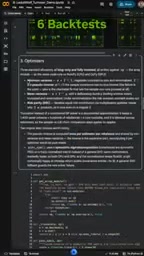
The results were impressive: after applying Ledoit-Wolf shrinkage, portfolio turnover was reduced by up to 57%. This means that without changing the strategy logic at all, simply improving the covariance estimation method can drastically cut transaction costs and directly boost net returns.
For quantitative strategies with high-frequency rebalancing or large stock universes, the practical value of this improvement cannot be overstated — every reduction in turnover translates directly into savings on fees, taxes, and slippage.
One Line of Code for GPU Acceleration: Backtest Time from 1.5 Hours to 9 Minutes
Beyond strategy-level optimization, this demonstration also showcased a remarkable engineering efficiency improvement.
The Performance Leap from CPU to GPU
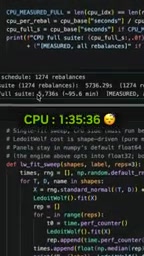
Initially, this suite of six backtests took over 1.5 hours to run on CPU. For quantitative researchers who need to iterate and validate frequently, such wait times severely slow down the R&D cycle.
The solution was surprisingly simple — adding one line of code before the import statements reduced backtest time from 1.5 hours to under 9 minutes, a nearly 10x efficiency gain.
cuML: NVIDIA's Open-Source scikit-learn GPU Accelerator
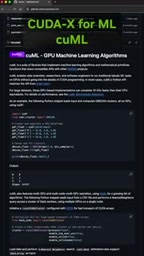
That one line of code activates cuML, NVIDIA's open-source scikit-learn GPU accelerator and a core component of the RAPIDS AI ecosystem. RAPIDS AI is an open-source data science ecosystem initiated by NVIDIA in 2018, designed to migrate the entire data processing and machine learning pipeline onto GPUs. Its core components include: cuDF (GPU-accelerated DataFrame library, comparable to pandas), cuML (GPU-accelerated machine learning library, comparable to scikit-learn), cuGraph (GPU-accelerated graph analytics library), and cuSignal (GPU-accelerated signal processing library).
cuML's greatest advantage is zero-code migration: there's no need to rewrite existing scikit-learn code. With just one activation statement, existing machine learning workflows automatically run on the GPU. Under the hood, it uses CUDA C++ for high-performance compute kernels while fully replicating scikit-learn's API at the Python layer. For tasks like covariance estimation that involve large-scale matrix operations, GPU parallel computing architecture has a natural advantage — modern GPUs have thousands of compute cores capable of executing massive floating-point operations simultaneously. For example, the NVIDIA A100 GPU has a peak FP64 throughput of 9.7 TFLOPS, far exceeding the capability of a single CPU core.
Even better, cuML comes pre-installed in GPU environments on Google Colab and Kaggle. On Google Colab, users can use a T4 GPU (16GB VRAM) for free, while paid users can access A100 GPUs. This means researchers can immediately experience GPU-accelerated performance gains on these free or low-cost cloud platforms without configuring complex CUDA environments themselves.
Conclusion: The Combined Power of Robust Statistics and Efficient Computing
This case study offers quantitative practitioners two clear improvement paths:
At the strategy level, Ledoit-Wolf covariance shrinkage is a mature tool for handling high-dimensional, small-sample covariance estimation. At minimal implementation cost, it delivers significant turnover reduction and weight stability improvement — making it a standard component worth incorporating into any portfolio strategy that relies on covariance optimization. It's worth noting that shrinkage is not the only covariance regularization technique — alternatives such as factor models (dimensionality reduction through a few common factors), Random Matrix Theory denoising, and Bayesian estimation can serve as substitutes or complements. However, the Ledoit-Wolf method holds unique appeal in practice due to its analytical solution's simplicity and parameter-free nature.
At the engineering level, as GPU acceleration ecosystems (like cuML) mature, the computational barrier for quantitative research is rapidly declining. A nearly 10x speedup from one line of code makes large-scale, high-frequency backtest iteration readily accessible, substantially accelerating the overall pace of strategy development. As GPU computing costs continue to fall and cloud platform ecosystems keep improving, computational resources once affordable only by large hedge funds are opening up to individual researchers and small teams.
Combining robust statistical methods with efficient computing tools is precisely the key to enhancing competitiveness in modern quantitative research.
Related articles

Gemini 2.0 Flash Coding Test: AI-Driven 3D Game Development from Start to Finish
Hands-on review of Gemini 2.0 Flash coding with SVG animation, Three.js 3D scene, and FPS game tests. Excellent code quality, spatial modeling, and cost efficiency with Antigravity CLI.

Understanding Context Windows: The Real Reason Your AI Coding Assistant Performs Poorly
Deep dive into how context windows impact AI coding Agents. Learn what context windows are, why bigger isn't better, how to manage Claude Code context, and optimization strategies for MCP servers and rules files.
GitFig: Git Version Control and Bidirectional Design Token Sync in Figma
GitFig is a Figma plugin enabling bidirectional design token sync with GitHub. Designers can branch, commit, and create PRs directly in Figma.