Legato Launches AI Hearing Glasses: Redefining Assistive Hearing Devices

Legato integrates AI hearing assistance into ordinary glasses to destigmatize and democratize hearing care.
Legato has launched an AI-powered device that embeds hearing assistance into an eyeglass form factor, directly targeting the three major pain points of traditional hearing aids: high cost, physical discomfort, and social stigma. Glasses, as an unassuming everyday accessory, naturally destigmatize the experience, removing the pressure of disclosing one's hearing condition. The AI layer handles acoustic scene recognition, speech enhancement, and noise suppression — delivering a smarter listening experience than conventional amplification. The product enters an emerging category between medical hearing aids and consumer electronics, riding both the wearables trend and the regulatory tailwind of OTC hearing aid rules. Real-world performance remains to be validated, but the concept points toward a more inclusive and invisible future for hearing care.
Assistive hearing devices are undergoing a fundamental form factor shift. Startup Legato has unveiled a pair of AI-powered hearing glasses, aiming to embed hearing assistance directly into everyday eyewear rather than relying on traditional in-ear hearing aids.
Addressing the Pain Points of Traditional Hearing Aids
Legato's product philosophy stems from a clear goal: making hearing care more accessible. In the traditional hearing aid market, three persistent barriers have long kept people from getting the help they need — prohibitive costs, physical discomfort, and the social stigma that comes with wearing a visible hearing device.
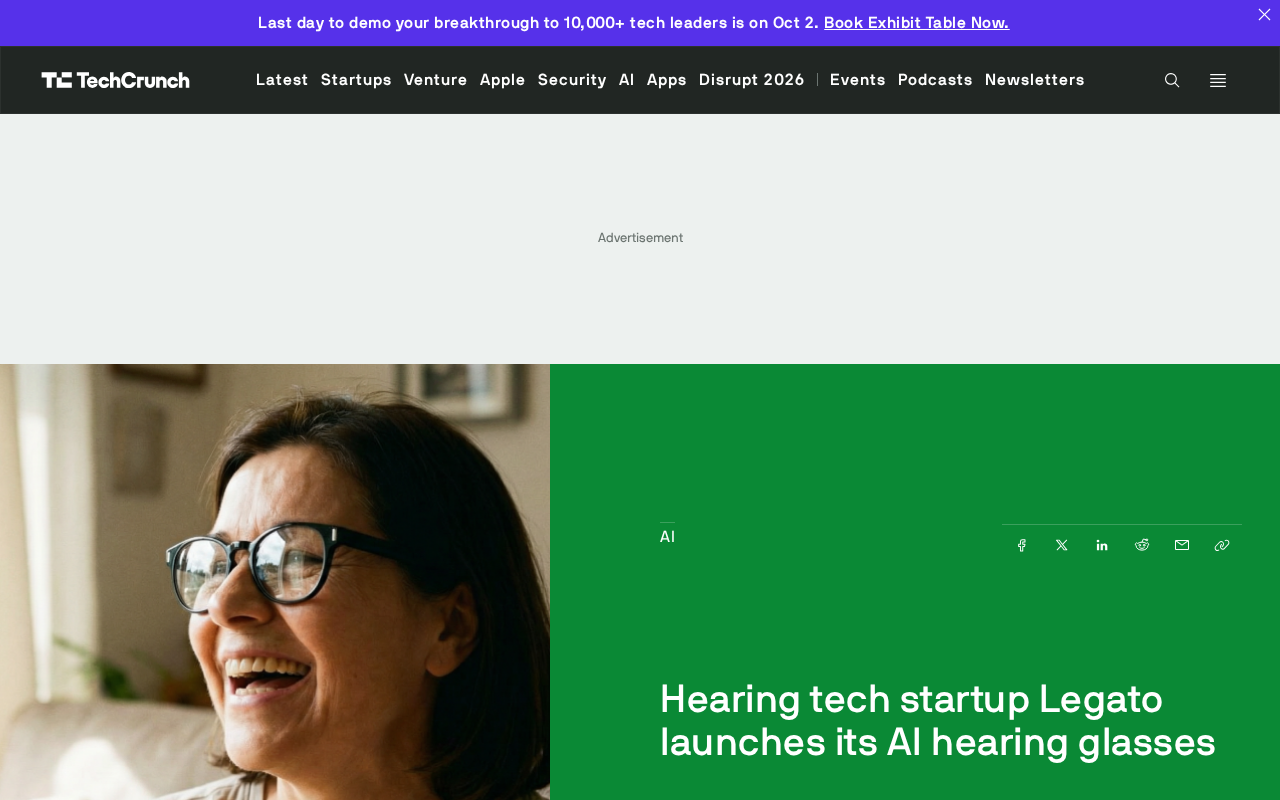
Traditional hearing aids are notoriously expensive, with prices routinely running into the thousands of dollars — a barrier that puts them out of reach for many people with mild to moderate hearing loss. On top of that, the physical discomfort of wearing in-ear devices for extended periods, combined with the social stereotype that "wearing a hearing aid signals old age or disability," leads many who could benefit to simply avoid them. Legato's decision to deliver hearing assistance through eyewear — a universally accepted and socially neutral accessory — is a direct response to each of these pain points.
The Design Logic Behind the Glasses Form Factor
Integrating hearing assistance into eyeglasses follows a clear product rationale. Glasses are an everyday accessory that draws no particular attention; wearing them carries no negative connotations — if anything, they can be a fashion statement.
The core value of this form factor innovation lies in destigmatization. When a hearing assistance device looks indistinguishable from ordinary glasses, users no longer face the psychological pressure of disclosing their hearing condition. This approach echoes the broader trend in smart glasses, AR eyewear, and other wearables, signaling that consumer electronics is increasingly exploring more natural, unobtrusive modes of human-computer interaction.
The Role of AI
The "AI" in the product name is key to understanding what this device does. While detailed technical specifications remain limited, AI in modern hearing assistance contexts typically handles core tasks such as acoustic scene recognition, speech enhancement, and noise suppression.
Unlike traditional hearing aids that simply amplify all sound, AI-driven solutions can intelligently distinguish speech from ambient noise and foreground conversational audio in noisy environments — delivering a meaningfully better real-world experience. This has become one of the primary directions for hearing device innovation in recent years. For Legato, AI capability is likely both a product differentiator and the technical foundation that makes professional-grade hearing assistance possible without sacrificing size or aesthetics.
The core technology stack for AI-powered hearing assistance typically involves several layers: beamforming, which uses multi-microphone arrays to spatially focus on a target sound source while suppressing noise from other directions; deep learning-based speech enhancement models, which separate voice from background noise in real time; and personalized adaptation algorithms, which apply frequency-specific compensation based on a user's audiogram. By contrast, traditional analog hearing aids perform broadband amplification, which tends to amplify noise along with speech — limiting their effectiveness in complex acoustic environments like restaurants or busy streets. For a glasses-form-factor product, latency control (typically requiring under 20 milliseconds to avoid an echo effect) and power management are the primary engineering challenges, directly affecting battery life and wearing comfort.
Market Significance and Outlook
Legato is entering a market in the midst of redefinition. As wearable devices become mainstream and consumer-level hearing assistance regulations loosen, an emerging category of "assistive hearing devices" — sitting between professional medical hearing aids and mainstream consumer electronics — is taking shape as a new competitive arena.
The shared logic across products in this space is to serve people who have been left behind by traditional hearing aids, by offering lower prices, a more comfortable wearing experience, and a lower psychological barrier to adoption. Whether Legato can deliver on its promises across key metrics — actual hearing performance, battery life, and wearing comfort — remains to be seen once the product reaches consumers. But from a positioning standpoint, it represents a plausible path toward making hearing care more inclusive and invisible.
In 2022, the U.S. FDA approved rules allowing over-the-counter (OTC) hearing aids to be sold without a prescription to adults with mild to moderate hearing loss — a policy shift widely regarded as a landmark moment for democratizing hearing care. Prior to this, the U.S. hearing aid market was long dominated by a handful of large medical device companies, with the traditional audiologist-fitting model pushing average prices to between $4,000 and $7,000 per pair. The OTC ruling opened the door for consumer electronics manufacturers, drawing in players like Apple (with the hearing assistance features in AirPods Pro) and Sony. Legato is squarely targeting the incremental population unlocked by this policy shift — an estimated tens of millions of American adults with mild to moderate hearing loss who have never used a hearing aid.
Related articles

Gaussian Process Bandit Optimization: Exploration Strategies and Inference Regret Guarantees
Cumulative regret guarantees in Bayesian optimization fail to reflect final recommendation quality. This article examines a new study that provides inference regret guarantees for Gaussian process bandit optimization through exploration query strategies and fill distance analysis, validated on hyperparameter optimization and control tasks.

The Most Detailed Codex Guide on Bilibili: From Installation to Real-World Practice
The most detailed Codex guide on Bilibili: from app store installation to daily work mode configuration, with a real coffee shop project demonstrating file organization, data extraction, dashboard creation, and other practical tasks. Learn to use Plan Mode and desktop pets to leverage Codex efficiently.

Appearance Compensation in Volume Rendering: Why RGB Accuracy Cannot Guarantee Density Correctness
Volume rendering research reveals that volumetric data perfectly reproducing external RGB views may still contain density errors: appearance compensation can double central density and keep external rays unchanged even when L2 error exceeds 14.52%. Density recovery depends on appearance capacity, spatial resolution, and measurement design.