LEMMO: Leveraging Pretrained LLMs for Million-Scale Electromagnetic Signal Understanding
LEMMO combines a linear-attention encoder with a pretrained LLM for recognition and structured description of million-sample IQ recordings.
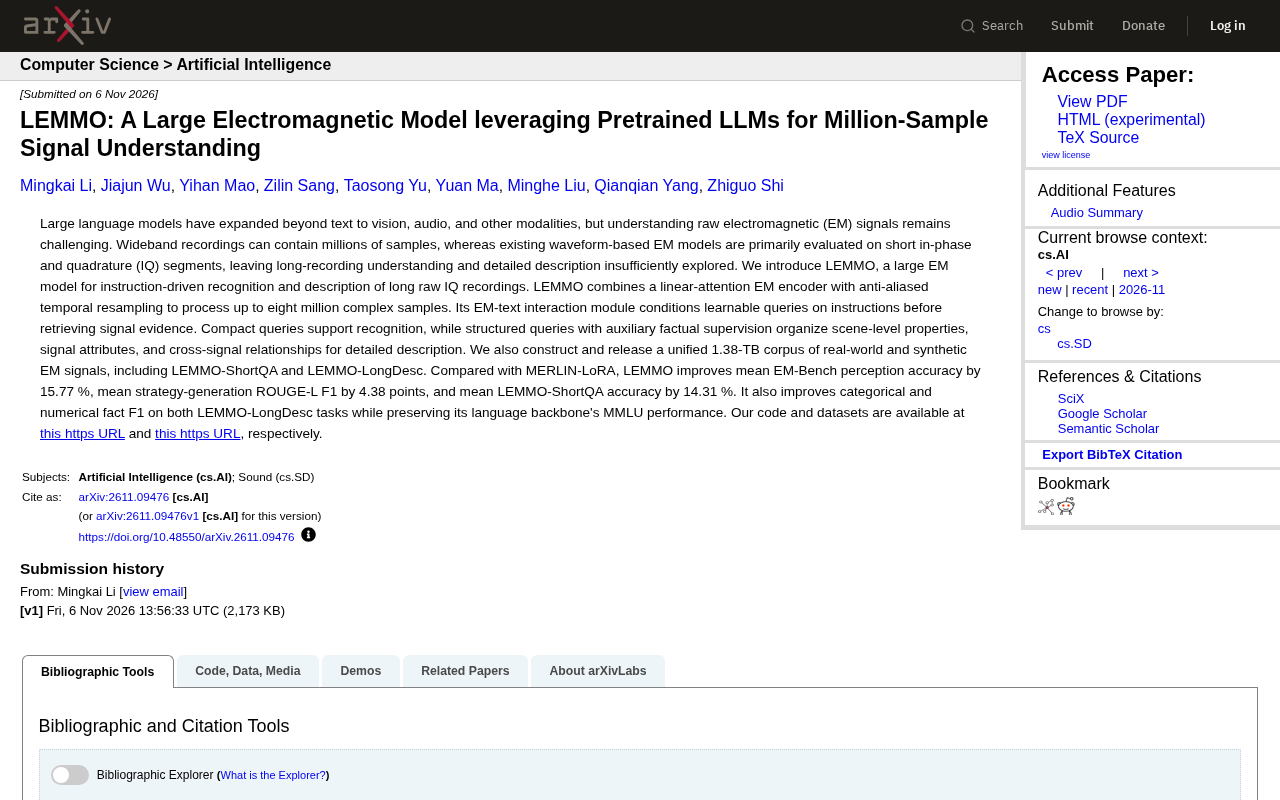
To address the inability of existing EM models to handle short IQ segments and long recordings, researchers propose LEMMO—a large electromagnetic model for instruction-driven recognition and description. Its linear-attention encoder with anti-aliasing temporal resampling handles up to eight million complex samples, with an EM-text interaction module enabling fast recognition and structured long descriptions. The team open-sourced a 1.38TB unified EM corpus with ShortQA and LongDesc subsets. Compared to MERLIN-LoRA, LEMMO improves EM-Bench perception accuracy by 15.77% and ShortQA accuracy by 14.31%, while preserving MMLU performance. Details on parameter count, training cost, and low-SNR robustness remain undisclosed.
New Challenges in Electromagnetic Signal Understanding
Large language models have successfully expanded into modalities such as vision and audio, but deep understanding of raw electromagnetic (EM) signals remains a difficult problem. Wideband recordings often contain millions of samples, while existing waveform-based EM models are primarily evaluated on short IQ (in-phase/quadrature) segments, falling far short of understanding and describing long recordings in detail.
To address this gap, researchers propose LEMMO—a large electromagnetic model for instruction-driven recognition and description, specifically designed to process long raw IQ recordings.
IQ signals are the most fundamental representation in electromagnetic signal processing: the in-phase component (I) and quadrature component (Q) form a pair of complex samples that jointly capture both amplitude and phase information. Compared to envelope detection, which retains only amplitude, IQ representation fully preserves the raw information from the RF frontend, making it the standard data format for software-defined radio and spectrum monitoring. A wideband IQ recording can have a sample rate of tens of megasamples per second, so even a few seconds of recording produces millions of complex samples—this is precisely the root of the "long recording understanding" challenge emphasized in the paper: sequence lengths far exceed what conventional Transformers can handle.
LEMMO's Core Architecture Design
The key innovation of LEMMO lies in deeply integrating pretrained language models with electromagnetic signal processing. Its architecture comprises two core components:
- Linear-attention electromagnetic encoder + anti-aliasing temporal resampling: Enables the model to process up to eight million complex samples, breaking through the sequence-length limitations of traditional models.
- Electromagnetic-text interaction module: Conditions learnable queries on instructions before retrieving signal evidence. Compact queries are used for recognition tasks, while structured queries with auxiliary factual supervision organize scene-level attributes, signal attributes, and cross-signal relationships to support detailed description.
This design allows the model to perform both fast recognition and generate structured long descriptions, rather than simply outputting labels.
Linear attention is a mechanism that reduces the computational complexity of standard self-attention from quadratic growth with sequence length (O(n²)) to linear growth (O(n)). Common approaches include approximating softmax attention with kernel functions or reformulating attention computation through state recurrence so it can accumulate point-by-point like an RNN. This enables the model to handle million-length sequences without blowing up GPU memory. Anti-aliasing temporal resampling addresses downsampling of long sequences: directly decimating samples causes spectral aliasing and loss of high-frequency information, whereas low-pass filtering before resampling preserves signal structure, maintaining the identifiability of electromagnetic features while compressing sequence length. The combination of these two is the key to LEMMO's ability to ingest eight million samples.
Data Foundation: 1.38TB Unified Corpus
To endow the model with generalization capability, the research team built and open-sourced a unified electromagnetic signal corpus of 1.38TB, covering both real-world and synthetic signals. The corpus contains two subsets: LEMMO-ShortQA (short question-answering) and LEMMO-LongDesc (long description).
The dataset has been released on HuggingFace (DaftJun/RFLAS), and the code is hosted on GitHub (N1rv4n4/LEMMO), providing a reproducible foundation for future research.
MERLIN-LoRA is the baseline model repeatedly used for comparison in the paper, representing a class of electromagnetic models previously trained on waveforms or short IQ segments and adapted to downstream tasks via LoRA fine-tuning. LoRA (Low-Rank Adaptation) achieves parameter-efficient fine-tuning by injecting low-rank decomposition matrices alongside pretrained weights, and is a common technique for transferring general-purpose large models to specialized domains. Understanding this baseline helps gauge the magnitude of LEMMO's improvement: the comparison is not against a model starting from scratch, but against one already adapted to the domain, so accuracy gains of around 15% represent a fairly significant improvement within the field.
Performance: Comprehensive Gains Over the Baseline
Compared to MERLIN-LoRA, LEMMO achieves significant improvements across multiple dimensions:
- EM-Bench average perception accuracy improves by 15.77%
- Strategy generation ROUGE-L F1 improves by an average of 4.38 points
- LEMMO-ShortQA average accuracy improves by 14.31%
- On two LEMMO-LongDesc tasks, both classification and numerical fact F1 show improvement
More importantly, while enhancing electromagnetic signal understanding, LEMMO preserves the language backbone's MMLU performance, demonstrating that the model does not sacrifice existing language capabilities for the new modality.
MMLU (Massive Multitask Language Understanding) is a standard benchmark for evaluating the general knowledge and reasoning abilities of large language models, covering multiple-choice questions across dozens of disciplines including STEM, humanities, and law. During multimodal or domain-extension training, models often suffer from "catastrophic forgetting"—language abilities degrade as new modality capabilities improve. The paper specifically reports that MMLU performance is preserved, indicating that LEMMO's training strategy does not damage the language backbone's general representations while injecting electromagnetic understanding capabilities, which is crucial for maintaining the quality of instruction following and description generation.
Why It Matters
Electromagnetic signals are ubiquitous in wireless communications, radar, spectrum monitoring, and other domains. Traditional methods rely on expert feature engineering, whereas LEMMO demonstrates the feasibility of using pretrained LLMs to process million-scale sampled signals. It pushes "long recording understanding" and "detailed description" from marginal problems to an evaluable, reproducible research agenda.
The combination of open-source code and a terabyte-scale corpus also lowers the barrier for the community to enter multimodal electromagnetic signal research.
Limitations and Outlook
The paper abstract does not disclose model parameter count, training costs, or robustness details under varying signal-to-noise ratio conditions. The practical deployment efficiency of long recording understanding and generalization to unknown signal types remain directions requiring further validation.
One-line Summary
LEMMO combines a linear-attention encoder with a pretrained LLM to enable recognition and structured description of million-sample IQ long recordings.
Paragraph Summary
To address the problem that existing electromagnetic models can only process short IQ segments and struggle to understand long recordings, researchers propose LEMMO—a large electromagnetic model for instruction-driven recognition and description. At its core is a linear-attention electromagnetic encoder with anti-aliasing temporal resampling, capable of processing up to eight million complex samples, along with an electromagnetic-text interaction module for fast recognition and structured long descriptions. The team also open-sourced a 1.38TB unified electromagnetic signal corpus containing ShortQA and LongDesc subsets. Compared to MERLIN-LoRA, LEMMO improves EM-Bench perception accuracy by 15.77% and ShortQA accuracy by 14.31%, while preserving the language backbone's MMLU performance. The paper has not yet disclosed details such as parameter count, training costs, or low-SNR robustness.
Related articles
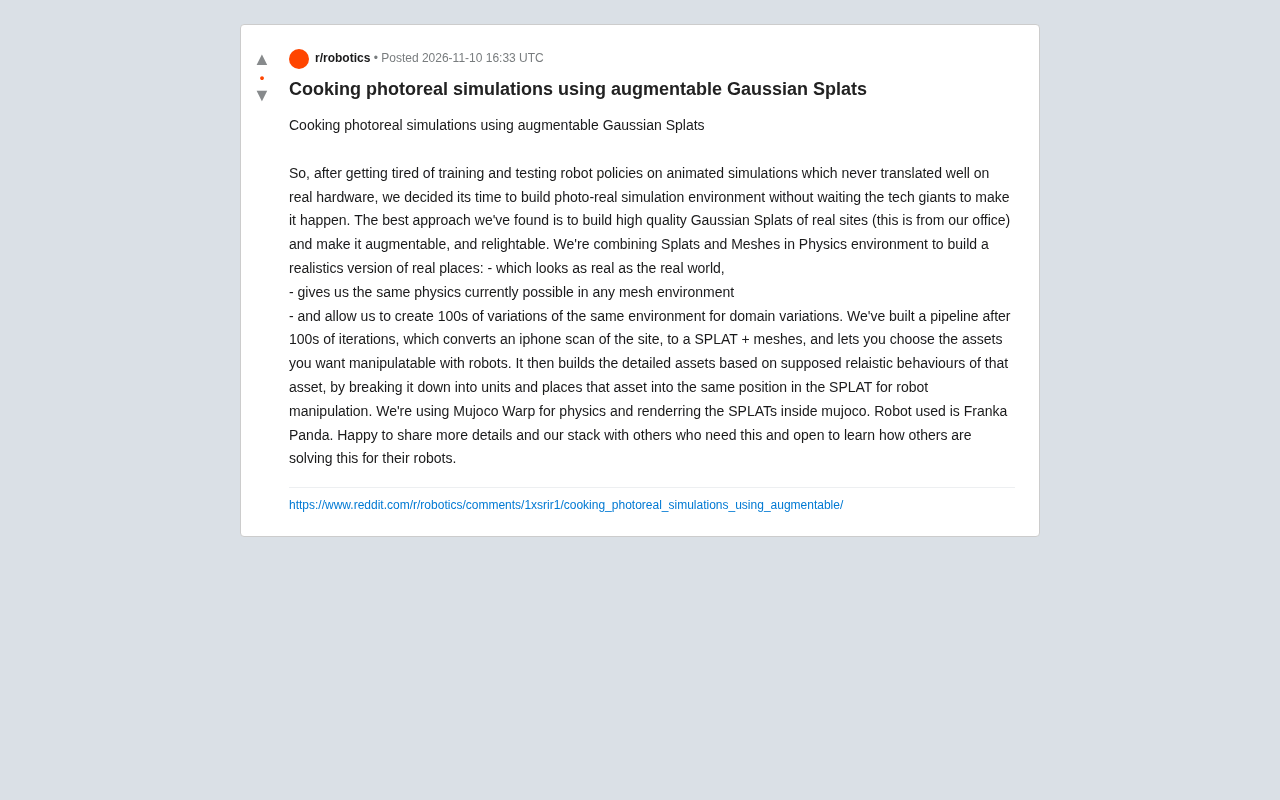
Augmentable Gaussian Splatting: Building Photorealistic Simulation Environments for Robot Training
Team combines Gaussian Splatting with meshes to build photorealistic robot simulation environments, integrating MuJoCo Warp physics and Franka Panda for augmentable, relightable real-site simulation.

Gemini 4 Carbon Released: The Leap from Gemini 3 to Gemini 4 in Under a Year
Google releases Gemini 4 Carbon, less than a year after Gemini 3. In the official demo, Carbon reverse-engineered the Theme Park binary, added a new DeepMind-themed ride, and ported it to the web in one shot.

Anthropic Launches AI Office Suite, Making Another Move in the Enterprise Market
Anthropic launches an AI office suite, expanding from coding tools to an enterprise office platform. This article analyzes its product strategy, competitive landscape, and significance for enterprise users.