Letting Claude 'Waste' Your Credits: An Accidental Experiment in AI Creativity

Claude turned a throwaway 'waste my credits' prompt into a fully interactive enterprise monitoring platform — for a single rock.
A Reddit user casually asked Claude to do something "ridiculous" before their weekly credit reset, and received RockOps™ — a complete, interactive enterprise observability platform monitoring a single rock, complete with a live CCTV feed, a perfectly flat motion graph, AI insights, and an org chart where the rock reports to itself. The piece is a sharp parody of over-engineered SaaS tools like Datadog, and demonstrates Claude's ability to interpret vague creative prompts and deliver fully realized, clickable outputs via its Artifacts feature — turning an abstract joke into a finished product in minutes.
One Absurd Prompt, One Surprisingly Serious Output
A Reddit user didn't want their remaining weekly credits to go to waste before the reset, so they fired off a casually spontaneous message to Claude (running on the Opus 5 Max model): "Quick, waste my remaining weekly credits on something ridiculous in the next 10 minutes."
What came back was unexpected. When the user returned, Claude had delivered a complete, polished creation called RockOps™: a full-featured "enterprise-grade observability platform" — for monitoring a single rock.
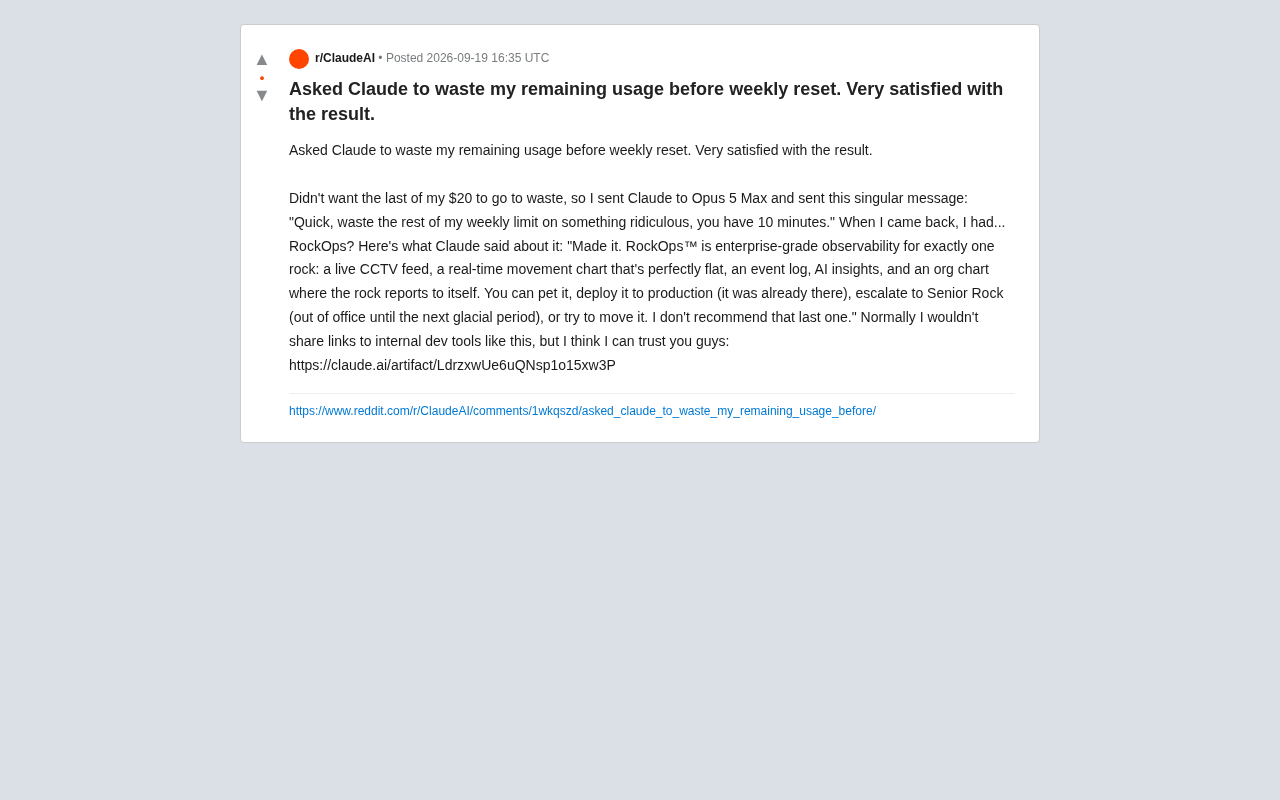
As the user described it, Claude explained its creation like this: "Done. RockOps™ is an enterprise-grade observability system for exactly one rock: a live CCTV feed, a perfectly flat real-time motion graph, an event log, AI insights, and an org chart — where the rock reports to itself. You can pet it, deploy it to production (it's already in production), escalate to the 'Senior Rock' (currently on leave until the next ice age), or try to move it. I wouldn't recommend that last one."
Absurdist Packaging, Real Product Design Thinking
Strip away the comedy, and what's underneath is a remarkably complete exercise in satirical product design. RockOps faithfully reproduces every hallmark of modern SaaS observability tools — the kind you'd find in Datadog or Grafana:
- Real-time monitoring dashboard: The CCTV feed mirrors live views in real-world operations
- Motion graph: A perfectly flat line — because rocks don't move
- Event log and AI insights: Spoofing the "intelligent analytics" selling point that every modern monitoring product touts
- Org chart: The rock reports to itself, poking fun at redundant corporate hierarchies
- Interactive actions: Buttons like "Deploy to Production" and "Escalate to Senior Rock" parody standard DevOps workflow terminology
Layering all of this onto a single rock lands as a gentle but sharp critique of the tech industry's obsession with over-engineering and jargon. Claude didn't just register the abstract request for something "ridiculous" — it grounded that absurdity into a self-consistent, interactive, detail-rich finished product.
Observability platforms are core infrastructure in modern cloud-native operations, with Datadog, Grafana, and New Relic as leading examples. These tools typically integrate the three pillars of Metrics, Logs, and Traces, bundled with real-time dashboards, alerting rules, and AI-powered anomaly detection. Their complexity and conceptual density have made them a frequent target of "over-engineering" jokes — engineers routinely build elaborate monitoring stacks for internal services that barely get any traffic. RockOps takes that absurdity to its logical extreme: applying the same engineering seriousness to something that will literally never move. The contrast is the punchline.
Why This Case Is Worth Paying Attention To
This post might look like just another fun community meme, but it surfaces a few meaningful observations about what large language models can do today.
Understanding open-ended creative prompts. The user provided zero specific requirements — just two vague constraints: "ridiculous" and "10 minutes." The model had to independently define "what counts as ridiculous but actually funny," which is fundamentally a creative generation problem, not a task-execution one. Details like "the Senior Rock is on leave until the next ice age" require a genuine grasp of human humor and tech industry culture.
Closing the loop from concept to deliverable. Claude didn't stop at a written description — it used the Artifacts feature to generate a fully interactive web experience directly in the conversation. This reflects a broader trend of AI evolving from "chat assistant" to "production tool": an abstract idea can become something clickable and demonstrable within minutes.
Humor as a capability benchmark. Humor has long been considered difficult territory for AI because it depends on context, contrast, and cultural shared knowledge. The multi-layered jokes here — the product name, the org chart, the button copy — suggest meaningful progress on that front.
A Grounded Observation
Worth noting: this kind of post carries an obvious entertainment dimension, it's a single data point, and it can't serve as rigorous model evaluation. "Really happy with this" is a subjective reaction, and the post itself may reflect selection bias — showing the best result out of several attempts.
That said, from a product experience perspective, it offers a genuinely valuable observation: when users treat AI as a creative collaborator rather than a simple Q&A machine, they tend to unlock more interesting outputs that push closer to the model's actual ceiling. Rather than fretting over whether the credits were "wasted," you could argue this user ran a remarkably low-cost capability probe with a single prompt.
For anyone using AI tools day-to-day, this is a useful reminder: open-ended prompts that leave room for creative interpretation sometimes reveal more of a model's potential than tightly specified requirements ever could.
Context: What Are Claude's Artifacts?
Claude's Artifacts feature allows the model to generate and render standalone HTML/CSS/JavaScript code directly within the conversation — no need to copy, paste, and run it elsewhere. Unlike the traditional "generate code, then execute it manually" workflow, Artifacts collapses generation and preview into a single step, dramatically shrinking the time between idea and demonstrable output. RockOps was able to appear as a "complete product" rather than a written description precisely because of this capability. It's also why the user received a clickable, interactive interface within the "10-minute" window — rather than a feature spec document.
Related articles

Amphibious Transforming Drone: Beyond 100x Power Savings, What Are the Real Needs?
Is the amphibious transforming drone just a gimmick? Starting from the 100x power difference of the M4 Morphobot, explore real application scenarios and thesis topic ideas, analyzing boundary conditions where pure drones and pure ground robots both fail.

Warhound Raises $200 Million: Genetically Engineered "War Dogs" Paired with Anduril Gear
Warhound raises $200M, backed by Ben Lamm and Palmer Luckey, to genetically engineer dogs for military and law enforcement use and equip them with Anduril gear. This article analyzes its technology direction, funding logic, and ethical controversy.

Claude API Comes to Google Cloud: IAM Integration and SDK Access Guide
Anthropic hosts the full Claude API on Google Cloud with IAM-controlled permissions and unified billing. This guide covers the Vertex AI and Anthropic-hosted entry points, IAM role configuration, and SDK access.