LibreOffice Takes a Swipe at Microsoft 365: The Open-Source Office Suite That Never Takes a Day Off
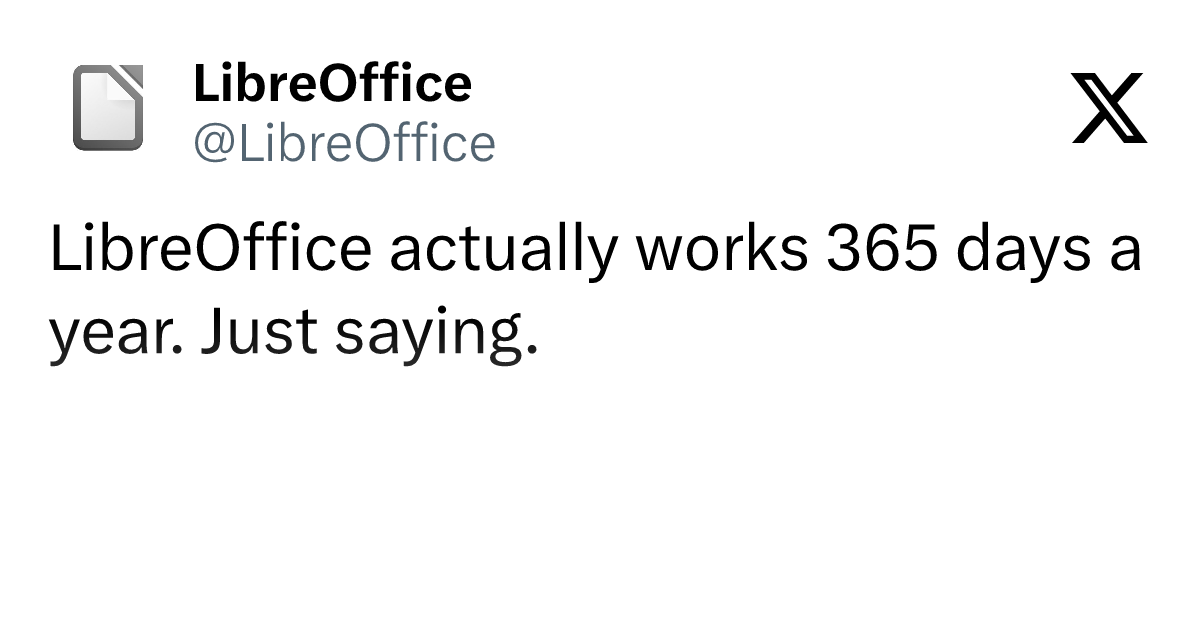
LibreOffice's "365 days" pun takes a jab at Microsoft 365, sparking debate over open-source vs. subscription models.
LibreOffice posted a punning tweet using "works 365 days a year" to jab at Microsoft 365's subscription brand, earning 356 points and 121 comments on Hacker News. The article outlines the fundamental difference between two product philosophies: subscriptions tie usage rights to continued payment, while open-source licenses grant rights once, with auditable code and self-deployment options. The comments reveal real divisions—supporters emphasize autonomy, cost, and data sovereignty, while skeptics point to gaps in format compatibility, VBA macro support, and enterprise collaboration ecosystems. The author argues that the core value of open-source office suites isn't in fully surpassing commercial software but in providing a vendor-independent choice that exerts market pressure on commercial pricing and license terms; ultimately, the choice should come down to specific use cases.
A Single Tweet Sparks a Discussion
The official LibreOffice account posted a short message on social media: "LibreOffice works 365 days a year. Just saying." On the surface, it simply means LibreOffice works every day of the year—but anyone paying attention can see this is a jab at Microsoft's Microsoft 365 brand. The tweet earned 356 points and 121 comments on Hacker News, showing that the tension between open-source office software and subscription-based commercial software can still easily stir the tech community.
This kind of tongue-in-cheek marketing is nothing new, but the reason LibreOffice's tweet resonated is that it precisely tapped into the sentiments of two groups of users: ordinary users fatigued by subscriptions, and open-source advocates sensitive about software autonomy.
One Brand Name, Two Product Philosophies
The core model of Microsoft 365 (formerly Office 365) is subscription-based: users pay annually or monthly in exchange for continuous updates and bundled cloud services. LibreOffice, by contrast, is free and open-source software maintained by The Document Foundation, available for free download, free distribution, and with publicly auditable code.
The difference isn't just the price tag. A subscription means the right to use the software depends on continued payment, whereas an open-source suite's license is granted once and doesn't depend on the vendor's backend. The tweet's pun on "works 365 days a year" restores "365" from a product name back to a unit of time, implying that real working capability doesn't need a brand name to advertise it.
From a technical standpoint, LibreOffice is indeed capable of handling everyday office documents, supporting interoperability between ODF and Microsoft Office formats, and covering core components such as word processing, spreadsheets, and presentations. For many individual users and organizations, it is already an adequate replacement for commercial office suites.
ODF (OpenDocument Format) is an XML-based family of office document formats maintained by the OASIS standards organization, covering text (.odt), spreadsheets (.ods), presentations (.odp), and other types, and is also the ISO/IEC 26300 international standard. LibreOffice uses ODF as its native format, while Microsoft Office has long used OOXML (.docx/.xlsx/.pptx) as its default format. The two have structural differences in style models, function semantics, and layout engines, so cross-format conversion may produce issues such as font substitution, pagination shifts, and misaligned complex tables—this is the technical root of the comment that "format compatibility is not perfect."
It's worth noting that format openness itself has strategic significance: ODF is a publicly documented specification that can be freely implemented, and any software can read and write it; while OOXML has a standard version, its actual implementation details often deviate from Microsoft product behavior, creating a de facto lock-in effect.
The Real Divide in the Hacker News Comments
The 121 comments the tweet generated on HN reflect the long-standing divisions within the tech community over open-source office software.
Supporters focus on autonomy and cost: software should serve users rather than lock them into a subscription cycle; open source means not being held hostage by a single vendor's policy changes, with document formats and code remaining in your own hands for the long term.
Skeptics point to real-world experience: format compatibility with Microsoft Office isn't perfect, there are still gaps in layout fidelity for complex documents, and support for macros and advanced features, and the collaboration and integration ecosystem in enterprise environments is hard to match that of commercial suites. These criticisms aren't unfounded—they are engineering challenges LibreOffice has long had to face.
The coexistence of these two voices precisely illustrates that the competitive logic of open-source software differs from that of commercial software—it doesn't need to win on every metric, but rather to provide a choice that isn't beholden to a vendor.
The gap in macros and advanced features is concentrated in VBA (Visual Basic for Applications) compatibility. Microsoft Office's VBA is a programming interface deeply embedded in the host application, on which a large number of enterprise intranet tools and report automation scripts are built. LibreOffice provides a Basic macro engine and supports a certain degree of VBA compatibility layer, but its support for ActiveX controls, Windows API calls, and complex object models is limited, and many business processes that depend on VBA encounter obstacles when migrating.
Similarly, enterprise-level integration ecosystems involve Exchange/SharePoint collaboration, Microsoft Graph interfaces, Group Policy centralized management, document rights management (IRM), and other capabilities. These aren't mere document editing features but organization-level infrastructure built around the office suite. Open-source suites can match on standalone document processing, but this kind of ecosystem coupling is hard to replicate in the short term—which is also a key trade-off for enterprises evaluating switching costs.
Where the Value of Open-Source Office Suites Really Lies
Treating this tweet as mere marketing gimmick underestimates its significance. The very existence of LibreOffice exerts a market constraint: when users have a free, auditable, self-deployable alternative, commercial vendors must be cautious about pricing and license terms.
For enterprises and public institutions, open-source office suites also mean controllability of data sovereignty—documents need not pass through third-party cloud services, and deployment can be fully on-premises. For individual users, it means being able to open their own files even when switching operating systems or going offline.
Of course, this doesn't mean open source is a universal solution. A reasonable criterion is the use case: for everyday document processing and collaboration with relatively simple formats, open-source suites are more than adequate; for scenarios with strict requirements for format fidelity and enterprise-level integration, commercial suites still have their place.
Conclusion
That a punning tweet could attract hundreds of points and over a hundred comments shows that the question of "should software be subscription-based" is far from settled. LibreOffice reaffirmed its stance with a joke: the value of a tool lies in its ability to work, not in what it's called. As for how users choose, it ultimately comes back to their own actual needs.
Related articles

AI Writes Your Code—Do You Still Need to Learn Git? Five Reasons
AI coding agents handle Git operations automatically—is it still necessary to learn Git? Five reasons: team communication, reviewing agent PRs, monitoring code changes, fallback when AI goes down, and the joy of learning—plus how the focus of learning Git is shifting in the agent era.

Anthropic Reportedly Prices IPO at $83 Per Share, Valuing Company at $1.5 Trillion
Anthropic reportedly prices IPO at $83 per share, above the expected range, with a fully diluted valuation of $1.5 trillion. This article analyzes the signal significance of the pricing and its impact on the AI industry's financing environment.

Open-Source Code Hosting Platform Codeberg Suffers Outage, Sparking Debate in Developer Community
Open-source code hosting platform Codeberg.org suffered an outage, sparking Hacker News debate over nonprofit platform stability and open-source infrastructure dependency risks.