LifeOS: An Open-Source Framework That Uses AI Hill-Climbing Algorithms to Optimize Your Life

LifeOS applies AI hill-climbing algorithms to systematically optimize personal growth as an iterative process.
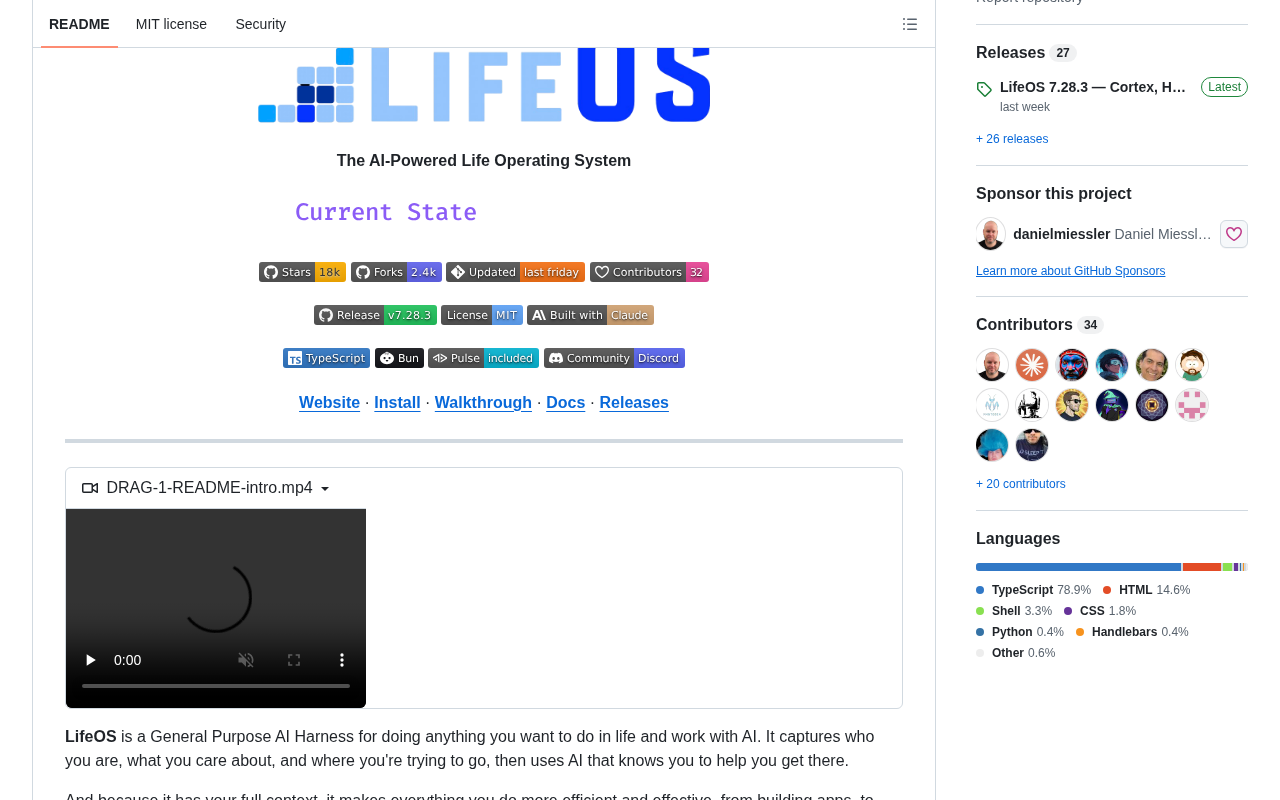
LifeOS is an open-source TypeScript framework by Daniel Miessler that applies hill-climbing optimization algorithms to personal growth. With 17,600+ GitHub stars, it positions AI as a life operating system—continuously assessing the gap between your current and ideal states across life dimensions and suggesting actionable improvements. Built as an orchestration harness rather than a simple app, it leverages LLMs through structured prompts and state tracking to turn vague life goals into iterable optimization problems.
A Project That Tackles Life's Problems with Engineering Thinking
Recently, LifeOS—an open-source project by security researcher and renowned content creator Daniel Miessler—has been skyrocketing on GitHub, amassing over 17,600 stars in a short period, with 143 new stars in a single day and 2,359 forks. Written in TypeScript, the project sums up its ambition with a philosophically-charged tagline: "A general-purpose 'hill-climbing' AI framework that helps you move from your Current State to your Ideal State in life and work."
Unlike most "AI productivity tools" on the market, LifeOS isn't yet another to-do list or note-taking app. Instead, it attempts to systematically transplant the "optimization algorithm" mindset from software engineering into the domain of personal growth.

What Is a "Hill-Climbing" AI Framework?
The Core Metaphor of Hill-Climbing
The central concept in the project's name—"Hill-climbing"—originates from a classic family of optimization algorithms in computer science. The basic idea behind hill-climbing is: start from an initial solution, continuously make local adjustments in directions that improve the objective function, and stop when no further improvement is possible—much like a person climbing a mountain in dense fog, choosing to step upward at every turn until reaching the summit.
From a technical perspective, hill-climbing belongs to the Local Search Algorithm family, alongside Simulated Annealing, Genetic Algorithms, and other metaheuristic optimization methods. In computer science, these algorithms are widely applied in combinatorial optimization, machine learning hyperparameter tuning, path planning, and more. Variants of hill-climbing include random-restart hill-climbing (which mitigates the local optimum problem through multiple random starting points) and steepest-ascent hill-climbing. Its core advantages lie in simple implementation and extremely low memory usage, with no need to store the state of the entire search space. However, its greedy nature means it's sensitive to the initial state and cannot guarantee finding the global optimum.
LifeOS maps this mathematical metaphor onto life planning:
- Current State: Your present situation, encompassing dimensions like work, health, finances, relationships, and more.
- Ideal State: The goals you want to achieve—your "summit."
- The Climbing Process: With AI assistance, continuously assess the gap between your current and ideal states, and generate actionable "improvement moves" for the next step.
In essence, LifeOS treats satisfaction across life's dimensions as values of a multi-dimensional objective function, using AI to help find the gradient direction—which dimension has the most room for improvement, which action offers the highest return on investment. The elegance of this design lies in transforming vague "life goals" into an optimization problem that AI can iteratively evaluate, giving each adjustment a clear sense of direction.
Why a "Harness" Rather Than an Ordinary App
The project description deliberately uses the word "harness" rather than "app" or "tool." This implies that LifeOS is more like a "skeleton that carries AI capabilities"—it provides structured workflows and context management, while the actual reasoning and recommendations are handled by large language models.
In the current AI Agent tech stack, a harness (also called an orchestration framework) refers to a middle-layer architecture responsible for managing Agent execution flows. Typical examples include frameworks like LangChain, AutoGPT, and CrewAI. These harnesses typically handle the following responsibilities: managing conversational context and long-term memory, defining task decomposition and execution flows, coordinating data flow between multiple AI calls, and maintaining state machines to track task progress. Compared to directly calling LLM APIs, the value of a harness lies in providing reproducible workflows, persistent state management, and structured input/output specifications.
As a harness, LifeOS doesn't train or fine-tune models. Instead, it guides the capabilities of general-purpose LLMs into the specific domain of life optimization through carefully designed prompt templates, state-tracking mechanisms, and iterative loops. This aligns with the mainstream approach in the AI Agent space in recent years: the model is the engine, and the framework is responsible for attaching the steering wheel and accelerator.
Author Background and Project Credibility
LifeOS's author, Daniel Miessler, enjoys considerable recognition in both information security and AI application domains. His previously open-sourced project Fabric (an open-source framework for building AI prompt workflows) is equally popular and has accumulated significant community endorsement.
The Fabric project has amassed over 25,000 stars on GitHub, with its core philosophy of decomposing complex AI tasks into reusable "Patterns." Each Pattern is essentially a carefully crafted system prompt designed to solve a specific class of problems—such as summarizing articles, extracting wisdom, or analyzing security threats. Fabric's design philosophy deeply influenced LifeOS: the latter can be seen as a vertical deepening of Fabric's ideas in the personal growth domain, moving beyond general-purpose AI workflow invocations to organize AI capabilities around the closed loop of "state assessment → gap analysis → action recommendations → iterative feedback."
Miessler himself has over 20 years of experience in information security, having worked at multiple well-known security companies. His blog regularly publishes deep thinking on security, AI, and human augmentation. This background provides a natural trust foundation for LifeOS's rapid rise—it's not an experiment from an unknown creator, but the latest output from a practitioner who has been consistently working on "AI-augmented human capabilities."
From a tech stack perspective, the project is written in TypeScript, meaning it targets developers familiar with the modern web development ecosystem and facilitates integration with various AI APIs and frontend interfaces.
Industry Trends Reflected by LifeOS
From "Productivity Tools" to "Life Operating Systems"
The naming of LifeOS itself reflects an ambition: positioning AI as an "operating system" for managing life, not merely a tool for completing individual tasks. This aligns with a wave of "personal AI assistant" and "second brain" projects that have emerged over the past year. People are no longer satisfied with having AI write emails or summarize documents—they want it to understand their long-term goals and provide continuous decision support over time.
The concept of a "life operating system" is rooted in the thriving "Second Brain" and Personal Knowledge Management (PKM) movements of recent years. Tiago Forte's PARA methodology (Projects, Areas, Resources, Archives), Nick Milo's ACCESS system, and tools like Obsidian, Notion, and Roam Research constitute the infrastructure of this domain. However, traditional PKM systems primarily solve problems of information storage and retrieval, lacking proactive goal tracking and intelligent recommendation capabilities. The new generation of solutions represented by LifeOS attempts to layer an AI-driven decision layer on top of PKM's information layer—not only helping you remember information, but also proactively inferring what you should do next based on your goals and current situation. This marks a paradigm shift in personal effectiveness tools from passive "information warehouses" to proactive "intelligent advisors."
Structured Frameworks vs. General Chat
As LLM capabilities grow increasingly powerful, purely conversational interaction actually exposes its limitations: lack of continuity, lack of structure, and a tendency to "forget after chatting." The value of projects like LifeOS lies precisely in using engineered frameworks to supplement AI with "memory" and "goal orientation." It decomposes life into quantifiable, iterable state transitions, transforming AI recommendations from scattered inspirations into continuous actions serving a clear optimization objective.
Open Source Community Enthusiasm
The data—143 stars in a single day and 17,000+ cumulative stars—reflects the developer community's intense interest in the intersection of "AI + personal growth." The low barrier of entry (self-deployable, customizable) and high emotional resonance (who doesn't want to optimize their life?) give such projects natural virality.
A Sober Perspective: The Limits of Hill-Climbing and Life's Complexity
You might not have noticed, but while simplifying life into a "hill-climbing optimization problem" is clever, it has obvious limitations. Hill-climbing's most famous flaw is its tendency to get trapped at "local optima"—reaching a small hilltop and being unable to proceed further, mistakenly believing you've reached the summit. Life works the same way: the "optimal next step" suggested by AI based on current information may not lead you toward your truly ideal destination, and could instead trap you at a local high point within your comfort zone.
In optimization theory, classic strategies for addressing local optima include: Simulated Annealing (accepting inferior solutions with a certain probability to escape local optima), Genetic Algorithms (exploring larger spaces through population diversity and crossover mutation), and Tabu Search (recording visited states to avoid cycles). Mapped to life scenarios, these strategies have profound real-world correspondences: Simulated Annealing corresponds to the wisdom that "sometimes you need short-term setbacks for long-term progress"—such as leaving a high-paying job to start a business; Genetic Algorithms correspond to the life philosophy of "maintaining diversity in your attempts and not converging too early"; Tabu Search corresponds to "learning from past failures and not repeating mistakes." A more mature version of LifeOS might need to incorporate these mechanisms to prevent users from being trapped at comfortable but mediocre local high points.
Furthermore, the definition of life goals is inherently highly subjective and dynamically changing—the "Ideal State" is difficult to precisely quantify like an objective function. From a mathematical perspective, life's objective function is non-stationary—as your age, experiences, and cognition change, your definition of "Ideal State" continuously evolves, posing additional challenges for any optimization algorithm. LifeOS's practical utility ultimately depends on how users set their goals, how honestly they assess themselves, and the reasoning quality of the underlying LLM.
Conclusion
LifeOS is a fascinating attempt to restructure personal growth with engineering thinking. It transforms the classic algorithm concept of hill-climbing optimization into an actionable AI framework, helping people turn "becoming better" from a vague aspiration into an iterable process. Regardless of whether it ultimately delivers on the grand promise of a "life operating system," this project represents an important direction for AI applications—making AI serve not just tasks, but people's long-term goals. For developers interested in AI Agents and personal knowledge management, it's undoubtedly worth paying attention to and trying out hands-on.
Related articles

Gaussian Process Bandit Optimization: Exploration Strategies and Inference Regret Guarantees
Cumulative regret guarantees in Bayesian optimization fail to reflect final recommendation quality. This article examines a new study that provides inference regret guarantees for Gaussian process bandit optimization through exploration query strategies and fill distance analysis, validated on hyperparameter optimization and control tasks.

The Most Detailed Codex Guide on Bilibili: From Installation to Real-World Practice
The most detailed Codex guide on Bilibili: from app store installation to daily work mode configuration, with a real coffee shop project demonstrating file organization, data extraction, dashboard creation, and other practical tasks. Learn to use Plan Mode and desktop pets to leverage Codex efficiently.

Appearance Compensation in Volume Rendering: Why RGB Accuracy Cannot Guarantee Density Correctness
Volume rendering research reveals that volumetric data perfectly reproducing external RGB views may still contain density errors: appearance compensation can double central density and keep external rays unchanged even when L2 error exceeds 14.52%. Density recovery depends on appearance capacity, spatial resolution, and measurement design.