LiFi: A New Framework for Generating LiDAR Point Clouds from Multi-View Images

LiFi proposes a latent diffusion framework with geometric and semantic dual-branch collaborative guidance to generate high-fidelity LiDAR point clouds from multi-view images.
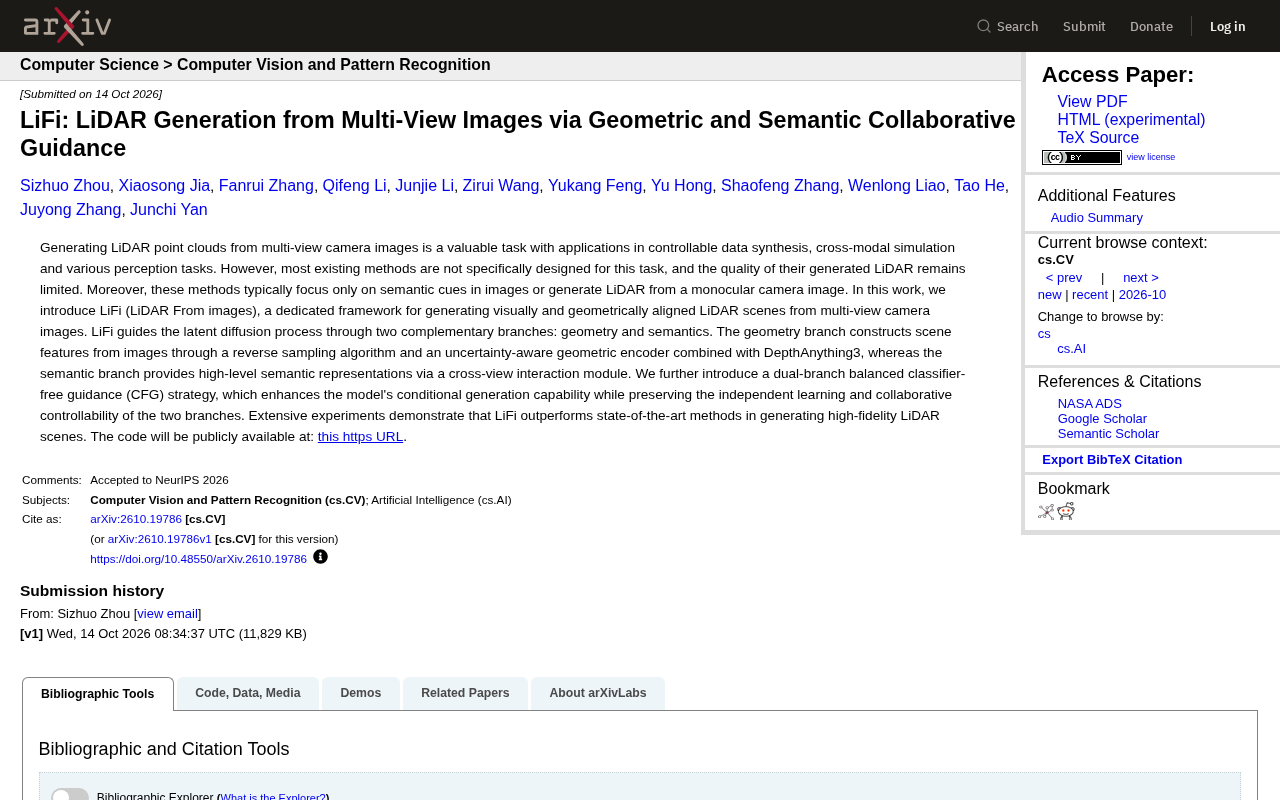
LiFi is a framework designed to generate LiDAR point clouds from multi-view camera images. It addresses the limitations of existing methods that rely only on semantic cues or monocular inputs by jointly guiding a latent diffusion process with geometric and semantic branches. The geometric branch uses reverse sampling and an uncertainty-aware encoder with DepthAnything3 depth priors, while the semantic branch captures multi-view consistency via a cross-view interaction module. A dual-branch balanced classifier-free guidance strategy enables independent optimization and collaborative control. Experiments show LiFi outperforms state-of-the-art methods in high-fidelity LiDAR generation, with code to be open-sourced on GitHub.
Generating LiDAR point clouds from multi-view camera images is a key task in autonomous driving perception, cross-modal simulation, and controllable data synthesis. However, most existing methods are not specifically designed for this task, resulting in limited LiDAR quality; they typically exploit only semantic cues from images, or generate LiDAR solely from monocular camera images, neglecting the importance of multi-view geometric information.
Recently, a paper titled "LiFi: LiDAR Generation from Multi-View Images via Geometric and Semantic Collaborative Guidance" proposed the LiFi framework, attempting to fundamentally address this problem.
LiFi's Core Idea: Geometric and Semantic Dual-Branch Collaboration
LiFi (LiDAR From images) is a framework specifically designed to generate visually and geometrically aligned LiDAR scenes from multi-view camera images. Its core innovation lies in jointly guiding the latent diffusion process through two complementary branches—a geometric branch and a semantic branch.
This dual-branch design stands in sharp contrast to previous methods that rely on only a single source of information. The paper points out that existing methods "typically focus only on semantic cues in images," resulting in insufficient geometric consistency in the generated outputs. LiFi compensates for this deficiency by explicitly introducing geometric guidance.
About Latent Diffusion Models (LDM)
Latent Diffusion Models (LDM) are the underlying architecture of mainstream generative models such as Stable Diffusion. The core idea is to first use an autoencoder (usually a VAE) to compress high-dimensional data (such as images or point clouds) into a low-dimensional latent space, and then perform the diffusion and denoising process in that latent space. The benefit is a significant reduction in computational cost while preserving generation quality. LiFi, aimed at LiDAR point cloud generation, likewise adopts a latent diffusion framework: the conditional information provided by the geometric and semantic dual branches is injected into every layer of the denoising network, guiding the latent variables to gradually reconstruct a LiDAR scene aligned with the input images. Understanding the two-stage structure of LDM (encoding compression + latent space diffusion) helps to grasp how LiFi combines multimodal conditions with the generation process.
Geometric Branch: Reverse Sampling and Uncertainty-Aware Encoding
The geometric branch is responsible for constructing scene features from images. Specifically, it employs a reverse sampling algorithm combined with an uncertainty-aware geometric encoder. This encoder integrates the depth estimation capability of DepthAnything3, thereby providing reliable geometric priors for the diffusion process.
The ingenuity of this design lies in "uncertainty awareness": depth estimation itself contains noise and errors, and using it directly may introduce artifacts. LiFi weights geometric features by perceiving uncertainty, improving the geometric fidelity of the generated point clouds.
About DepthAnything3 and Depth Estimation Priors
The DepthAnything series is a widely followed family of foundational models for monocular depth estimation in recent years. Its core idea is to train on large-scale, diverse image data (both labeled and unlabeled) to achieve relative depth prediction with strong generalization ability. DepthAnything3 is the latest iteration of this series, further optimized in multi-view consistency and depth accuracy. In LiFi, it is used as the source of depth priors for the geometric branch: the model first predicts a depth map from each input image, then back-projects the depth map into 3D points to form the geometric skeleton of the scene. The reason for not directly regressing LiDAR end-to-end from images is that explicit depth priors can significantly reduce the difficulty for the diffusion model to learn 3D geometry, while also giving the geometric branch's output clear physical meaning, facilitating subsequent fusion with the semantic branch.
Semantic Branch: Cross-View Interaction Module
The semantic branch focuses on providing high-level semantic representations. Through a cross-view interaction module, it establishes associations between different views, capturing the semantic consistency of the scene.
This cross-view interaction is crucial for multi-view inputs—the semantic information from a single view may be incomplete, while multi-view fusion can significantly enhance the comprehensiveness of semantic understanding. The two branches each perform their own duties while complementing each other, jointly providing conditional guidance for the diffusion model.
About Cross-View Interaction and Multi-View Fusion
Cross-view interaction modules are typically implemented based on attention mechanisms: features extracted from different camera views are treated as sequences, and self-attention or cross-attention allows the views to query each other and exchange information. The goal is to address the problem of incomplete semantics from a single view—for example, an object may be occluded in one view but visible in another. Through cross-view aggregation, the model can construct a more complete and consistent 3D semantic field. This approach is in line with the BEV (Bird's Eye View) perception paradigm commonly used in autonomous driving, but LiFi applies it to the construction of semantic conditions for a generation task rather than directly outputting detection results. Cross-view interaction can also implicitly encode the relationship between camera poses and scene structure, aligning the conditions provided by the semantic branch with the geometric branch spatially, laying the foundation for subsequent dual-branch fusion.
Dual-Branch Balanced Classifier-Free Guidance Strategy
LiFi also introduces a dual-branch balanced classifier-free guidance (CFG) strategy. This strategy enhances the model's conditional generation capability while preserving the independent learning and collaborative controllability of the two branches.
Traditional CFG strategies are typically designed for a single condition, whereas LiFi's dual-branch balanced CFG needs to coordinate both geometric and semantic conditions simultaneously. The paper emphasizes that this strategy enables the model to independently optimize each branch while achieving collaborative control of both, thus striking a balance between generation quality and controllability.
About Classifier-Free Guidance (CFG)
Classifier-Free Guidance (CFG) is a conditional sampling technique in diffusion models. During training, the model simultaneously learns both conditional and unconditional (i.e., with conditions randomly dropped) denoising processes; during sampling, the predictions of the two are linearly extrapolated with a certain weight, thereby enhancing adherence to the condition while maintaining sample diversity. The larger the guidance strength ω, the closer the generated result is to the condition, but too large a value may lead to oversaturation or mode collapse. LiFi's innovation lies in the fact that the condition is not singular but consists of two paths: geometric and semantic. If standard CFG were directly applied, a unified guidance weight would need to be chosen, making it difficult to accommodate the differing contributions of the two types of conditions. LiFi therefore designs a dual-branch balancing strategy, setting adjustable guidance coefficients for geometry and semantics separately, and introducing a balancing mechanism to prevent one branch from dominating, thereby achieving finer-grained control between geometric fidelity and semantic consistency.
Experimental Performance and Open-Source Plans
According to the paper, extensive experiments show that LiFi outperforms existing state-of-the-art methods in generating high-fidelity LiDAR scenes. Although the abstract does not disclose specific quantitative metrics, the authors state that the code will be made publicly available on GitHub (https://github.com/szzhou88/LiFi), providing a basis for subsequent reproduction and comparison.
Potential Applications and Significance
LiFi's value lies in the breadth of its application scenarios: controllable data synthesis, cross-modal simulation, and various perception tasks. In the field of autonomous driving, LiDAR data collection is costly and annotation is difficult; generating high-quality LiDAR point clouds from multi-view images can significantly lower the barrier to data acquisition.
In terms of cross-modal simulation, LiFi can help build more realistic simulation environments for training and testing perception algorithms. Moreover, the idea of geometric and semantic collaborative guidance may also inspire research on other cross-modal generation tasks.
With the code going open source, LiFi is expected to become an important baseline in the field of multi-view image-to-LiDAR generation, promoting reproducible research and practical deployment in this direction.
One-line Summary
LiFi proposes a latent diffusion framework with geometric and semantic dual-branch collaborative guidance to generate high-fidelity LiDAR point clouds from multi-view images.
Paragraph Summary
LiFi is a framework specifically designed for generating LiDAR point clouds from multi-view camera images. To address the problems of existing methods that rely only on semantic cues or monocular inputs and lack geometric consistency, it proposes a latent diffusion process guided collaboratively by geometric and semantic dual branches. The geometric branch employs reverse sampling and an uncertainty-aware encoder, combined with DepthAnything3 to provide reliable depth priors; the semantic branch captures multi-view semantic consistency through a cross-view interaction module. Together they condition the diffusion model, paired with a dual-branch balanced classifier-free guidance strategy that enables independent optimization and collaborative controllability. Experiments show that LiFi outperforms existing state-of-the-art methods in generating high-fidelity LiDAR scenes, and the code will be open-sourced on GitHub. This work is expected to lower the cost of LiDAR data acquisition for autonomous driving and advance controllable data synthesis and cross-modal simulation.
Related articles

Giving Coding Agents Hearing: How AirShot Closes the Audio Feedback Loop
AirShot gives coding agents audio perception: pure CPU offline operation, CLI and MCP invocation modes, with MCP avoiding 20-40s model reload delays. Critic scores against 7 professional launch videos with timestamped suggestions, registers into Cloud Code without a GPU.

MCP Protocol Explained: Giving AI Agents Tools and Memory
MCP lets AI agents securely connect to Gmail, Slack, and other tools with persistent memory. This article explains the three-step loop—connect tools, add memory, define goals—and how it eliminates repetitive work, turning AI from a chat tool into a practical productivity system.

Don't Trust AI Agent Installs? RepoGates' Five-Gate Test in Practice
RepoGates uses five gates to guard AI agents' repo clones, package installs, and MCP server additions, covering browser, Clawed Code, MCP clients, checkup, and deep scan—each with its own blind spots.