Lightweight Training Monitor limen_pulse: Adaptively Catching Silent Crashes in LLM/RL Training

limen_pulse uses an adaptive IQR noise engine to monitor training stability in real time, catching silent crashes with ~2.5%-3.4% false positives.
limen_pulse is a lightweight, adaptive training stability monitoring and crash audit tool built to address "silent crashes" in LLM, RL, and mixed-precision training where no error is reported. Its core is a self-calibrating IQR noise engine that learns the baseline noise of the current run early in training and dynamically adjusts sensitivity instead of relying on static thresholds. The tool applies different anomaly detection strategies for supervised learning, LLMs, RL, and mixed-precision training, and offers a local real-time HTML dashboard plus post-training diagnostic reports. Telemetry collects only scalar metrics and stays on the local machine. The developer offers a free Crash Audit tier (up to 25k steps) in exchange for returned audit reports as part of beta testing. However, adaptive effectiveness has not been validated at large scale across heterogeneous setups, the false positive rate is self-reported, and manual review of alerts is recommended.
Why Your GPU Hours Keep Evaporating in "Silent Crashes"
When training large language models, reinforcement learning policies, or mixed-precision tasks, the most maddening thing isn't an error—it's no error at all. You leave your workstation overnight, come back the next day, and find the loss curve has long since flatlined, or NaN has quietly crept in—the model weights are already corrupted, but the training loop keeps spinning, burning GPU hours in what's known as a "silent crash."
According to a developer's experience shared on Reddit, traditional threshold-based alerting is nearly useless in these scenarios: set the threshold tight, and normal batch noise triggers constant false alarms; set it loose, and by the time a real anomaly appears, it's already too late. To fill this gap, he built limen_pulse—an adaptive, real-time training stability monitor and crash audit tool. It's now at v0.6.0 and looking for beta testers.
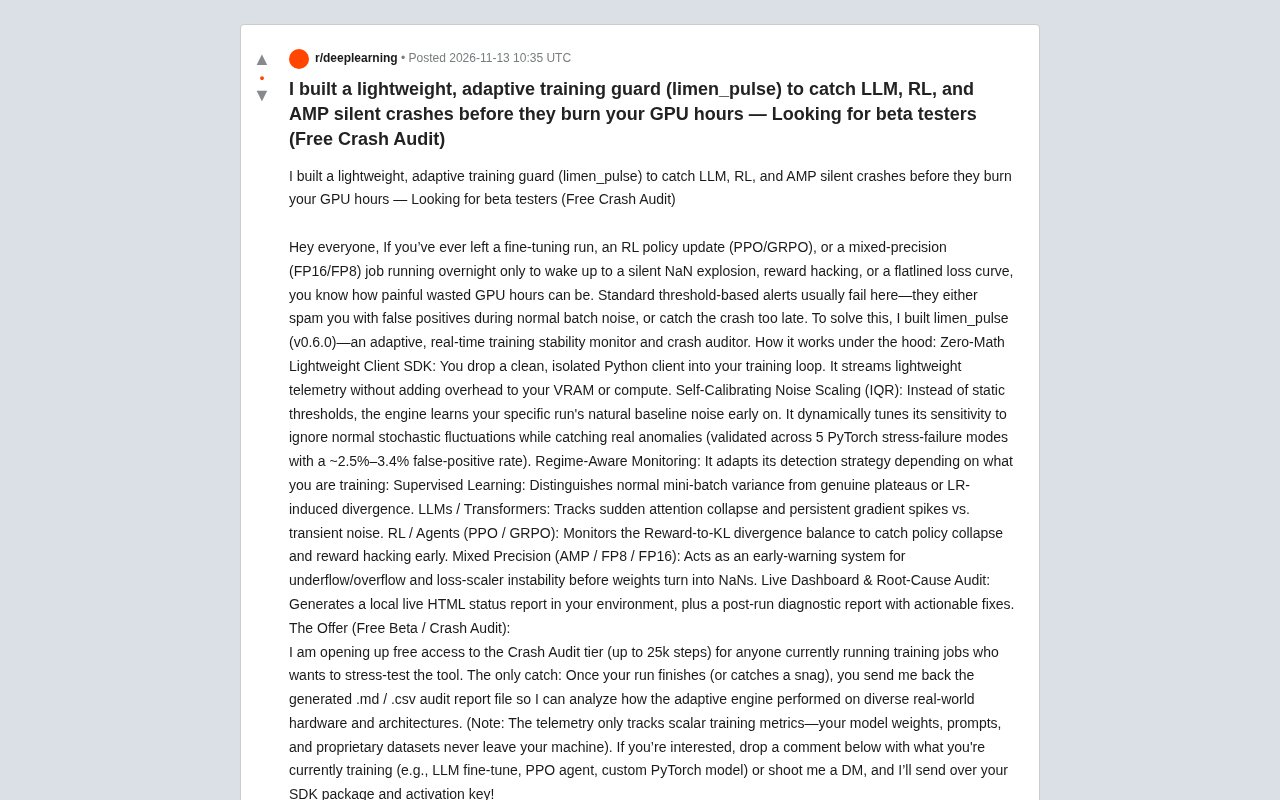
Core Design: A Lightweight Client That Stays Out of the Way + a Noise Engine That Learns
limen_pulse's architecture is built around two principles: zero intrusion into the training loop, and replacing static thresholds with adaptivity.
A Math-Free, Lightweight Client SDK
The developer provides a clean, isolated Python client that plugs directly into your training loop. It only streams lightweight telemetry data—no VRAM consumption, no extra overhead on the computation graph. That means you don't need to refactor your training code just to add monitoring, and monitoring itself won't slow down training.
Self-Calibrating Noise Scaling (IQR)
This is the core of what sets the tool apart from traditional alerting. Early in training, the engine learns the run-specific baseline noise for the current run, rather than applying a fixed set of thresholds. It then dynamically adjusts sensitivity: normal random fluctuations are ignored, while real anomalies are amplified. According to the developer, this approach was validated across 5 PyTorch stress-failure modes, with a false positive rate of roughly 2.5%–3.4%—a fairly restrained false-alarm level for 3 a.m. alerts.
IQR (Interquartile Range) is a robust statistical measure of dispersion, defined as the difference between the 75th percentile (Q3) and the 25th percentile (Q1) of the data. Unlike standard deviation, IQR does not assume the data follows a normal distribution and is insensitive to outliers. In training monitoring scenarios, loss value sequences often exhibit non-stationary, heavy-tailed distributions due to batch noise, learning rate warmup, and other factors—using mean and standard deviation directly makes them susceptible to interference from extreme values. limen_pulse uses IQR to characterize the baseline noise bandwidth and dynamically adjusts the anomaly decision boundary: alerts are only triggered when a new observation falls outside the reasonable range defined by the IQR. This approach adapts to noise levels across different training stages and reduces false positives.
"Situational Awareness" That Switches by Training Paradigm
limen_pulse doesn't treat all training the same—it switches detection strategies based on task type:
- Supervised learning: Distinguishes normal mini-batch variance from genuine plateaus or learning-rate-induced divergence.
- LLM/Transformer: Tracks attention collapse and persistent gradient spikes, filtering out transient noise.
- RL/agents (PPO/GRPO): Monitors the balance between reward and KL divergence, detecting policy collapse and reward hacking early.
- Mixed precision (AMP/FP8/FP16): Warns of underflow/overflow and loss scaler instability before weights turn into NaN.
Mixed-precision training (AMP) accelerates computation and reduces memory usage via lower-precision formats such as FP16 or FP8, but the narrower dynamic range makes it prone to gradient underflow (becoming 0) or overflow (becoming Inf/NaN). Loss scaling avoids gradient underflow by scaling up loss values, and dynamically adjusts the scaling factor when overflow is detected. Monitoring the trend of loss scaling factors and gradient norms can provide early warning of numerical instability before weights are corrupted. Reward hacking is a common problem in reinforcement learning: the agent finds loopholes in the reward function and obtains high rewards while deviating from the intended design, manifesting as a rising reward curve accompanied by abnormally increasing KL divergence or a sudden drop in policy entropy. limen_pulse can detect such anomalies early by jointly monitoring reward and KL divergence.
Real-Time Dashboard and Post-Mortem Root Cause Audit
Beyond real-time alerts, limen_pulse generates a viewable-in-real-time HTML status report locally, and outputs a diagnostic report with actionable remediation suggestions after training ends. For teams that need to review "exactly which step this training run went off the rails," post-mortem audits are often more valuable than real-time alerts.
The developer emphasizes that telemetry only collects scalar training metrics—model weights, prompts, and proprietary datasets never leave your machine. For teams with data compliance concerns, this is the precondition for whether they can even try it.
Telemetry here refers to scalar metrics automatically collected and transmitted during training, such as loss values, gradient norms, learning rate, and loss scaling factors. These data only reflect training state and do not include model weights, prompts, or dataset content, so privacy risk is low. limen_pulse emphasizes that telemetry is processed only locally and never uploaded to the cloud, meeting data compliance requirements. For distributed training, scalar metrics typically come from aggregation across ranks, and synchronization overhead should be noted; however, limen_pulse's lightweight client design avoids intrusion into the training loop.
Free Beta and the "Crash Audit" Exchange
The developer has opened free access to the Crash Audit tier (capped at 25k steps), aimed at users currently running training tasks who are willing to stress-test it. The exchange: after the run completes (or after catching an anomaly), send back the generated .md / .csv audit report to help analyze how the adaptive engine performs across different real hardware and architectures.
If you're doing LLM fine-tuning, PPO agents, or custom PyTorch model training, you can comment on the original post with your training type, or DM the developer directly to get the SDK package and activation key.
A Bit of Sober Judgment
The value of this kind of tool depends heavily on whether "adaptive" is truly adaptive. Noise characteristics vary widely across model scales, data distributions, and hardware; the 2.5%–3.4% false positive rate comes from the developer's own account of five stress-test modes and has not yet been validated at large scale across heterogeneous setups—which is precisely why he's recruiting beta testers. For teams sensitive to training costs, trading one free audit for a diagnostic report is low risk; but handing alert thresholds entirely to the tool without manual review is still premature.
One-line Summary
limen_pulse uses an adaptive IQR noise engine to monitor training stability in real time, catching silent crashes with a false positive rate of about 2.5%–3.4%.
Paragraph Summary
limen_pulse is a lightweight, adaptive training stability monitoring and crash audit tool designed to solve the "silent crash" problem in LLM, RL, and mixed-precision training where no error is reported. Its core is a self-calibrating IQR noise engine that learns the baseline noise of the current run early in training, dynamically adjusts sensitivity, and replaces static thresholds. The tool applies different anomaly detection strategies for supervised learning, LLMs, RL, and mixed-precision training, and provides a local real-time HTML dashboard and post-training diagnostic reports. Telemetry collects only scalar metrics, and data never leaves the local machine. The developer has opened a free Crash Audit tier (capped at 25k steps) in exchange for returning audit reports as part of beta testing. However, the adaptive effectiveness has not yet been validated at large scale across heterogeneous setups, and the false positive rate data comes from the developer's own account—manual review of alerts is recommended.
Related articles

ChatGPT Plus Subscription Pitfall Guide: Go/Plus/Pro Tier Comparison and Quick Activation
A complete ChatGPT Plus subscription guide based on a Bilibili tutorial: from registering an account, comparing Go/Plus/Pro tiers, to the practical steps for quickly completing your subscription.

GPT-6.2 Sol/Astra Released! A Step-by-Step ChatGPT Plus Subscription Guide and Tier Comparison
GPT-6.2 Sol/Astra is out—here's a ChatGPT Plus subscription guide: register an account, compare Go/Plus/Pro tiers, and subscribe in a minute.

Comparing Three Channels for Subscribing to GPT Plus in China: Is Website Top-Up the Easiest?
How to subscribe to GPT Plus in China? This article compares website top-up, credit card, and mobile top-up channels—process, cost, and risk—with steps and tips to help you choose wisely.