Ling-3.1-flash 1019 Update: Intelligence Index Hits 44, Open Weights Coming Soon

Ant's Ling-3.1-flash 1019 update: Intelligence Index 44, agent scores up, API and open weights coming soon.
Ant Group's Ling-3.1-flash is getting a '1019' update. Per Reddit citing the official announcement, the Artificial Analysis Intelligence Index rises from 41 to 44, with bigger agent gains: AutomationBench-AA up from 62% to 68% and AA-Briefcase Elo from ~1400 to 1524. API access and open weights are both marked 'coming soon,' with no date set. The agent metrics matter more than raw scores for coding and automation workflows, though frequent iterations raise version-management and migration concerns.
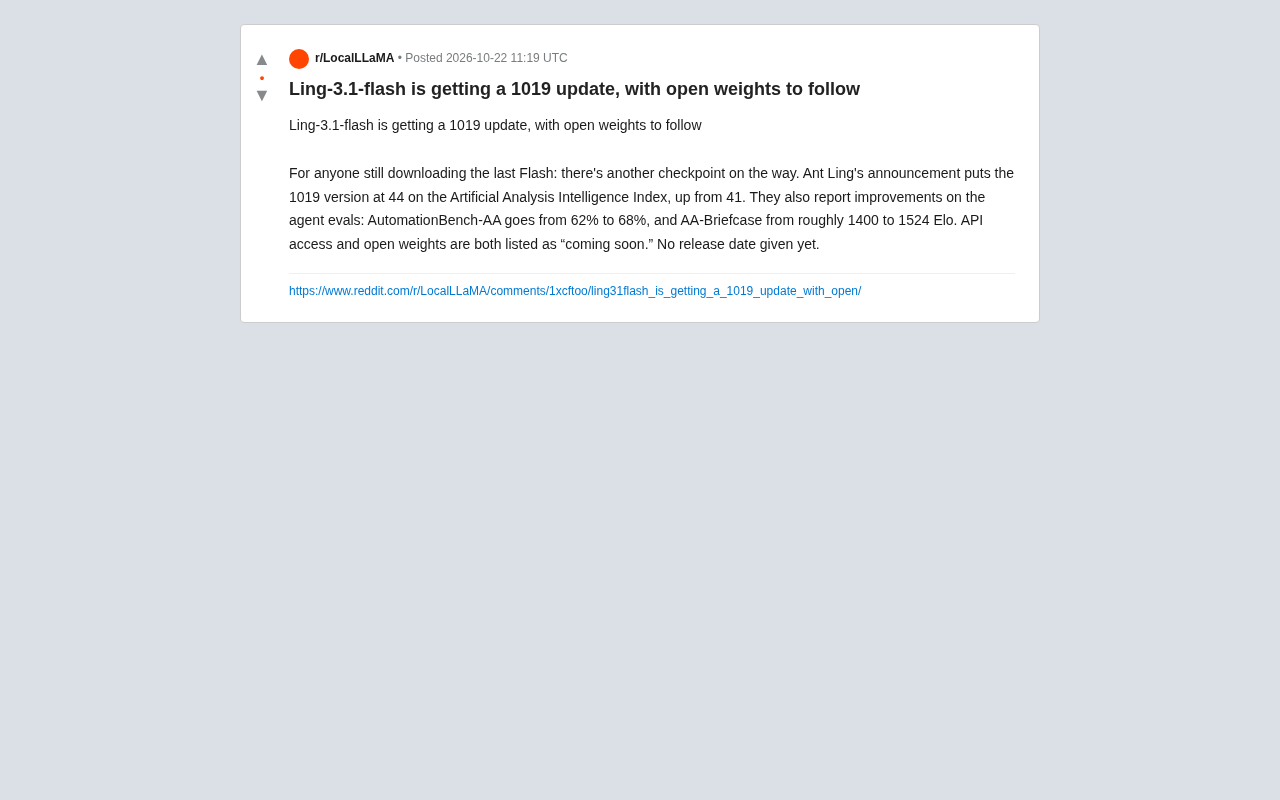
Ant Group's Ling-3.1-flash model is about to receive an update codenamed "1019." According to a Reddit community post citing an Ant Ling announcement, the new version improves its Artificial Analysis Intelligence Index score from 41 to 44, with notable gains in agent evaluations as well. More importantly, the announcement also lists API access and open weights, both marked as "coming soon."
Intelligence Index Up 3 Points, Agent Capabilities Improve More Noticeably
The Artificial Analysis Intelligence Index is a third-party benchmark measuring a model's overall reasoning ability, and a 3-point gain is a perceptible improvement among comparable updates. But the more noteworthy data comes from agent evaluations: AutomationBench-AA rises from 62% to 68%, and AA-Briefcase's Elo score climbs from roughly 1400 to 1524.
These two metrics point to the model's performance in actual task execution rather than pure question-answering ability. AutomationBench-AA measures automated task completion rate, and a 6-percentage-point gain means the model is more reliable in scenarios like tool calling and multi-step operations. AA-Briefcase uses an Elo rating mechanism, and a 124-point jump shows the new version has opened up a gap with the old one in adversarial evaluations.
For developers interested in open-source models, these numbers are more informative than raw benchmark scores—agent capabilities directly determine whether a model can handle real coding and automation workflows.
Artificial Analysis is an independent AI model evaluation organization whose Intelligence Index quantifies a model's overall reasoning ability by aggregating multiple standardized benchmarks (such as MMLU, GPQA, HumanEval, etc.). The index is widely cited in the industry because it attempts to provide a comparable framework across models and vendors. However, a single index cannot reflect differences in a model's performance on specific tasks, so it usually needs to be combined with domain-specific evaluation results to fully assess a model's capabilities.
The Elo rating in AA-Briefcase borrows from the chess rating system, dynamically adjusting scores based on head-to-head matchups between models. The absolute value of an Elo score is of limited significance on its own; what matters is its relative position compared with other models on the same leaderboard—1524 points means a high win rate against baseline models, but without leaderboard context it's hard to judge absolute competitiveness. AutomationBench-AA, meanwhile, focuses on end-to-end automated task completion rate, covering dimensions such as tool calling, multi-step planning, and error recovery. A 68% completion rate indicates the model has some production readiness, but there is still room for improvement before it reaches high reliability.
Open Weights "Coming Soon," but Timeline Still Unannounced
In the announcement, both API access and open weights are marked as "coming soon," with no specific release date given. This phrasing is common in model releases, but it also means the community will need to be patient.
Strategically, Ant Group is continuing the Ling series' open-source approach. Previous Ling models have already gained some attention in the open-source community, and opening the weights means developers can deploy locally, fine-tune, and use them in private environments. For enterprise users who need data isolation, this is an important option beyond the API.
However, the vague "coming soon" phrasing also brings uncertainty. Some Reddit users joked, "Still downloading the last Flash version, and the new one is already coming," reflecting how the accelerating pace of model iterations troubles users. Version management and migration costs are real issues that open-source model users must face.
Open weights refer to the neural network parameter files made public after a model is trained; developers can download them and run or fine-tune the model locally or on private servers. Unlike fully open-source training code and data, open weights usually do not disclose training details but are sufficient to support local deployment and secondary development. For data-sensitive industries such as finance and healthcare, open weights mean the model can be used without sending data outside the internal network—an advantage that API calls cannot replace. Common open-weight licenses include Apache 2.0, MIT, and community licenses with usage restrictions; differences in terms directly affect the feasibility of commercial adoption.
Why Agent Evaluations Matter More Than the Intelligence Index
Where does an Intelligence Index score of 44 place the model in the current model lineup? That requires looking at the specific leaderboard, but a 3-point gain indicates a solid iteration rather than marketing packaging.
The agent evaluation data is more telling. AutomationBench-AA's 68% completion rate means the model still has about a one-third failure margin in automated tasks—still some distance from a reliable production-grade agent, but the direction of progress is clear. AA-Briefcase's Elo of 1524 requires comparison with other models on the same leaderboard to judge relative position, and the announcement did not provide that context.
From a developer's perspective, improved agent capabilities directly affect whether the model can be used for coding assistants, automated testing, workflow orchestration, and similar scenarios. If the 1019 version delivers these benchmark gains in real-world use, Ling-3.1-flash's competitiveness among open-source models will be further strengthened.
Faster Release Cadence, Community Expectation and Concern Coexist
The short interval between this update and the previous Flash version reflects the competitive pace in the large-model field. Ant Group is keeping its models fresh through frequent iterations, but the community needs time to digest and evaluate each version.
Reddit discussions contain both anticipation for performance gains and concern about version fragmentation. The promise of open weights "coming soon" needs a timeline before developers can plan migrations. Before the official date is announced, it is advisable to follow updates in the Ling series repositories and keep an eye on changes to the API documentation.
For teams currently using the older Flash version, they can evaluate in advance whether the 1019 version's improvements on agent tasks are worth upgrading for, while also paying attention to the license terms for the open weights—these often affect practical adoption decisions more than benchmark scores.
One-line Summary
Ant's Ling-3.1-flash will receive the 1019 update, raising its Intelligence Index to 44, significantly improving agent capabilities, with API and open weights coming soon.
Paragraph Summary
Ant Group's Ling-3.1-flash model is about to release an update codenamed "1019." According to Reddit citing an official announcement, the new version raises its Artificial Analysis Intelligence Index from 41 to 44, with more notable gains in agent evaluations: AutomationBench-AA rises from 62% to 68%, and AA-Briefcase Elo increases from about 1400 to 1524. The announcement also lists API access and open weights, both marked "coming soon," but no specific date was disclosed. The article argues that agent capability data is more informative than raw benchmark scores and directly relates to whether the model can handle coding assistants and automation workflows. Frequent iterations also bring version management and migration cost issues, and developers should pay attention to license terms and repository update news.
Related articles

Amphibious Transforming Drone: Beyond 100x Power Savings, What Are the Real Needs?
Is the amphibious transforming drone just a gimmick? Starting from the 100x power difference of the M4 Morphobot, explore real application scenarios and thesis topic ideas, analyzing boundary conditions where pure drones and pure ground robots both fail.

Warhound Raises $200 Million: Genetically Engineered "War Dogs" Paired with Anduril Gear
Warhound raises $200M, backed by Ben Lamm and Palmer Luckey, to genetically engineer dogs for military and law enforcement use and equip them with Anduril gear. This article analyzes its technology direction, funding logic, and ethical controversy.

Claude API Comes to Google Cloud: IAM Integration and SDK Access Guide
Anthropic hosts the full Claude API on Google Cloud with IAM-controlled permissions and unified billing. This guide covers the Vertex AI and Anthropic-hosted entry points, IAM role configuration, and SDK access.