Linkly AI Clipper: Save Webpages as AI Agent-Friendly Markdown
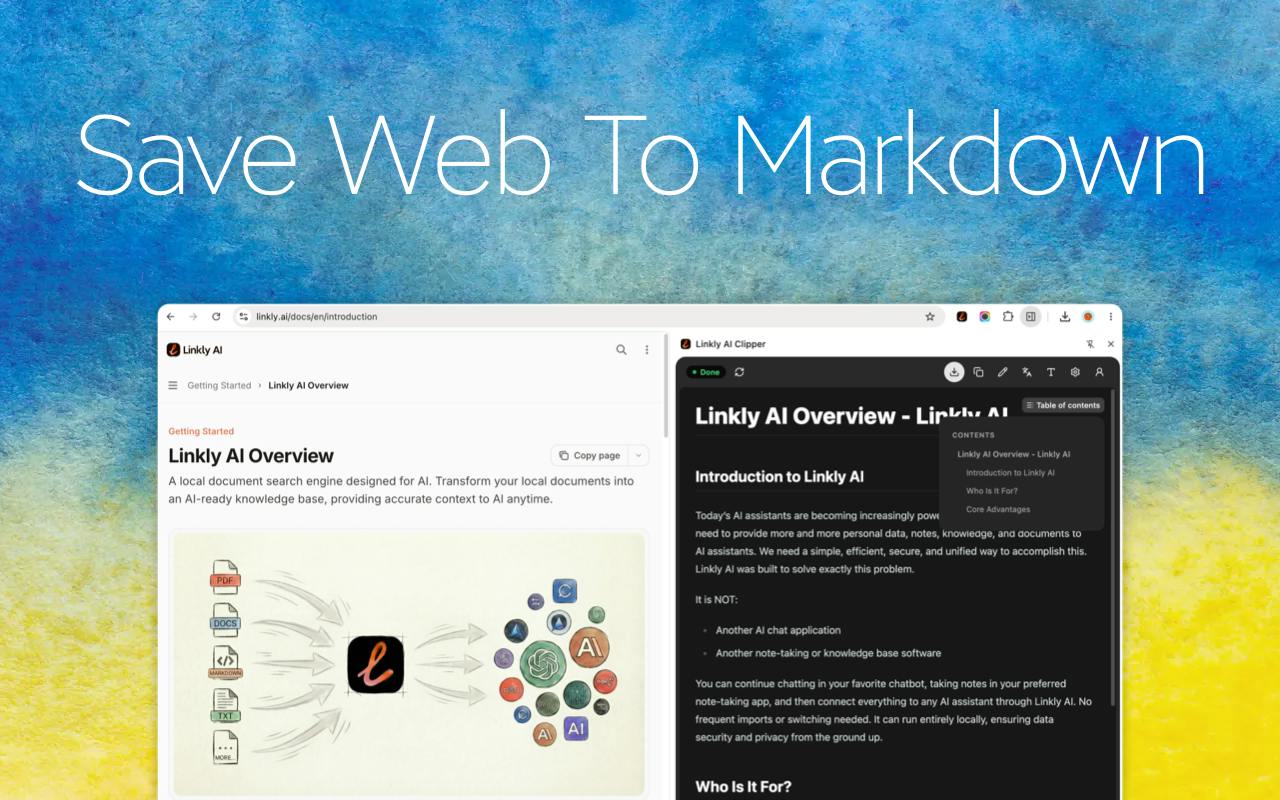
Linkly AI Clipper uses a browser extension to convert webpages into Agent-friendly structured Markdown in one click.
Linkly AI Clipper is a Chrome extension that converts the current webpage into well-formatted Markdown with one click, with sidebar preview, copy, or download. Its core selling point is "Agent-friendly": removing noise like ads and navigation, preserving heading hierarchy and code blocks, and improving token efficiency, so webpage content can serve directly as large model context, RAG corpus, or Agent tool-call input. It takes a lightweight single-point approach without cloud sync or batch scraping, suited to scattered collection rather than systematic corpus engineering. It got 67 upvotes and ranked #16 on its first day on Product Hunt, still in the niche early-adopter stage, but it has hit the trend that webpage readability standards are being redefined by Agents.
Why We Need an "AI-Friendly" Web Clipping Tool
When using large models to process web content, the most troublesome part is often not the model itself, but the process of "feeding" the webpage into it: ads, navigation bars, and script residue mixed into the body text consume a large number of tokens as noise, and the model easily loses focus on what matters. Linkly AI Clipper aims to solve exactly this link—using a browser extension to convert the current page into clean, structured Markdown in one click, ready for AI Agents to use.
It was launched on Product Hunt with the tagline "Save web as an Agent-friendly Markdown browser extension," positioned as a Chrome extension in the productivity and note-taking category. On its launch day it received 67 upvotes and 3 comments, ranking #16. The data shows it's not a breakout hit, but the direction itself is worth attention: as AI Agents become the new subject of content consumption, the standard for webpage "readability" is being redefined.
Token efficiency refers to the proportion of useful information in the model's input. Raw webpage HTML usually contains large amounts of navigation, scripts, styles, and advertising code, so a single request may consume tens of thousands of tokens, of which only a small portion is truly useful body text. Since mainstream large models charge by token and have context window limits, noise not only drives up costs but also dilutes key information and reduces the model's ability to locate important points. Converting a webpage into Markdown that retains only the body text and necessary structure is essentially "noise-reduction compression" on the input side, letting the same length of context carry more effective semantics.
Product Form: One-Click Conversion in the Sidebar
Linkly AI Clipper's interaction is pared down to the bare minimum: click the extension icon, and the current page is converted into well-formatted Markdown, with the result displayed in the browser sidebar. Users can preview the result in the sidebar, then decide whether to copy it to the clipboard or download it as a file.
This three-step design of "preview—copy—download" corresponds to three typical scenarios: temporarily pasting a piece of content into a chat window, saving a full page of material into a local knowledge base, and handing a webpage as context to an automated workflow. The three keywords the official description emphasizes are simple, lightweight, and that all saved content is optimized for AI Agents—meaning the output is not a webpage snapshot for humans to view, but structured text for models to read.
What "Agent-Friendly" Really Means
The keyword in this tagline is worth unpacking. For an AI Agent, an ideal webpage input should satisfy at least a few conditions: body text separated from noise, heading hierarchy preserved, structures such as links and code blocks not lost, and sufficient token efficiency. Markdown happens to be the intersection of these requirements—it is much lighter than HTML, yet retains the necessary structural information that plain text lacks.
By making "optimized for Agent use" its core selling point, Linkly AI Clipper means that during conversion it tends to strip out non-body elements such as navigation and ads while preserving semantic structure. For users who need to use webpage content as RAG corpora, Agent tool-call results, or prompt context, this is far more reliable than the traditional "Save Page As" or manual copy-paste.
You may not have noticed that most webpage clipping tools on the market are aimed at human reading and note organization, with output formats mainly rich text or proprietary note formats. Clipping tools that explicitly target Agent consumption as their first goal remain rare, and Linkly AI Clipper has hit a niche need that is taking shape.
RAG (Retrieval-Augmented Generation) is a technical approach that lets a model retrieve external material before answering: documents are split into chunks, vectorized, and stored in an index, and when a question is asked, relevant chunks are recalled and spliced into the prompt. Its opposite is answering purely from the memory stored in the model's parameters. The upstream of RAG is corpus quality—if the original webpages are chunked into the database along with navigation menus, copyright notices, and recommendation slots, the retrieval stage is easily disturbed by these irrelevant chunks, and the generated answers go off track accordingly. Therefore, the collection stage aimed at RAG generally emphasizes body-text extraction and structure preservation; clean Markdown chunks are both easy to split by heading hierarchy and make citation tracing clearer.
Agent tool calling refers to a large model actively calling external functions or interfaces during operation to obtain information and perform actions, rather than answering solely from a single prompt. For example, an Agent can call a webpage-fetching tool to read a certain link, then use the returned content as context for subsequent reasoning. Such scenarios are particularly sensitive to the return format: messy HTML eats up context quota and increases the parsing failure rate, while well-formed Markdown is closer to the large number of document formats the model has seen during training, making parsing and locating more stable. This is also why "webpage formats for Agents to read" are gradually becoming independent of "webpage formats for humans to read."
The Trade-offs of the Lightweight Approach
Judging from the product information, Linkly AI Clipper takes a single-point tool approach: no note management, no cloud sync, no complex template system—it just does "webpage to Markdown" cleanly. For users tired of heavyweight knowledge management suites, this restraint is actually an advantage—install and use, with no learning curve.
The cost is also obvious. The lack of capabilities such as batch scraping, site-level rule customization, and output format fine-tuning means it is better suited to scattered content collection than to systematic corpus engineering. The first-day popularity of 67 upvotes and 3 comments also shows that it is still in the niche early-adopter stage, and its product maturity and ecosystem accumulation remain to be seen.
Who Should Use It
The first group is content workers who frequently converse with large models: converting reference material into Markdown in one click before pasting is more controllable than dropping a link directly, and it avoids information loss when the model scrapes the webpage. The second group is developers building personal knowledge bases or RAG pipelines: clean Markdown is high-quality raw corpus. The third group is automation enthusiasts who need to inject webpage context into Agent workflows.
Conversely, if what you need is complete webpage archiving, mixed text-and-image notes, or a team collaboration space, this tool is not for you. It is a sharp little knife, not a Swiss Army knife.
Conclusion
The value of Linkly AI Clipper lies not in how complex its features are, but in that it has turned a detail that is becoming important into a product: before webpage content enters the AI world, it needs a "translation" in format. As Agents increasingly browse and digest information on behalf of humans, lightweight tools oriented toward machine readability may become more common than clipping tools oriented toward human reading.
One-line Summary
Linkly AI Clipper uses a browser extension to convert webpages into Agent-friendly structured Markdown in one click.
Paragraph Summary
Linkly AI Clipper is a Chrome extension that converts the current webpage into well-formatted Markdown with a single click of the icon, and lets you preview, copy, or download it in the sidebar. Its core selling point is not note management but "Agent-friendly": stripping out noise such as ads and navigation, preserving structures such as heading hierarchy and code blocks, and improving token efficiency, so that webpage content can be directly used as input for large model context, RAG corpora, or Agent tool calls. The product takes a lightweight single-point approach, with no cloud sync or batch scraping, suitable for scattered collection rather than systematic corpus engineering. It received 67 upvotes and ranked #16 on its first day on Product Hunt and is still in the niche early-adopter stage, but it has hit the trend that "the standard for webpage readability is being redefined by Agents."
Related articles

AI Coding Model Leaderboard: Opus 5.5 Crowned, Gemini Neon Stages a Comeback
Tech blogger Matthew Berman releases an AI coding model tier list: Claude Opus 5.5 holds S-tier, Gemini Neon surprises with A-tier, OpenAI Astra lands B-tier. How do open-source models like DeepSeek fare? We break down the scoring logic and practical takeaways.

New Jersey Joe Sandwich: Meat and Coleslaw on Triple-Decker Rye
New Jersey Sloppy Joe isn't a ground beef burger—it's triple-decker rye bread with meat, Swiss cheese, and coleslaw, plus Russian dressing. Learn the authentic Essex County method and family recipe.

Genie 4's New Trick: Change Scenes in Real Time While Exploring Generated Worlds, and Add Characters Too
Google Genie 4 adds real-time prompting: enter new prompts while exploring generated worlds to add characters or switch scenes, with native audio adapting in sync. Available to eligible Google AI Ultra subscribers in Project Genie.