Linux Creator Calls Anti-AI Rules 'Idiotic,' Sparks Heated Debate on the Boundaries of AI Coding

Torvalds called anti-AI rules idiotic; the community debate centers on the difference between responsible engineering and mindless reliance.
The article revolves around the Reddit discussion sparked by Linus Torvalds calling anti-AI rules "idiotic," noting that community reactions are polarized and that Torvalds supports responsible AI use rather than mindless reliance. The core distinction in the discussion is between "using AI for engineering" and "vibe coding": the former involves humans taking responsibility for architecture, design, interface definition, and code review, commanding LLMs as a junior engineer team; the latter expects one sentence to generate a complete application. AI accelerates grunt work like writing code, testing, debugging, and documentation, but architecture, UX, and innovative ideas still require substantial human time. The article also points out that simple applications are losing value due to AI, executives have a cognitive gap regarding AI capabilities, and the term "vibe coding" originated from Karpathy and has been misused and stigmatized. The conclusion is that the question is not whether to use AI, but whether users have the ability to understand and manage AI output.
Title
Linux Creator Calls Anti-AI Rules "Idiotic," Sparks Heated Debate on the Boundaries of AI Coding
Meta Description
Linus Torvalds calling anti-AI rules "idiotic" has ignited Reddit debate. Developers clash over engineering vs. vibe coding: AI speeds up grunt work, but architecture, design, and understanding remain human core value, and simple apps are rapidly losing value.
Article Content
Linux founder Linus Torvalds recently called certain anti-AI rules "idiotic," sparking intense discussion among developers on Reddit. The debate goes far beyond emotional venting—it touches on a core contradiction in the use of AI programming tools: the essential difference between "engineering" and "vibe coding."
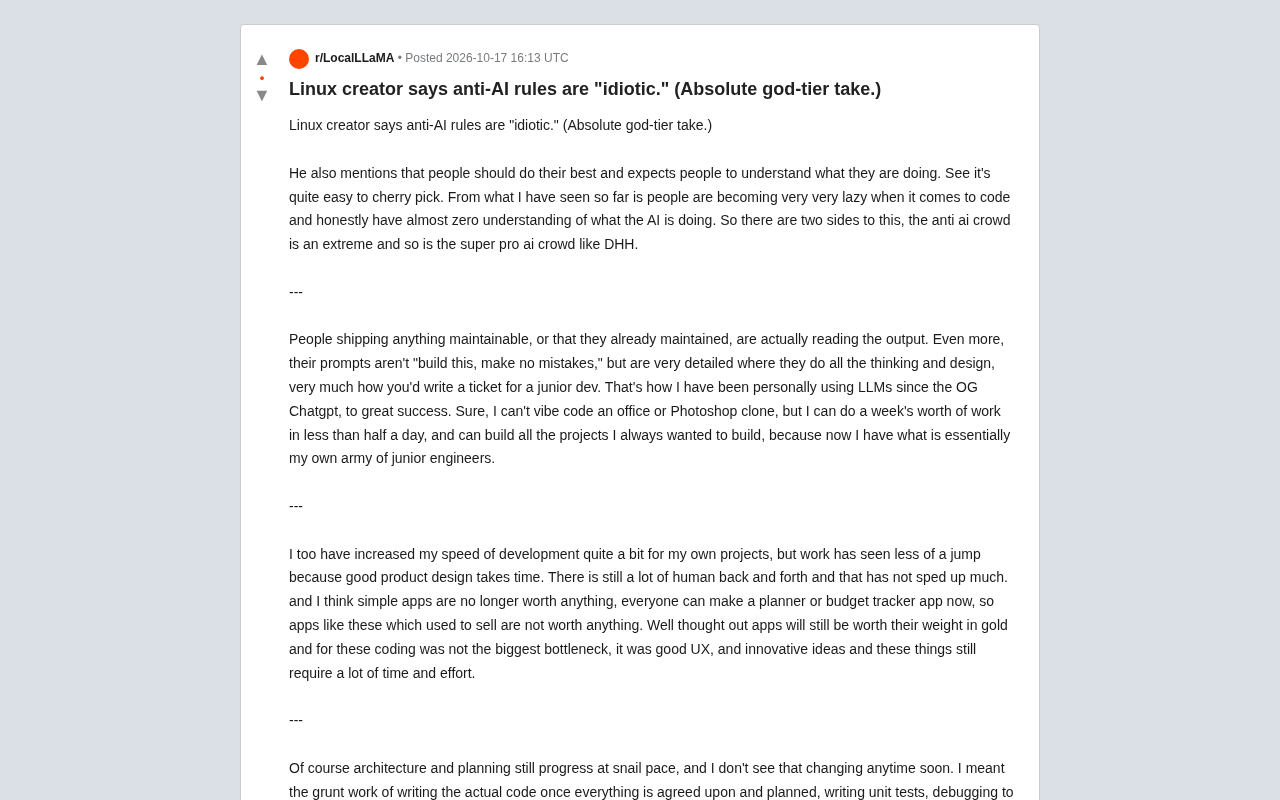
Linus's "Idiotic" Claim and Polarized Developer Reactions
According to the Reddit post, Torvalds considers anti-AI rules to be "idiotic," while also emphasizing that people should do their best and be expected to understand what they're doing. This seemingly simple statement was quickly interpreted by the community as "god-tier" support for AI programming.
However, developer reactions were not one-sided. Some users stated bluntly that what they've observed is many people becoming "very, very lazy" when writing code, with "almost zero understanding" of what the AI is doing. This user pointed out that the anti-AI crowd represents one extreme, while super AI-supporters like DHH represent another extreme.
This polarization precisely illustrates the high risk of Torvalds's words being taken out of context. What he supports is responsible use of AI, not mindless reliance on it.
The Line Between "Engineering" and "Vibe Coding"
A key distinction repeatedly mentioned in the discussion is: using AI for engineering and vibe coding are two different things.
One developer described their approach: starting from the earliest ChatGPT, they treated LLMs as a "team of junior engineers." The prompts weren't "build this, don't make mistakes," but rather extremely detailed explanations of the thinking process and design, like writing tickets for junior developers. In this mode, they could complete a week's worth of work in less than half a day—but the prerequisite is taking on all the thinking and design themselves.
Another developer with nearly 20 years of personal project experience put it more clearly: in the past, they read a lot of literature and understood the mechanisms and principles, but had no hands to implement them. Now they focus on architecture, algorithm and library selection, defining interfaces, contracts, and boundaries between components, then letting the LLM fill in the implementation. Reviewing each component and test still takes time, but it's at least 20 times faster than pure manual work.
A commenter hit the nail on the head, pointing out that the fundamental difference from "vibe coding" is ENGINEERING. Some believe the term "vibe coding" is used to lump everyone who uses AI into one category so their work can be dismissed without engaging in genuine intellectual discussion.
What AI Accelerates and What It Doesn't
The improvement in development speed is not uniform across the board. Some users noted that their personal project development speed increased dramatically, but the improvement at work was less obvious because "good product design takes time."
There's still a lot of back-and-forth communication between humans, and that part has barely accelerated. The more important change is that the value of simple applications is approaching zero. Now everyone can build a planner or budget tracker app—applications that once could be sold are no longer valuable. Well-thought-out applications remain invaluable because their bottleneck was never coding, but rather good user experience and innovative ideas, which still require substantial time and effort.
Architecture and planning remain slow-moving and won't change in the short term. What AI accelerates is the "grunt work": writing actual code once everything is agreed upon and planned, writing unit tests, debugging, and writing documentation.
Executives' Misunderstanding and the Real Barrier
Another sharp observation in the discussion is the cognitive disconnect between software developers and executives. Executives think that with Claude, they can directly generate entire applications with prompts like "build an X, but with good design," unaware that there are still a thousand steps in between that depend on qualified software developers.
But this doesn't mean the barrier hasn't been lowered. Some comments suggest that the entry barrier in tech has significantly decreased, and ultimately those with zero understanding will hit a wall and need people with real experience and skills to navigate. Meanwhile, those who truly have skills and experience are quietly enjoying this subsidized, super-useful tool.
Using AI itself is not the problem—the problem is whether you understand what you're doing. As the original post says, people should do their best and understand what they're doing—this is perhaps the most memorable takeaway from this debate.
The Birth and Misuse of a Term
Regarding the origin of the term "vibe coding," some users pointed out it came from an Andrej Karpathy tweet (link), although the term's current usage differs from its original definition. Others acknowledged that the term is indeed used in negative contexts.
The stigmatization of this term has made discussions about AI programming more difficult. Conflating "engineers who use AI" with "vibe coders" is neither fair nor helpful for truly understanding the appropriate role of AI tools in software development.
Andrej Karpathy is a founding member of OpenAI, former Director of AI at Tesla, and now founder of Eureka Labs. He is one of the most influential evangelists in the field of deep learning. He coined the term "vibe coding" in 2023, originally referring to an experimental approach of completely letting go and having AI generate code without scrutiny—users don't even look closely at the generated code, relying solely on intuition to sense whether the results meet expectations. Karpathy used it to describe a relaxed, exploratory coding experience not premised on engineering rigor, with an obvious tone of jest and self-deprecation. But after the term entered public discussion, its meaning drifted, gradually being used to broadly refer to any behavior of writing code with AI, and acquiring pejorative connotations of "unprofessional" and "lazy." This slippage from a specific experimental scenario to a generalized label is precisely the root of what the original text calls "terminological stigmatization."
Conclusion: Not Pro-AI or Anti-AI, But Understanding vs. Not Understanding
The reason Torvalds's "idiotic" claim spread widely is that it resonated with the emotions of the pro-AI camp. But looking at the full discussion, what the community truly cares about is not whether to ban or encourage AI, but whether users have the ability to understand and manage AI output.
Treating AI as a team of junior engineers to command, while taking responsibility for architecture, design, and review yourself—that's the engineer's approach. Treating AI as a magic button, expecting one sentence to generate a complete application—that's the approach that hits a wall. The gap between the two is the core insight of this discussion.
One-line Summary
Torvalds called anti-AI rules idiotic; the community debate centers on the difference between responsible engineering and mindless reliance.
Paragraph Summary
The article revolves around the Reddit discussion sparked by Linus Torvalds calling anti-AI rules "idiotic," noting that community reactions are polarized and that Torvalds supports responsible AI use rather than mindless reliance. The core distinction in the discussion is between "using AI for engineering" and "vibe coding": the former involves humans taking responsibility for architecture, design, interface definition, and code review, commanding LLMs as a junior engineer team; the latter expects one sentence to generate a complete application. AI accelerates grunt work like writing code, testing, debugging, and documentation, but architecture, UX, and innovative ideas still require substantial human time. The article also points out that simple applications are losing value due to AI, executives have a cognitive gap regarding AI capabilities, and the term "vibe coding" originated from Karpathy and has been misused and stigmatized. The conclusion is that the question is not whether to use AI, but whether users have the ability to understand and manage AI output.
Related articles

5 Practical Ways Real Estate Agents Can Use AI to Boost Efficiency (2026 Edition)
How can real estate agents use AI to boost efficiency? Based on a YouTube walkthrough, this breaks down five methods — ChatGPT for listing descriptions, Canva for marketing materials, forms for open house leads, Zapier for automated follow-up, and seller meeting prep — and flags risk boundaries like fair housing laws, photo authenticity, and price verification.

Grok Bot vs ChatGPT Agent: Which AI Agent Is More Powerful?
How does Grok Bot differ from ChatGPT Agent? This comparison examines how they work: Grok Bot has a cloud computer and runs persistently inside tools to execute multi-step tasks automatically; ChatGPT Agent operates web pages in a browser and is more mature at general tasks. Includes selection advice.

Walmart Agent Gateway: AI Shops for You Automatically—Why Is Amazon Going the Opposite Way?
Walmart's Agent Gateway lets ChatGPT, Gemini and other AI assistants access its product catalog to search, compare and add to cart, with spending limits and per-purchase approval. Amazon blocks external AI agents—two retail giants, opposite paths. Currently US-only, India may follow.