Liquid AI LFM2.5-24B Tested on Mac mini M6: 70 TPS and 128K Context

LFM2.5-24B achieves ~70 tokens/sec local inference on Mac mini M6 with 4-bit quantization, enhanced by Shortcuts optimization.
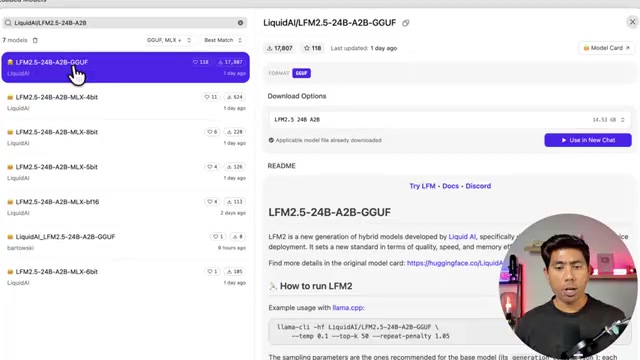
Based on a Bilibili creator's hands-on video, this article covers Liquid AI's LFM2.5-24B local deployment on Mac mini M6 (32GB RAM). This 24B MoE model outperforms Qwen on agentic and tool-use tasks, running at ~68.8-71.21 tokens/sec with 4-bit quantization in LM Studio at ~28GB memory, stably handling 50K+ token sessions within its 128K context window. Apple Shortcuts and skill encapsulation improve OpenClaw responsiveness and reduce token usage. Compared to a 2.6B model, the 24B offers smoother agent experience despite higher memory use.
Liquid AI's LFM2.5-24B model has drawn widespread attention in the local inference space. A Bilibili creator conducted detailed testing on a Mac mini M6 (32GB RAM) using the OpenClaw framework and the 4-bit quantized version, achieving approximately 70 tokens/second inference speed and successfully running within a 128K context window. This article, based on that video's content, organizes the key performance data, optimization techniques, and comparisons with smaller models to provide a reference for developers interested in local AI deployment.
Model Performance and Benchmark Results
According to the creator, LFM2.5-24B is a 24B-parameter MoE model that performs exceptionally well on agentic and tool-use tasks. The video cites benchmark data: it scores 48.09 on the LiveClaw evaluation, while the compared Qwen model scores 38.19, demonstrating an advantage with roughly 50% of the total and activated parameters. The creator notes that this model outperforms Qwen on most benchmarks, being only slightly weaker on Web Arena and Pinch Bench.
In actual inference tests, the creator loaded the 4-bit quantized model using LM Studio and obtained 68.8 tokens/second with simple prompts; when the question involved OpenClawAd, the speed reached 71.21 tokens/second. Memory usage was approximately 28GB, with the model fully loaded and running OpenClaw background tasks.
The core of the MoE (Mixture of Experts) architecture lies in splitting the model into multiple "expert" subnetworks, activating only a few of them per inference. Thus, while the total parameter count is large, the number of activated parameters actually involved in computation is significantly smaller. This is the background for the article's statements about "24B parameters" and "an advantage with roughly 50% of the total and activated parameters": LFM2.5-24B has 24B total parameters, but each token generation only invokes a subset of them, thereby reducing compute and VRAM requirements while maintaining large knowledge capacity—this is also the prerequisite for running it with 4-bit quantization on a 32GB Mac mini.
OpenClaw Integration and Optimization on Mac mini M6
The creator emphasizes that efficiently running this model on the Mac mini M6 requires optimizing the inference engine and quantization choice. He chose 4-bit quantization rather than 5-bit or 6-bit to avoid hitting the 32GB memory ceiling. At the same time, he leveraged Apple Shortcuts and the system's built-in AI foundation models to create a series of automated actions, significantly improving OpenClaw's response speed.
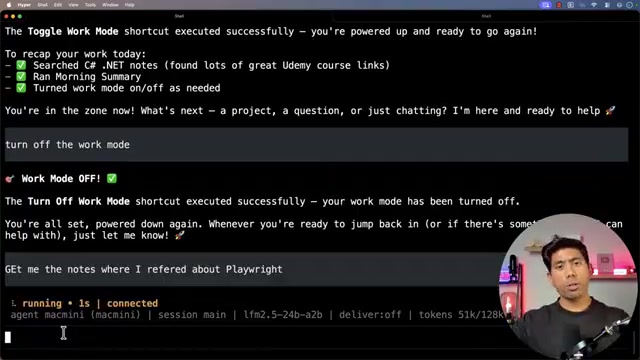
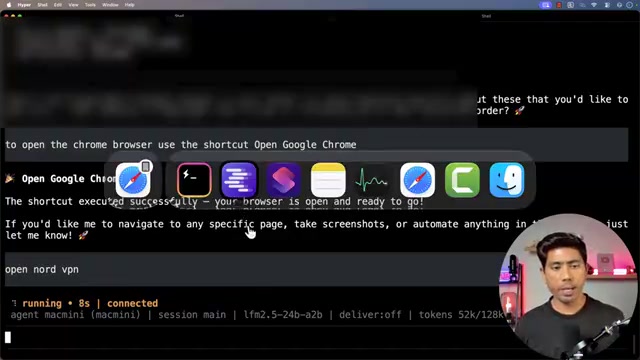
For example, Shortcuts enable a "work mode" toggle (automatically opening VS Code and Notes), querying Apple Notes content, opening the Chrome browser, connecting to NordVPN, and more. The creator demonstrated instructing OpenClaw in natural language to invoke these shortcuts, with operations completing almost instantly. He also noted that OpenClaw can remember shortcuts it has already used and automatically reuse them in subsequent requests.
4-bit quantization refers to compressing model weights from 16-bit floating point to 4-bit integer representation, reducing model size and memory usage to about one quarter, at the cost of a small amount of precision loss. For local deployment, quantization bit width is a key trade-off between memory and quality: lower bit width saves more memory, but too low harms inference quality. The article chooses 4-bit rather than 5-bit or 6-bit precisely because the 24B model's weight size at 5-bit/6-bit would approach or even exceed the 32GB unified memory ceiling, leaving insufficient space for the system and OpenClaw background tasks—making 4-bit the upper limit for stable operation on this hardware.
Context Management and Skill Reuse
Within the 128K context window, the creator demonstrated the ability to handle sessions of 50,000+ tokens. The terminal showed approximately 51,000 tokens used, and the model continued to generate responses stably. LM Studio's server logs showed that prompt processing speed and generation speed remained good.
The creator also introduced the concept of "skills": encapsulating commonly used shortcuts as skills for OpenClaw to call. This reduces the number of tokens sent to the large model, lowering inference overhead. For example, by creating dedicated skills for Apple Notes and Reminders, the model only needs to call the skill name rather than detailed steps.
A context window refers to the total number of tokens a model can "remember" in a single conversation; 128K means approximately 128,000 tokens. Because the Transformer's attention mechanism computation grows with context length, long contexts significantly increase prompt processing time and memory usage (with the KV Cache expanding accordingly). The article's session of approximately 51,000 tokens is already near half the window and still generates stably, indicating that the model's long-context efficiency is good; the reason "skill" encapsulation reduces overhead is that it replaces lengthy operation steps with short invocation names, directly reducing the number of tokens injected per request and thereby shortening prompt processing time.
Comparison with Smaller Models: The Trade-off Between Speed and Intelligence
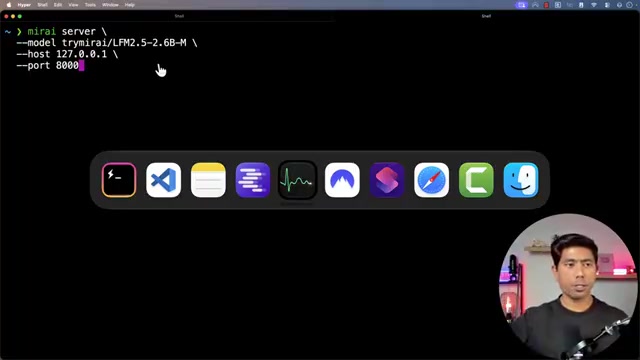
To demonstrate the difference, the creator replaced the model with LFM2.5-2.6B (run via the Mirai AI server). In the same OpenClaw task (with work mode disabled), the smaller model's memory usage dropped to 17GB, but operations took noticeably longer, generation speed was approximately 54.2 tokens/second, and the task was not completed in time.
In contrast, the 24B model, despite using nearly 30GB of memory, responded quickly and achieved high task completion. The creator concluded: small models save memory but insufficient intelligence leads to operational delays; the large model provides a smoother agent experience on a 32GB Mac mini.
Limitations and Future Testing
In the current tests, the NordVPN shortcut cannot specify a connection location, which the creator suspects requires writing a script to resolve. Additionally, he has not yet tested the model on an Apple M5 Max, but cites documentation claiming it can reach 184 tokens/second. The creator stated that if viewers are interested, he can further test M5 models and more complex task scenarios.
Overall, LFM2.5-24B demonstrates excellent local inference performance on the Mac mini M6, and combined with shortcut optimization, provides a viable solution for a personal AI assistant. For users with 32GB Apple Silicon devices, this is a model worth trying.
One-line Summary
LFM2.5-24B achieves approximately 70 tokens/second local inference on Mac mini M6 with 4-bit quantization, enhancing the agent experience with Shortcuts optimization.
Paragraph Summary
Based on a Bilibili creator's hands-on video, this article organizes the local deployment performance of Liquid AI's LFM2.5-24B model on a Mac mini M6 (32GB RAM). This 24B MoE model outperforms the compared Qwen model on agentic and tool-use tasks. After loading the 4-bit quantized version with LM Studio, inference speed is approximately 68.8 to 71.21 tokens/second, memory usage is about 28GB, and it can stably handle sessions of over 50,000 tokens within a 128K context window. The creator improved OpenClaw's response speed and reduced token consumption through Apple Shortcuts and "skill" encapsulation. Comparison with a 2.6B small model shows that the small model saves memory but insufficient intelligence leads to task delays, while the 24B model provides a smoother experience.
Related articles

Amphibious Transforming Drone: Beyond 100x Power Savings, What Are the Real Needs?
Is the amphibious transforming drone just a gimmick? Starting from the 100x power difference of the M4 Morphobot, explore real application scenarios and thesis topic ideas, analyzing boundary conditions where pure drones and pure ground robots both fail.

Warhound Raises $200 Million: Genetically Engineered "War Dogs" Paired with Anduril Gear
Warhound raises $200M, backed by Ben Lamm and Palmer Luckey, to genetically engineer dogs for military and law enforcement use and equip them with Anduril gear. This article analyzes its technology direction, funding logic, and ethical controversy.

Claude API Comes to Google Cloud: IAM Integration and SDK Access Guide
Anthropic hosts the full Claude API on Google Cloud with IAM-controlled permissions and unified billing. This guide covers the Vertex AI and Anthropic-hosted entry points, IAM role configuration, and SDK access.