Living Brain: Breaking Down AI Memory Silos to Give Agents Persistent Memory

Living Brain launches a cross-model interoperable memory layer that lets AI conversation knowledge be continuously reused across tools.
Living Brain is the second-ranked product on Product Hunt, positioned as an interoperable memory layer for agentic AI. Through API, SDK, and MCP, it shares memory with multiple models and agents such as ChatGPT, Claude, Gemini, Cursor, and Codex. Its core workflow has three steps: capturing conversational knowledge, connecting it to an existing knowledge graph, and reusing it across tools. The goal is to break memory silos between AI products so every interaction builds on existing context. MCP support lowers integration costs, but official compression ratios and performance data are not disclosed. Competition is intense, with native model memory as the main substitute pressure, and privacy and data governance remain key unresolved issues for enterprise readiness.
Knowledge generated in AI conversations often disappears when the window closes, and memory cannot be shared across different tools. Living Brain, ranked second on Product Hunt, aims to solve this problem: it positions itself as an "interoperable, efficient memory layer for agentic AI," sharing memory with multiple AI models and agents such as ChatGPT, Claude, Gemini, Cursor, and Codex via API, SDK, or MCP, so that every interaction can build on existing knowledge.
Why AI Needs an Independent Memory Layer
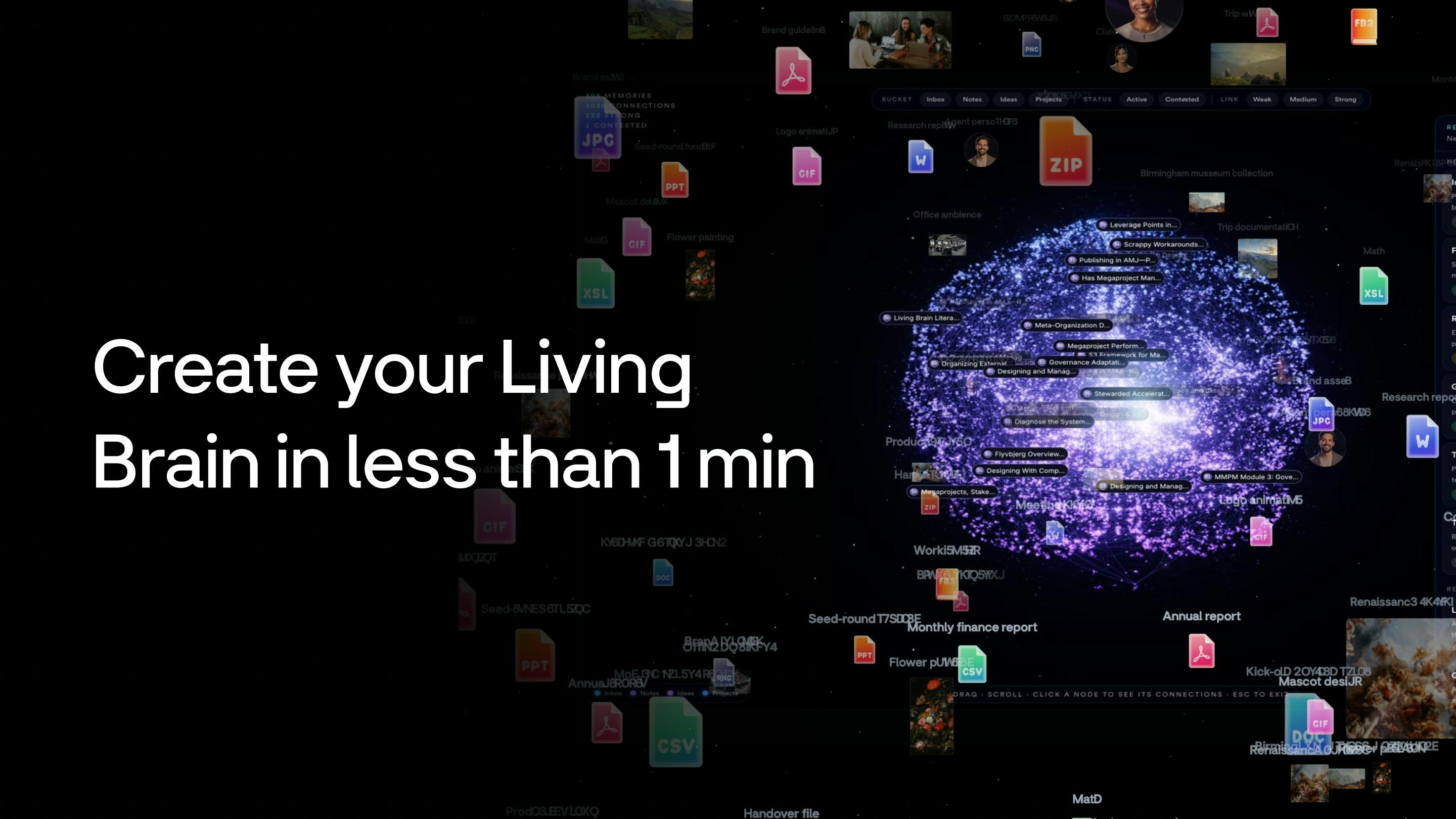
Current mainstream AI products operate in isolation: context accumulated in ChatGPT cannot be carried over to Claude, and coding preferences formed in Cursor cannot be reused by Codex. Living Brain's starting point is precisely this "memory silo" problem: it captures valuable knowledge from conversations, connects it with the user's existing knowledge, and forms persistent memory that continuously evolves.
This approach aligns with industry trends—memory is shifting from a built-in model capability to independent infrastructure. Living Brain does not tie itself to a single model but emphasizes interoperability, making it more like a cross-platform memory middleware than yet another chat application.
Core Mechanism: Capture, Connect, Reuse
According to the official description, Living Brain's workflow can be divided into three steps. The first is capture, extracting knowledge worth retaining from AI conversations; the second is connect, associating new knowledge with the user's existing knowledge graph; and the third is reuse, outputting memory to different AI models, applications, and agents via API, SDK, or the MCP protocol.
MCP support is particularly noteworthy. As an open protocol connecting AI models with external tools, MCP allows Living Brain to integrate naturally into existing agent workflows without requiring developers to rewrite the integration layer. The officially listed compatible targets include ChatGPT, Claude, Gemini, OpenClawAd, Hermes, Cursor, Codex, and others, covering everything from general conversation to coding agents.
MCP (Model Context Protocol) is an open protocol proposed by Anthropic in late 2024, designed to standardize how AI models connect to external data sources and tools. It abstracts the integration layer into a unified client-server architecture: the model side acts as a client initiating requests, while external services act as servers exposing resources and tools. Compared with writing a separate plugin for each model, developers only need to implement an MCP server once, and it can be called by all models that support the protocol. This feature led MCP to be quickly adopted by tools such as Cursor and Claude Desktop, and it has also become a low-friction entry point for third-party memory layers and retrieval layers to embed into existing agent workflows.
Knowledge graph in this context refers to a structured knowledge representation organized with entities and relationships as nodes and edges, rather than conversation logs stacked in chronological order. Associating newly captured knowledge with an existing graph means the system needs to perform entity disambiguation, relationship extraction, and conflict detection, thereby supporting retrieval of relevant memories by semantics rather than keywords. This structure allows memory to evolve incrementally and to be reused across different models in a consistent semantic form, which is the key difference between the "connect" step and simple vector storage.
The Practical Value of Multi-Model Reuse
For developers, cross-model memory reuse means they do not have to explain background from scratch when switching tools. For example, project conventions formed in Cursor can be inherited by Codex or Claude, reducing the overhead of repeated prompting. For ordinary users, when migrating between different AI assistants, personal preferences and historical conclusions can carry over, making the experience more coherent.
Efficiency is another selling point emphasized by Living Brain. It claims to manage memory in an "efficient" way, avoiding re-injecting all context on every interaction. However, the official materials do not disclose specific compression ratios or performance data, so actual results still need to be verified by developers.
Context injection is one of the main cost sources in current large-model applications: each request requires historical conversations or relevant documents to be assembled into the prompt, token consumption grows linearly with context length, and it is constrained by the model's context window limit. So-called "efficient memory management" usually refers to injecting only fragments relevant to the current task—rather than the full history—through summary compression, hierarchical retrieval, or on-demand recall. Because different models have different context windows and billing methods, cross-model memory reuse also requires handling format adaptation and truncation strategies, which are technical details that third-party memory layers need to address.
Competitive Landscape and Open Questions
The memory layer track is not empty: there are both memory features built by model vendors themselves and startups focused on memory management. Living Brain's differentiator is "interoperability"—not locking into a single model ecosystem. But this also brings challenges: as various models strengthen native memory, the value of a third-party memory layer depends on the depth of its cross-platform integration and data portability.
Privacy and data governance are another key issue. Persistent memory means sensitive information is retained long-term and flows across tools, so Living Brain needs to provide a clear data control plan. Public information so far does not cover storage location, encryption methods, or user deletion mechanisms, and these will be important dimensions for evaluating its enterprise readiness.
Who Should Try It
Developers who frequently switch between multiple AI tools, product teams that need to build long-term context for agents, and power users who want to turn personal knowledge into reusable assets are Living Brain's main target groups. Its result of 107 votes and second place on Product Hunt shows that its positioning has attracted initial attention, but 10 comments also indicate that community discussion is still early.
Whether memory can become an infrastructure layer for agents depends on the degree of standardization and the speed of ecosystem adoption. Living Brain has chosen to start with MCP and APIs, which is the right direction; what remains to be seen is whether its integration experience and data trust can withstand real-world scenarios.
One-line Summary
Living Brain launches a cross-model interoperable memory layer that lets AI conversation knowledge be continuously reused across tools.
Paragraph Summary
Living Brain is the second-ranked product on Product Hunt, positioned as an interoperable memory layer for agentic AI. Through API, SDK, and MCP, it shares memory with multiple models and agents such as ChatGPT, Claude, Gemini, Cursor, and Codex. Its core workflow consists of three steps: capturing conversational knowledge, connecting it to an existing knowledge graph, and reusing it across tools. The goal is to break down memory silos between AI products so that every interaction builds on existing context. MCP support lowers integration costs, but the official materials do not disclose memory compression ratios or performance data. The memory layer track is highly competitive, with model vendors' native memory features posing the main substitution pressure, while privacy and data governance plans have not yet been made public—a key unresolved issue for enterprise readiness.
Related articles
 Tech Frontiers
Sherlock: An Open-Source Tool for Tracking Usernames Across Social Networks
Sherlock is an open-source Python tool that tracks social accounts across networks by username. This article covers its core features, why developers love it, typical use cases, and privacy compliance considerations.
 Tech Frontiers
GitHub Daily·Nov 07: Agent-Ready and Context Compression
GitHub Trending Nov 07: meta's agent-ready design system astryx, billion-context's 5x context compression, sherlock nearing 100k stars, plus local-first localthings and bare-metal GPU orchestration nvke.
 Tech Frontiers
Buoyant Open-Sources Kinference: An Inference Control Plane for vLLM on K8s
Buoyant open-sources Kinference, an inference control plane for vLLM on Kubernetes, with declarative routing, KV-cache-aware load balancing, and per-tenant metrics—claiming 95% lower median TTFT in official benchmarks.