llama.cpp: A C++-Implemented Local LLM Inference Engine

llama.cpp implements LLM inference in pure C/C++, using quantization and the self-developed ggml library to run large models on ordinary hardware.
llama.cpp is a pure C/C++ large model inference engine maintained by ggml-org, with over 134,000 GitHub stars and over 25,000 forks. The article explains that C/C++ was chosen to meet inference requirements for low memory, fast startup, few dependencies, and easy deployment, and its self-developed ggml tensor library avoids mainstream deep learning frameworks. Quantization is its key capability, reducing model size and memory bandwidth needs, enabling larger models on consumer devices. Positioned as an inference engine rather than an application framework, it serves as a general foundation for tools like chat and RAG, with an active community driving rapid adaptation to new model architectures. The article advises starting with official examples and small models, understanding quantization levels and hardware backends before scaling up.
llama.cpp: A C++-Implemented Local LLM Inference Engine
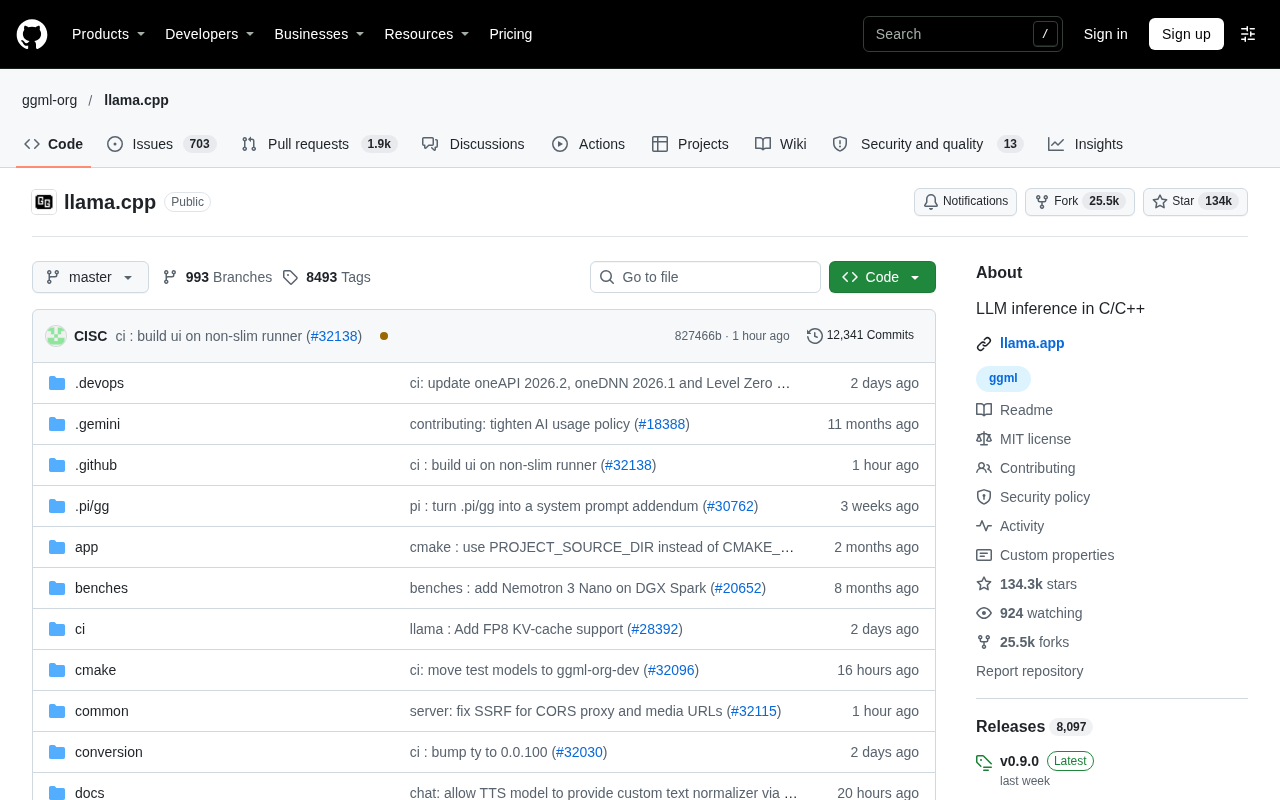
Amid the wave of AI applications dominated by cloud APIs, a project written in pure C/C++ continues to attract developers' attention. ggml-org/llama.cpp has now garnered over 134,000 stars and 25,000 forks on GitHub, with still 162 new stars added in a single day. Such popularity is unusual for a low-level inference engine—it points to a real need: to run large models on ordinary hardware, free from expensive GPU clusters.
Why Use C/C++ for LLM Inference
llama.cpp's core positioning is "LLM inference in C/C++." Choosing C/C++ over Python is itself a statement of engineering orientation. The Python ecosystem is irreplaceable for model training and experimentation, but the requirements at the inference stage are entirely different: small memory footprint, fast startup, simple deployment, and few dependencies. Native binaries compiled from C/C++ can run on everything from servers to Raspberry Pis with virtually no runtime dependencies, which is clearly valuable in edge deployment and privacy-sensitive scenarios.
The ggml tensor library behind the project is likewise a self-developed pure C implementation, avoiding dependence on mainstream deep learning frameworks. This "rewrite from the ground up" approach makes the entire inference stack controllable and trimmable, and also leaves room for subsequent quantization optimization.
GGUF (GPT-Generated Unified Format) is the model file format currently used by the llama.cpp ecosystem, replacing the earlier GGML format. It uses a structure of key-value metadata plus tensor data, packing model architecture hyperparameters, tokenizer configuration, quantization type, and other information together with the weights in a single file, so a single file is self-describing and requires no additional configuration files. GGUF also supports memory-mapped (mmap) loading, allowing the operating system to page weights into memory on demand, significantly shortening startup time for large models and reducing peak memory. The format's extensibility enables the community to quickly incorporate support for new model architectures (such as different attention variants and MoE structures), which is one of the important reasons llama.cpp can rapidly follow new models.
Quantization: Squeezing Large Models into Consumer-Grade Hardware
One of llama.cpp's best-known capabilities is its support for model quantization. By compressing weights from high-precision floating point into lower-bit representations, model size and memory bandwidth requirements drop substantially, allowing models with considerable parameter counts to run on consumer-grade devices. Quantization is not lossless, but the project offers multiple quantization levels so users can trade off between accuracy loss and resource usage.
This design directly expands the usable boundary of large models. For individual developers, it means local experimentation without relying on the cloud; for enterprises, it means inference can be completed without data leaving the internal network.
Quantization essentially approximates the original FP16/BF16 floating-point weights and activations with low-bit-width integers (such as 4-bit, 5-bit, 8-bit). LLM inference is a memory-bandwidth-intensive task: the larger the model weights, the more data must be moved to generate each token, so compressing weight bit width often directly improves decoding speed and reduces VRAM/RAM usage. Common post-training quantization methods include GPTQ, AWQ, and the GGUF format promoted by llama.cpp together with the K-quants series (such as Q4_K_M); the latter allocates different bit counts to different tensors according to sensitivity, preserving more accuracy at the same size. In practice, 7B-level models quantized to 4 bits can usually be compressed to about 4GB, making it possible to run them on a laptop with 16GB of RAM; while 2-bit or lower levels are smaller in size, perplexity rises noticeably and should be evaluated carefully.
Ecosystem Position: An Inference Engine, Not an Application Framework
It is important to distinguish that llama.cpp is an inference engine, not an upper-layer application framework. It provides low-level capabilities such as model loading, computation scheduling, and sampling, and developers build concrete applications like chat, RAG, and code completion on top of it. This layering allows it to exist as a general-purpose foundation called by various front-end tools and wrapper libraries.
Judging from the scale of stars and forks, the project has already formed an active contributor community. 25,000 forks mean a large number of developers are doing secondary development or adaptation on top of it, which is also an important reason it can quickly follow new model architectures—community efforts share the adaptation work.
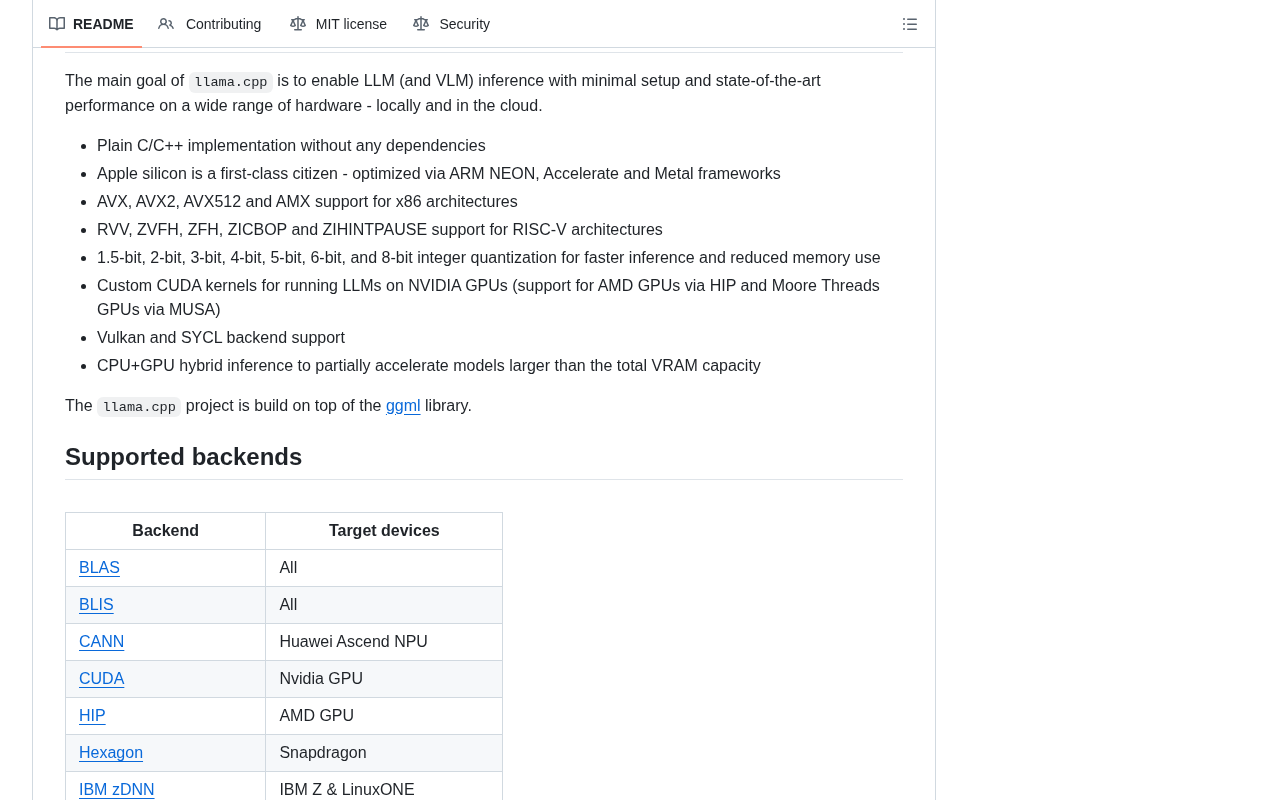
The choice of inference backend directly affects llama.cpp's actual performance. The project supports pure CPU inference (leveraging SIMD instruction sets such as AVX2, AVX-512, and NEON), and also supports offloading some or all layers to the GPU for execution. GPU backends cover CUDA (NVIDIA), Metal (Apple Silicon), Vulkan, ROCm/HIP (AMD), and others; the -ngl parameter controls the number of layers offloaded to the GPU, enabling hybrid CPU-GPU scheduling. For Apple Silicon devices, the Metal backend combined with the unified memory architecture often delivers good value for money; while in multi-GPU or insufficient-VRAM scenarios, layer-wise offloading lets users balance throughput and latency on limited hardware. Understanding these backend differences is a prerequisite for selection and tuning.
Target Audience and Getting Started Tips
llama.cpp is better suited to developers with practical performance and deployment requirements, not beginners who just want to quickly call an API. Before getting started, you need to understand the meaning of quantization levels, the choice of hardware backend (CPU, GPU, or hybrid), and the model format conversion process. It is recommended to start with the official examples, first run the complete pipeline with a small model, then gradually replace it with the target model and adjust quantization parameters.
For teams that need to deploy large models locally or in private environments, this kind of C/C++ inference engine provides a viable path that does not depend on cloud services; for application-layer developers, understanding its capability boundaries helps determine when to use it and when to use a higher-level wrapper during selection.
One-line Summary
llama.cpp implements LLM inference in pure C/C++, using quantization and its self-developed ggml library to run large models on ordinary hardware.
Paragraph Summary
llama.cpp is a pure C/C++ large model inference engine maintained by ggml-org, with over 134,000 GitHub stars and over 25,000 forks. The article notes that C/C++ was chosen to meet the inference stage's requirements for low memory, fast startup, few dependencies, and easy deployment, and its self-developed ggml tensor library avoids mainstream deep learning frameworks. Quantization is its key capability, reducing model size and memory bandwidth requirements by compressing weight bit width, enabling consumer-grade devices to run larger models. The project is positioned as an inference engine rather than an application framework, serving as a general-purpose foundation called by upper-layer tools such as chat and RAG, and an active community also drives rapid adaptation to new model architectures. The article concludes by recommending developers start with official examples and small models, understand quantization levels and hardware backend choices, and then gradually replace them with target models.
Related articles

ChatGPT Plus Subscription Pitfall Guide: Go/Plus/Pro Tier Comparison and Quick Activation
A complete ChatGPT Plus subscription guide based on a Bilibili tutorial: from registering an account, comparing Go/Plus/Pro tiers, to the practical steps for quickly completing your subscription.

GPT-6.2 Sol/Astra Released! A Step-by-Step ChatGPT Plus Subscription Guide and Tier Comparison
GPT-6.2 Sol/Astra is out—here's a ChatGPT Plus subscription guide: register an account, compare Go/Plus/Pro tiers, and subscribe in a minute.

Comparing Three Channels for Subscribing to GPT Plus in China: Is Website Top-Up the Easiest?
How to subscribe to GPT Plus in China? This article compares website top-up, credit card, and mobile top-up channels—process, cost, and risk—with steps and tips to help you choose wisely.