llama.cpp Merges MTP Support: Qwen Flash Next Inference Acceleration in Practice

llama.cpp merges native MTP support for Qwen Flash Next with GGUF quantization, boosting local inference speed.
llama.cpp has merged PR #29761 by developer am17an, officially adding MTP (Multi-Token Prediction) support to the Qwen Flash Next model. MTP is a mechanism built into the model weights that generates multiple candidate tokens at once before verifying them, reducing decoding steps and improving throughput without sacrificing quality — and without requiring a separate draft model. Official GGUF quantized versions are now available on Hugging Face (ggml-org/Qwen3.8-Flash-Next-GGUF), further lowering the barrier for consumer hardware deployment. The entire process from development to merge took roughly 17 hours, signaling that training-inference co-designed acceleration methods like MTP are rapidly moving from research into production.
llama.cpp Brings MTP Support to Qwen Flash Next
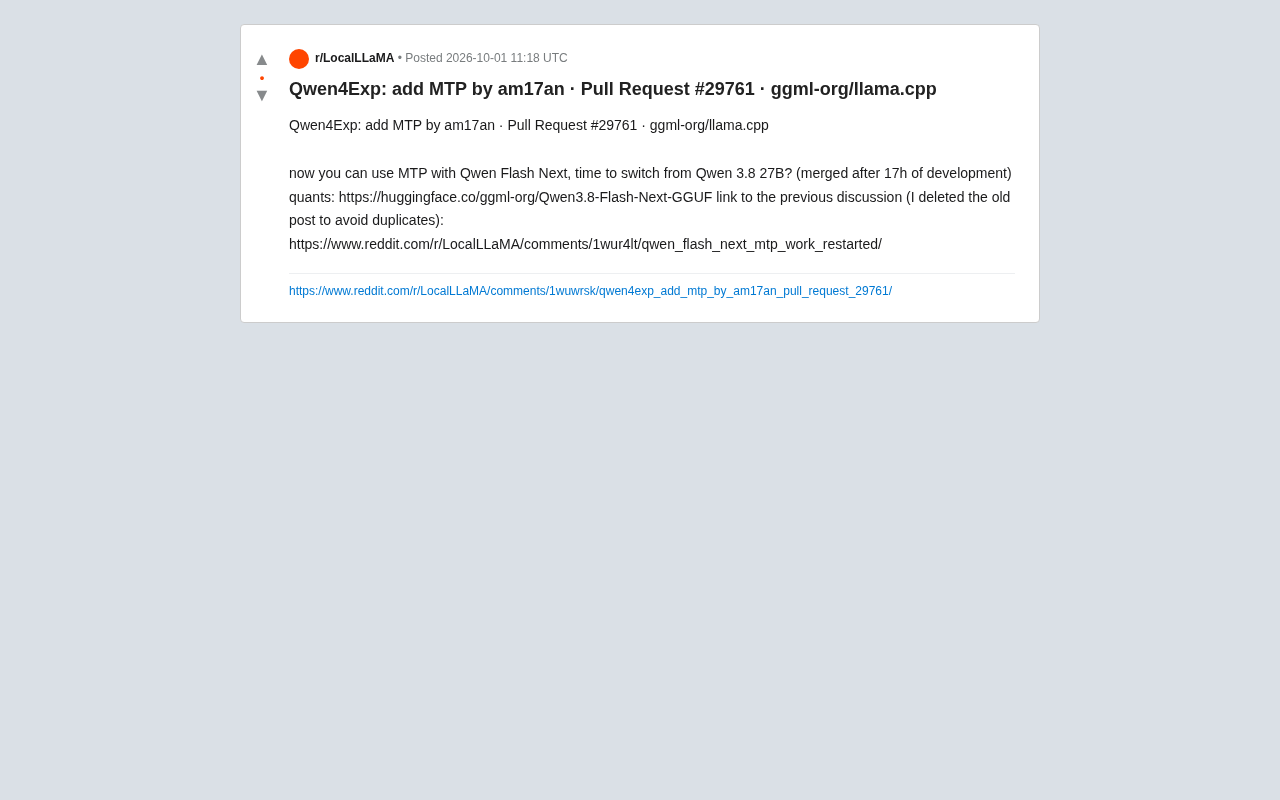
The open-source inference framework llama.cpp has recently merged an important update submitted by developer am17an (Pull Request #29761), adding MTP (Multi-Token Prediction) support for the Qwen Flash Next model. This feature was officially merged into the mainline after approximately 17 hours of development, meaning local deployment users can now enjoy inference acceleration powered by MTP on Qwen Flash Next.
For the community that has long been following local LLM deployment, this is a noteworthy development. As the core engine of the GGUF ecosystem, llama.cpp's support for new features often directly determines whether everyday users can efficiently run the latest models on consumer-grade hardware.
What Is MTP and Why Does It Matter
MTP (Multi-Token Prediction) is a technique that predicts multiple subsequent tokens in a single inference step. Traditional autoregressive decoding generates only one token per step, whereas MTP uses auxiliary prediction heads built into the model to speculatively predict several upcoming tokens, then verifies them — reducing the number of decoding steps and improving throughput without sacrificing output quality.
This approach is conceptually similar to speculative decoding, but MTP's advantage lies in the fact that its predictive capability is built directly into the model itself, requiring no separate draft model. For models like Qwen Flash Next that natively support MTP, once llama.cpp implements the engine-side support, users can directly leverage the multi-token prediction structures already present in the model weights to gain inference speed improvements.
From a technical standpoint, MTP typically attaches several lightweight prediction heads on top of the main model, with each head responsible for predicting tokens further ahead in the sequence. During training, a multi-objective loss simultaneously optimizes both the primary sequence prediction and auxiliary multi-step predictions. During inference, these heads generate candidate sequences all at once, which are then accepted or truncated through autoregressive verification. Compared to speculative decoding — which relies on an independent draft model — MTP has higher parameter reuse and lower deployment complexity, but it does require the model to have been trained with MTP support. Only weights natively trained with MTP can activate this feature at inference time, which is why llama.cpp's engine support needed to be specifically adapted for the Qwen Flash Next weight structure. Real-world speedups are heavily influenced by sequence length, batch size, and hardware memory bandwidth, and tend to be most pronounced in long-context, low-batch local deployment scenarios.
Quantized Versions Ready, Lower Deployment Barrier
Following the PR merge, official quantized model files (in GGUF format) are now available on Hugging Face at ggml-org/Qwen3.8-Flash-Next-GGUF. The significance of GGUF quantization is that it substantially reduces VRAM and memory requirements, enabling models to run on consumer-grade GPUs or even in CPU-only environments.
Combining quantization with MTP creates a dual benefit for local deployment: quantization solves the "can it even run" problem, while MTP solves the "is it fast enough" problem. The original post's author half-jokingly asked, "Is it time to switch from Qwen 3.8 27B?" — reflecting the community's anticipation of the Flash Next series' balance between efficiency and performance.
GGUF (GPT-Generated Unified Format) is the single-file model format that dominates the llama.cpp ecosystem, bundling weights, quantization parameters, tokenizer, and metadata into one file, eliminating multi-file dependencies. Quantization precision is typically labeled with names like Q4_K_M, Q5_K_S, and Q8_0 — the number indicates bits per weight, and the letter suffix denotes the variant of the quantization strategy. For example, Q4_K_M's 4-bit quantization can compress an original FP16 model's VRAM footprint to roughly one-quarter, allowing an 8B-class model to fully load on a consumer GPU with just 8GB of VRAM. When choosing quantization precision, you need to balance model quality loss against resource savings. The Q5 or Q6 series generally strikes a good balance between quality retention and compression ratio, while Q4 is better suited for scenarios with very limited VRAM.
Community Discussion and Development Pace
This work didn't happen overnight. The original poster mentioned that a previous discussion about "restarting Qwen Flash Next MTP work" had already taken place, and deleted the old post to avoid duplication before reposting. Completing the journey from development to merge in 17 hours reflects the high responsiveness of the llama.cpp community when it comes to popular features, and also demonstrates the vitality of the ecosystem surrounding the Qwen model series.
It's worth noting that the source material comes from a single discussion thread in the Reddit community (r/LocalLLaMA). Specific performance improvement figures, compatible hardware ranges, and actual speedup ratios from MTP still need to be confirmed through official documentation and follow-up community benchmarks.
What This Means for Local Deployment Users
For developers and enthusiasts looking to run large models locally, this update sends several clear signals: mainstream open-source inference frameworks are accelerating support for the native acceleration features of next-generation models; the Qwen series continues to solidify its position in the local ecosystem; and acceleration methods like MTP — which require no additional draft model — are rapidly moving from research concepts to engineering reality.
Users interested in trying this out are advised to download quantized weights directly from the official GGUF repository and build with the latest version of llama.cpp to get MTP support. Before deploying in production, it's worth running a benchmark on your own hardware to compare decoding speed and output quality with MTP enabled versus disabled, to assess whether switching your existing workflow is worthwhile.
Related articles

Random Pruning of the DPO Computation Graph: 1.4x Training Speedup and Lower Peak Memory
DPO training too slow and memory-hungry? This paper proposes a random pruning framework for the DPO computation graph, sampling independently across position, sequence, and branch dimensions; branch pruning achieves a 1.426x step-time speedup and cuts training time by about 30%, with in-depth attribution of memory and time gains.

Why Does JEPA Underperform MLM in Longitudinal EHR Representation Learning?
New study compares JEPA and MLM for longitudinal EHR representation learning on MIMIC-IV: three JEPA variants train stably without collapse but underperform MLM; target size, not heterogeneity, drives prediction error.

Transfer Learning + Visible Light Communication: A New Approach to Energy-Efficient Indoor Positioning
A study proposes a transfer learning-based visible light communication indoor positioning method, achieving 47% accuracy improvement on the BOSCH factory dataset, 67.5% model efficiency under high noise, and introducing the ME composite metric for energy-efficient positioning in energy-constrained industrial IoT scenarios.