LLM 0.37.1 Released: Community Collaboration Fixes Critical Bugs
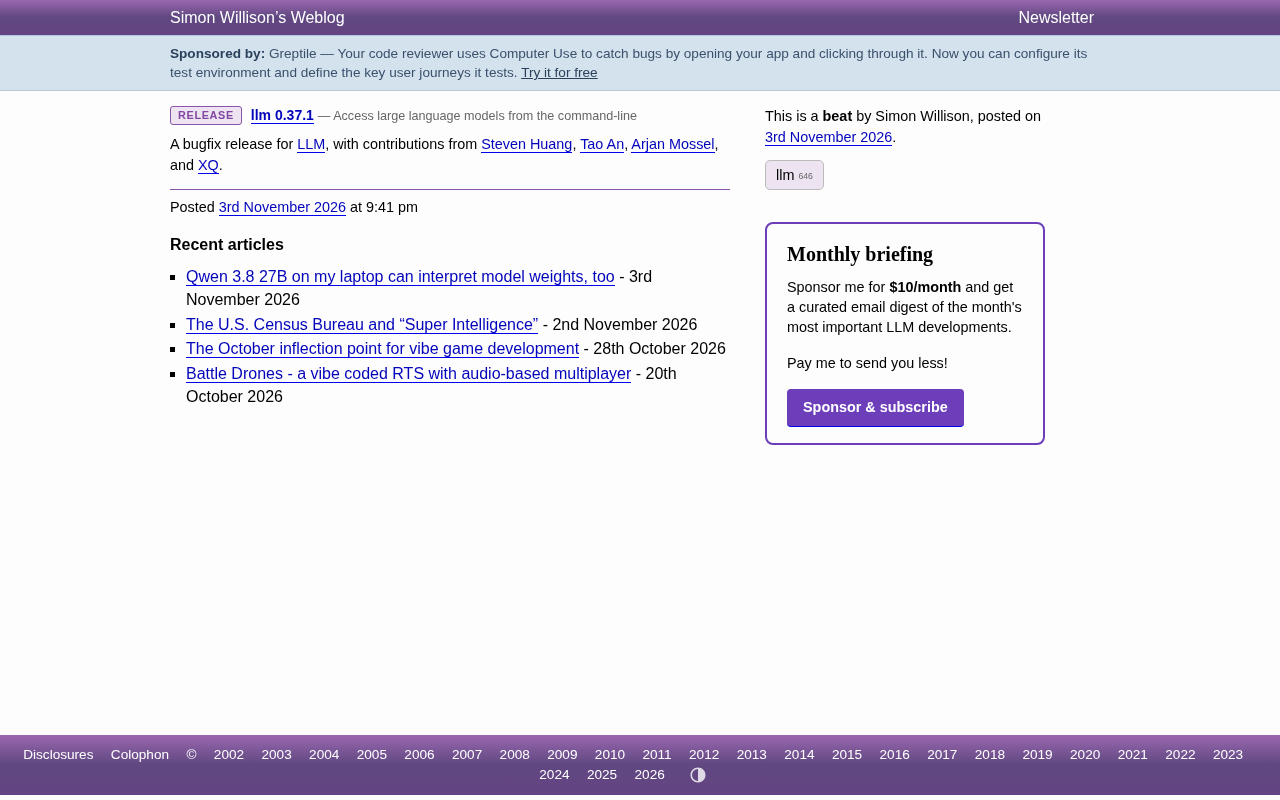
LLM command-line tool releases 0.37.1 bug-fix version, completed by four community contributors.
LLM is a command-line tool by Simon Willison for interacting with LLMs in the terminal. LLM 0.37.1 is a patch release focused on bug fixes, with code from four community contributors: Steven Huang, Tao An, Arjan Mossel, and XQ. Though fixes aren't itemized, patch releases affect stability and address real pain points like command parsing, output formatting, or model API compatibility. Users integrating LLM into automation scripts should upgrade promptly to avoid interruptions. Upgrade via pip or Homebrew, and review changes beforehand for plugin compatibility. The article sees this small release as showing the value of open source collaboration in tool polishing.
LLM is a command-line tool developed by Simon Willison that lets users interact directly with large language models from the terminal. Recently, LLM released version 0.37.1, a bug-fix-focused release that brings together code from four contributors: Steven Huang, Tao An, Arjan Mossel, and XQ.
A Fix Release Built Through Community Collaboration
Like many open source projects, LLM's iteration depends on community participation. As a patch release, 0.37.1's core goal is to address issues exposed in previous versions. Although the release notes do not list each specific fix, they explicitly name the contributors, reflecting the project's recognition of community contributions.
The involvement of Steven Huang, Tao An, Arjan Mossel, and XQ shows that LLM's ecosystem is attracting developers from diverse backgrounds. For a command-line tool, this kind of diverse contribution often covers edge cases that the core team might not have noticed.
Patch Releases and Semantic Versioning
LLM's version numbers follow the Semantic Versioning (SemVer) convention, in the format "major.minor.patch." Under this convention, the increase in the last digit of 0.37.1 indicates that this is a patch release containing only backward-compatible bug fixes, introducing no new features and not changing the behavior of the existing command-line interface. By contrast, an increase in the minor version number (e.g., from 0.37 to 0.38) usually means new features have been added, while a change in the major version number (e.g., from 0 to 1) may include incompatible breaking changes. Understanding this convention helps users assess upgrade risk: patch releases can generally be upgraded safely, while it is worth checking the changelog before upgrading minor and major versions.
Why Patch Releases Are Worth Paying Attention To
For developers who use LLM day to day, patch releases may not be as eye-catching as feature releases, but they directly affect the tool's stability and reliability. Bug fixes often target pain points encountered in actual use, such as command parsing exceptions, output formatting errors, or compatibility issues with specific model APIs.
Upgrading to 0.37.1 in a timely manner can avoid potential usage obstacles. This is especially true for users who integrate LLM into automation scripts or workflows, where even a small bug can interrupt the entire process.
How to Get and Upgrade
Users can install or upgrade to the latest version through package managers such as pip or Homebrew. LLM's GitHub repository provides detailed release notes and installation guides. It is recommended to review the changes before upgrading to ensure compatibility with existing plugins and configurations.
For plugin developers, paying attention to the release of such patch versions also helps them understand upstream changes and adjust their plugin code in a timely manner.
LLM's Plugin Mechanism
LLM extends support for different models and data sources through plugins. Users can install plugins with the llm install command, for example to connect to local models, other vendors' APIs, or custom tools. Plugins are distributed as Python packages and follow a specific entry point convention, allowing them to be automatically discovered by the main program. This has a practical implication: when the main program is upgraded, if internal interfaces have changed, plugins may need corresponding updates to continue working properly. Therefore, the article's recommendation to confirm plugin compatibility before upgrading is not superfluous—for workflows that depend on specific plugins, it is best to verify in a small-scale environment first, or check whether the plugin repository has released an update adapted to the new version.
Outlook
The LLM project has maintained an active update cadence, from feature enhancements to bug fixes, backed by sustained community investment. Although 0.37.1 is a small release, it reflects the value of open source collaboration in polishing tools. As more contributors join, LLM's stability and functional boundaries are expected to continue expanding.
One-line Summary
LLM command-line tool releases 0.37.1 bug-fix version, completed by four community contributors.
Paragraph Summary
LLM is a command-line tool developed by Simon Willison that lets users interact directly with large language models from the terminal. LLM 0.37.1 is a patch release focused on bug fixes, bringing together code from four community contributors: Steven Huang, Tao An, Arjan Mossel, and XQ. Although the release notes do not list each fix, patch releases directly affect the tool's stability and reliability, addressing real pain points such as command parsing, output formatting, or model API compatibility. For users who integrate LLM into automation scripts, timely upgrades can avoid process interruptions. Users can upgrade via pip or Homebrew, and it is recommended to review the changes before upgrading to ensure plugin compatibility. The article believes that this small release reflects the value of open source collaboration in polishing tools.
Related articles

Ring Launches $999 Autonomous Patrol Robot RoverCam
Ring launches RoverCam, an autonomous mobile security camera with a 4K periscope camera, two-way talk, and built-in siren. Priced at $999.99, it targets commercial use and is seen as a de-personified rebirth of the Astro robot.
Weight-Space Programming: A New Paradigm Where LLMs Directly Rewrite Neural Network Weights
What is weight-space programming? This article explains this new paradigm: LLMs directly reason about, modify, and even generate neural network weights from scratch—without loss functions or gradient descent—and analyzes its dual significance for optimization efficiency and explainability.

Ring Drone Cam Hands-On: The Indoor Security Camera That Flies
Ring Drone Cam hands-on: this 2K indoor security drone flies preset routes for 5 to 8 minutes and auto-returns to its base to charge, but needs 8 minutes of charging per 1 minute of flight and runs noticeably loud. Priced at $249.99, with shipping planned for January 2027.