Weight-Space Programming: A New Paradigm Where LLMs Directly Rewrite Neural Network Weights
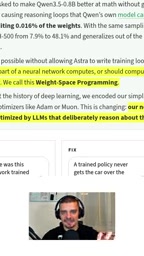
Weight-space programming advocates letting LLMs directly reason about and modify neural network weights, bypassing gradient descent to improve efficiency and explainability.
The article introduces a new direction called "weight-space programming," in which large language models directly read, reason about, and modify neural network weights without relying on loss functions, gradient descent, or training loops. Its core claim is that neural network weights will be natively optimized by LLMs that deliberately reason about weights, shifting the optimizing subject. Its value lies in potentially lower costs and better results, and more importantly, explainability—LLMs can explain how other networks work and why they behave certain ways. However, the source is only an opinionated exposition and does not explain implementation details such as how LLMs read massive floating-point weights or how to ensure modified networks remain valid, and using LLMs to explain weights may introduce a new layer of opacity. Still, the perspective of treating weights as objects that can be reasoned about and edited is illuminating, suggesting that model optimization and understanding may converge.
What Is Weight-Space Programming?
The traditional path for training neural networks is almost fixed: define a loss function, run gradient descent, iterate in a loop, and finally obtain a set of weights and biases. But a new direction called "Weight-Space Programming" is breaking this process—instead of merely training a network to produce weights, it lets large language models directly read, reason about, and modify those weights.
According to the explanation from this YouTube source, this process does not rely on a loss function, does not use gradient descent, and does not require a training loop. The LLM simply "looks at the weights" and can reason about them, modify them, and even generate them from scratch. This amounts to treating model weights as an object that a language model can understand and edit, rather than a black-box parameter that can only be adjusted indirectly through numerical optimization.
Gradient descent and loss functions: The core mechanism of traditional neural network training. The loss function measures the gap between model predictions and true labels, and gradient descent gradually adjusts weights along the direction of the loss function's gradient to minimize the loss. This process requires repeated forward and backward propagation, is computationally intensive, and depends on large amounts of labeled data. The reason weight-space programming emphasizes "not relying on gradients" is that it attempts to bypass this numerical optimization loop and instead use the reasoning capabilities of language models to directly edit weights at a semantic level. This requires the LLM to understand the patterns contained in weight tensors, rather than treating them as an unstructured collection of floating-point numbers.
Weights as editable objects: From the traditional perspective, weights are numerical matrices fixed after training that are difficult for humans to directly interpret or modify. Weight-space programming treats weights as a kind of "text" or "program" that an LLM can read like code and modify like code. The implicit assumption behind this is that there is regular structure in weight space that language models can capture—for example, specific neuron activation patterns corresponding to certain concepts. If this assumption holds, model optimization would shift from black-box search to white-box editing. However, how to encode high-dimensional floating-point weights into sequences that an LLM can process remains an unsolved technical challenge.
Core Claim: Weights Will Be Natively Optimized by LLMs
The source makes a rather bold judgment: neural network weights will soon be natively optimized by "LLMs that deliberately reason about weights." The key phrase here is "deliberate reasoning"—not using LLMs for peripheral assistance such as hyperparameter search or architecture suggestions, but having the LLM directly intervene in optimization decisions about the weights themselves.
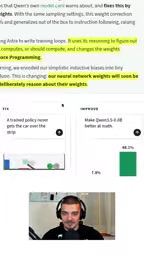
The disruptive nature of this claim lies in the shift of the optimizing subject. In the traditional process, humans are the designers, the optimizer is the executor, and the weights are the result; in the vision of weight-space programming, the LLM plays both the roles of understander and modifier, and weights become objects that can be conversed with. The source does not elaborate on a specific technical implementation path, but it clearly establishes the premise of "not relying on gradients," meaning it is fundamentally different from existing training paradigms.
Why It Matters: Efficiency and Explainability
The source points out that this direction has two layers of significance. The first is cost and effectiveness: optimizing neural networks this way may be cheaper and may also work better. This is an engineering-level attraction, but the source does not provide specific data to support it—it is more of a directional judgment.
The second layer is what the source explicitly calls "more important"—explainability. If a large language model can tell you how another neural network or another large language model works, how it reasons, and why it exhibits certain behaviors, that would be a game changer. The reason is straightforward: we would finally have a chance to truly understand what is happening inside these AI models.
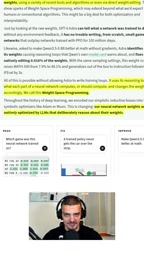
Explainability has long been a weak point of deep learning. Weight-space programming offers a new idea: rather than using external tools such as probes and attention visualizations to guess at the meaning of weights, let an LLM with reasoning capabilities directly read the weights and provide explanations. The source acknowledges that this sounds like "AI talk," but insists that it is truly disruptive.

Explainability research: Current deep learning explainability mainly relies on external attribution methods such as saliency maps, attention visualizations, and probe classifiers. These methods can only provide local or indirect explanations and cannot fully characterize the causal mechanisms inside a network. Weight-space programming proposes an "endogenous explanation" path: let an LLM with reasoning capabilities directly analyze the weights themselves, thereby generating natural language descriptions of network behavior. This idea intersects with mechanistic interpretability, which attempts to reverse-engineer the internal circuits of neural networks, but weight-space programming places more emphasis on using the LLM as the explaining subject rather than manually designing analysis tools. Its potential advantage is the coverage and flexibility of explanations; its risk is that the LLM may generate explanations that seem plausible but are actually wrong—that is, the hallucination problem amplified in explanatory settings.
A Sober View: The Gap Between Vision and Implementation
One additional point: this source is a highly opinionated exposition rather than a technical report. It does not explain how an LLM reads weights (weights are massive arrays of floating-point numbers—how do they enter the language model's context), how to ensure that a modified network remains valid, or at what scale "creating weights from scratch" is feasible. These are precisely the questions that weight-space programming must answer to move from concept to practice.
Another question worth asking is: if LLMs themselves are difficult to fully explain, does using an LLM to explain another network's weights introduce a new layer of opacity? The source lists explainability as the greatest value, but the rigor of this logical chain remains to be verified.
Nevertheless, the perspective of treating weights as objects that can be reasoned about and edited is itself illuminating. It suggests that model optimization and model understanding may converge: the same reasoning process both modifies weights and explains them. For readers interested in the evolution of AI programming and AI applications, this is a direction worth continuing to follow.
One-line Summary
Weight-space programming advocates letting LLMs directly reason about and modify neural network weights, bypassing gradient descent to improve efficiency and explainability.
Paragraph Summary
The article introduces a new direction called "weight-space programming," in which large language models directly read, reason about, and modify the weights of neural networks without relying on loss functions, gradient descent, or training loops. The core claim of this direction is that neural network weights will be natively optimized by LLMs that deliberately reason about weights, shifting the optimizing subject. Its value lies on two levels: engineering-wise, it may reduce costs and improve effectiveness, and more importantly, explainability—LLMs can explain how other networks work and why they exhibit certain behaviors. However, the source is only an opinionated exposition and does not explain implementation details such as how an LLM reads massive floating-point weights or how to ensure that a modified network remains valid, and using an LLM to explain weights may introduce a new layer of opacity. Nevertheless, the perspective of treating weights as objects that can be reasoned about and edited is illuminating, suggesting that model optimization and understanding may converge.
Related articles

Anthropic Launches Dual Flagships Claude Fable 5.2 and Mythos 5.2, Topping Coding and Science Benchmarks
Anthropic releases Claude Fable 5.2 and Mythos 5.2 dual flagships, with full upgrades in coding, 3D interaction, and life sciences, topping third-party intelligence index, integrated by GitHub Copilot and Cursor, API pricing lower than competitors.

Claude Code Reportedly Leaks Secrets to GitHub, Sounding the Alarm for AI Coding Security
Claude Code reportedly exposed passwords and API keys to GitHub, per Ars Technica. We recap the incident alongside Claude Fable 5.2's 20% price cut and Meta Muse Ember, urging developers to check commit settings before granting permissions.

Getting Started with LangChain: Core Concepts of the Agent Development Framework
Starting from the three major limitations of LLMs, this article explains LangChain's positioning and value as an Agent development framework: limited knowledge, external system interaction, and state retention, along with its official documentation system and learning path.