Ring Drone Cam Hands-On: The Indoor Security Camera That Flies
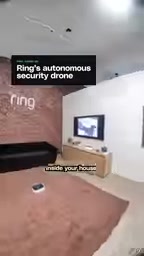
Ring launches a flying indoor drone camera that replaces multi-camera deployment with mobility.
Ring Drone Cam is a 2K-resolution indoor drone camera that flies preset routes for 5 to 8 minutes before automatically returning to its base to charge, with the core idea of replacing whole-home multi-point deployment with a single flying camera. Its main shortcoming is efficiency: every 1 minute of flight requires 8 minutes of charging, making it better suited to on-demand checks than continuous patrolling. It runs noticeably loud and can't approach targets silently, and how pets at home will react is still uncertain. Priced at $249.99 with shipping planned for January 2027, the article sees it as representing a valuable product direction, but at this stage more of a supplementary measure than a replacement solution, with engineering issues such as indoor positioning, obstacle avoidance, and privacy handling still to be resolved.
Ring has sent the security camera into the air. This indoor drone camera, called Ring Drone Cam, has a straightforward core idea: instead of installing a camera in every room, let one camera fly over to take a look itself.
One Camera Covers the Whole House
According to a YouTube hands-on video, Ring Drone Cam is a 2K-resolution drone camera that can fly indoors along preset routes, with a single flight lasting between 5 and 8 minutes, after which it automatically returns to its base to recharge.
Its value proposition is "one camera, goes anywhere." The video's author mentions that they have liked the concept ever since first seeing it in 2023 — when you're away from home and want to confirm whether the stove was turned off or why the back door suddenly opened, you don't need cameras all over the house; a flying device can take their place.
Battery Life Is a Hard Constraint: 1 Minute of Flight, 8 Minutes of Charging
The efficiency math for this system doesn't look great. Every 1 minute of flight requires 8 minutes of charging time. In other words, after a 5-to-8-minute patrol ends, the device has to stay on the ground for quite a long while before it can take off again.

This means it's better suited to "checking on demand" rather than "continuous patrolling." When a user triggers a check and the drone flies to the target location to take a look, the battery-life shortcoming is still acceptable in that scenario; but if you expect it to automatically patrol around the clock, the charging cadence becomes an obvious bottleneck.
The 8:1 charge-to-flight ratio is no accident — it reflects the physical ceiling of energy density for small indoor drones. Current consumer drones generally use lithium polymer batteries with an energy density of about 150-250 Wh/kg, while indoor flyers, for safety and noise reasons, are limited in propeller size and rotational speed, giving them aerodynamic efficiency far below that of outdoor models. Hovering itself is the most power-hungry flight state — without the airflow-assisted lift of forward flight, all thrust is generated vertically downward by the rotors. On top of that, indoor obstacle avoidance requires continuously running visual sensors and compute chips, pushing overall power consumption even higher. To improve this ratio, the industry's directions include higher-energy-density semi-solid-state batteries, contact-based recharging when docked at fixed points, and lightweight airframes to reduce hovering power — but in the short term, none of these can compress 8:1 to a level that supports continuous patrolling.
Noise: An Inspector That Can't Hide
The video's description of the noise is quite blunt: this drone is "super loud," and it's impossible for it to approach silently without being noticed.
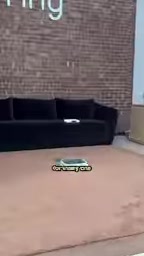
For a security device, this is actually a double-edged sword. On one hand, the obvious noise and sense of presence are themselves a deterrent; on the other hand, if there are pets at home — such as the cat mentioned by the video's author — how they'll react to this buzzing flying object is currently unknown.

Indoor drone noise mainly comes from the rotor blade-tip speed and the high-frequency whine of the motors. To ensure stable hovering in confined spaces, such devices typically use small-diameter, high-RPM propellers, and the higher the RPM, the sharper the fundamental frequency of the aerodynamic noise and the easier it is for the human ear to pick up. Outdoor drones can reduce noise by increasing propeller diameter and lowering RPM, but indoor models are constrained by airframe size and have almost no such margin. This is also why Ring Drone Cam's noise is described as "super loud" — it's not a tuning issue, but a structural characteristic of small indoor flyers. For security scenarios, this means the idea of "covert reconnaissance" basically doesn't hold up, and the product positioning can only shift toward "overt deterrence" or "checking on demand."
Price and Release Date
Ring Drone Cam is priced at $249.99 and is scheduled to ship in January 2027. The video's author closes with a rather interesting remark: now it's just a question of whether Ring will actually build and sell this thing.
From concept demo to mass production, indoor flying security devices have far more to solve than just battery life and noise — indoor positioning accuracy, obstacle avoidance reliability, and how privacy data is handled are all engineering problems that can't be avoided before actual delivery.
Indoor autonomous flight places far higher demands on positioning and obstacle avoidance than outdoor flight. GPS fails indoors, so devices must rely on solutions such as visual-inertial odometry (VIO), ultrasound, or UWB to achieve centimeter-level positioning, while also using depth cameras or ToF sensors to build a room map and recognize dynamic obstacles such as furniture and pets. Running this kind of perception stack within a limited compute and power budget is the core engineering challenge for indoor drone deployment today. Privacy is equally critical: for a camera that can fly into bedrooms and bathrooms, how the video it captures is encrypted, where it is stored, and whether it is uploaded to the cloud directly determine whether home users will accept it. As an Amazon-owned brand, Ring's data flows will come under especially close scrutiny. These factors combined are precisely the hardest gap to bridge between "concept demo" and "mass production."
Worth Looking Forward To, But Don't Rush to Order
Ring Drone Cam represents an interesting product idea: using mobility to replace camera density and reduce the hardware cost and installation complexity of whole-home security. A 5-to-8-minute flight window combined with 2K image quality is enough to complete a targeted inspection task.
But the 8:1 charge-to-flight ratio, the obvious operating noise, and the still-uncertain pet compatibility all suggest that it's more of a "supplementary measure" than a "replacement solution." For users who already find whole-home camera deployment a hassle, this is a direction worth watching; for scenarios that demand 7×24 uninterrupted monitoring, the current version simply doesn't have an answer.
Related articles

Anthropic Launches Dual Flagships Claude Fable 5.2 and Mythos 5.2, Topping Coding and Science Benchmarks
Anthropic releases Claude Fable 5.2 and Mythos 5.2 dual flagships, with full upgrades in coding, 3D interaction, and life sciences, topping third-party intelligence index, integrated by GitHub Copilot and Cursor, API pricing lower than competitors.

Claude Code Reportedly Leaks Secrets to GitHub, Sounding the Alarm for AI Coding Security
Claude Code reportedly exposed passwords and API keys to GitHub, per Ars Technica. We recap the incident alongside Claude Fable 5.2's 20% price cut and Meta Muse Ember, urging developers to check commit settings before granting permissions.

Getting Started with LangChain: Core Concepts of the Agent Development Framework
Starting from the three major limitations of LLMs, this article explains LangChain's positioning and value as an Agent development framework: limited knowledge, external system interaction, and state retention, along with its official documentation system and learning path.