LLM Agent: A Practical Guide from Technical Frameworks to Agent Tuning
A complete walkthrough of why LLMs need Agent tech, the Prompt→RAG→Agent framework, and when Agent Tuning is worth the investment.
Starting from the real pain point of LLMs giving incorrect answers, this article identifies three core drivers for Agent technology: hallucinations, inability to update in real time, and the need for multi-step execution in complex tasks. It breaks down LLM applications into three layers — Prompt, RAG, and Agent — and explains why complex Prompts alone aren't enough for weaker models. Private deployment requirements and cost constraints make Agent Tuning on small 3B/7B models a practical necessity. The article concludes with a development loop (strong model → training data → Tuning → replace) and an A100 cost estimate to help teams decide whether to invest.
Why LLM Applications Need Agent Technology
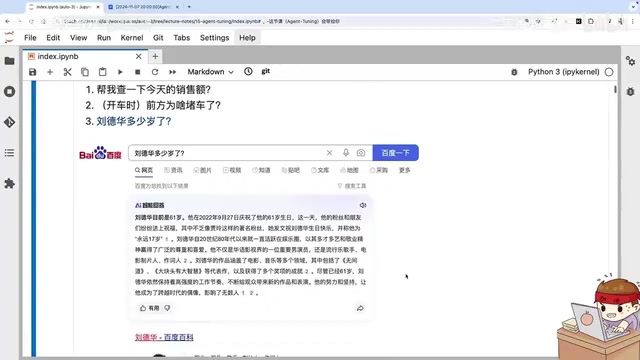
If you ask a general-purpose large language model questions like "How old is Andy Lau?", "What are today's sales figures?", or "Why is there traffic ahead?", you'll often get inaccurate or outdated answers. A real example from the video illustrates this perfectly: a month prior, when someone asked Baidu's ERNIE Bot about Andy Lau's age, the model returned "61" based on data from an old webpage — specifically, a 2022 birthday news article. That answer was clearly stale. By contrast, an upgraded model was able to first query the current date, then calculate the correct age from the birth date, and display the entire reasoning process along the way.
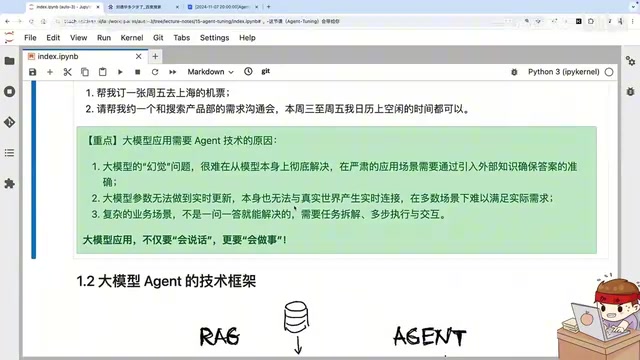
This comparison gets at the core value of Agent technology. The instructor summarizes three reasons why LLM applications need it:
- Hallucinations are hard to eliminate. LLMs are probabilistic generation models — errors are inevitable. In high-stakes scenarios, external knowledge must be introduced to ensure answer accuracy.
- Model parameters can't be updated in real time. Once training is complete, a model is a static snapshot. Training costs are enormous, making it impossible to stay continuously synchronized with the real world.
- Complex tasks require multi-step execution. Tasks like booking flights or scheduling a requirements review meeting can't be handled in a single exchange. They require task decomposition, multi-step execution, and often iterative back-and-forth with the user.
In short, LLMs are already good at "talking" — but to truly operate in a business context, they also need to be able to "get things done."
The Technical Framework: From Prompt to RAG to Agent
The instructor references a summary diagram from an overseas website that breaks down LLM applications into three layers.
The most basic form is a Prompt — a user instruction goes in, the model acts as a black box and returns a response. Simple, one-turn, one-answer.
One level up is RAG (Retrieval-Augmented Generation), a common approach to addressing hallucinations. When a question requires real-time or more reliable information, the system first retrieves relevant context from an index, a knowledge base, or the open web, then feeds both the reference material and the original question to the model — letting it answer from a grounded, trustworthy source.
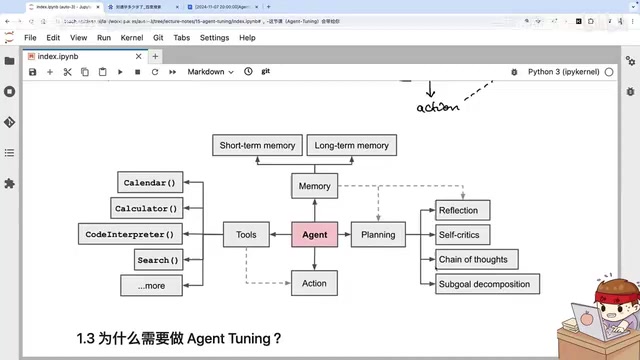
At the Agent layer, complexity increases significantly. An Agent not only has access to a richer toolkit (retrieval is just one capability; real deployments involve all sorts of business-specific tools), but also possesses memory (both long-term and short-term) and reasoning abilities. It can break problems down, execute across multiple steps, and iterate until the task is complete.
Looking more closely, the core of an Agent is the Planning process on the right side of the architecture — deep thinking, self-critique, chain-of-thought reasoning, and step-by-step subtask decomposition and execution. On the left side sits a rich toolkit, combined with memory and action instructions for using those tools. Together, this makes Agent a far more complete and production-ready framework.
It's worth taking a closer look at how RAG actually works. In a standard RAG pipeline, the user's question is first converted into a vector representation, then semantically similar document chunks are retrieved from a pre-built vector database. Those chunks are prepended as "context" to the original question and sent together to the LLM to generate the final answer. RAG's key advantage is that the knowledge base can be updated independently of the model — you simply re-index documents without retraining, at a fraction of the cost of fine-tuning. Its limitation is that retrieval quality depends heavily on the vectorization and chunking strategy: if the phrasing of a question differs significantly from how information is stored in the knowledge base, or if an answer is spread across multiple document chunks requiring cross-segment reasoning, RAG performance drops noticeably. This is exactly why, for complex tasks involving multi-step reasoning and tool calls, RAG alone isn't enough — a full Agent framework is still needed.
What Is Agent Tuning and Why Does It Matter
If you can implement Agent workflows using complex Prompts (like AutoGPT-style prompting), why bother with Agent Tuning? The instructor points to a critical prerequisite: using Prompts to drive an Agent only works if the underlying model is smart enough to follow instructions just by reading a "manual."
A Prompt is essentially a written instruction manual for the model — laying out the workflow and requirements. That's precisely what Prompt Engineering is. But in practice, only top-tier models like GPT-4 are capable of following complex Prompts to complete Agent-style tasks. Many models, including GPT-3.5, simply can't. Feed a small, less capable model the kind of dense instructions AutoGPT uses, and it will often fail to understand them at all.
There are three main real-world constraints that motivate Agent Tuning:
- The strongest APIs may be off-limits. In many real deployments, models like GPT-4, GPT-4o, or o1 simply can't be used due to private deployment requirements — everything must run on an internal network.
- Inference costs need to be controlled. Enterprises often need to build and operate models within a predictable cost envelope.
- Small models can do the job. With targeted training, models with as few as 3B or 7B parameters can develop solid Agent capabilities — at lower inference cost and with easier deployment.
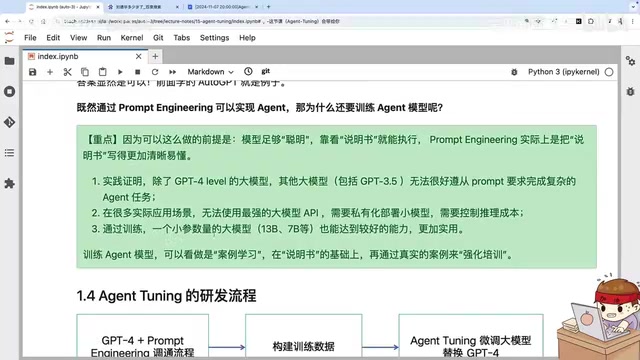
The instructor uses a fitting analogy: Agent Tuning is like a college graduate entering the workforce. General education provides broad knowledge and general-purpose skills, but before starting a specific job, targeted on-the-job training is still required. Agent Tuning is exactly that — reinforcement training on top of the Prompt "manual," using real-world examples.
At a technical level, Agent Tuning is a specialized form of Instruction Fine-Tuning. While general instruction fine-tuning teaches a model to "answer questions based on instructions," Agent Tuning specifically trains the model to master tool-calling formats, task decomposition logic, and multi-turn decision-making chains. In practice, training data is typically organized as trajectories — each sample contains a complete reasoning trace: receive task → analyze → select tool → construct call parameters → observe tool output → continue to next step or deliver final answer. By repeatedly learning from these trajectories, the model internalizes "when to call a tool, how to format the call, and how to adjust the next step based on the result." Frameworks like AutoGPT and ReAct (Reasoning + Acting) provide paradigms for generating these trajectories, and the common industry practice of running the full pipeline with GPT-4 first and then distilling into a smaller model is a widely used cost-reduction strategy.
Agent Tuning: Development Workflow and Cost Considerations
A typical development loop looks like this: start by using a powerful model like GPT-4 to fully work through the business-integrated Agent workflow; then build training data on top of that — since the Prompt and the training data are closely linked, a stronger model can auto-generate data, which is then corrected by humans to form the training set; next, run Agent Tuning on your own model; finally, replace GPT-4 with the fine-tuned model to close the loop.
It's important to note that Agent Tuning is not necessary for every business scenario. Training has a cost. If a business can use an API directly and the cost estimate is acceptable, there's no need to do Tuning at all.
The instructor provides a rough cost reference: for a 7B model with approximately 4.7 million tokens of training data over 5 epochs, using Alibaba Cloud A100 pricing, roughly 4 GPUs are needed — and that's just the one-time training cost. Any subsequent adjustments will add to that. This figure can serve as a practical anchor for teams deciding whether to invest in Tuning.
Summary
This tutorial starts from real application scenarios and clearly walks through the full chain: why Agent technology is needed → the Agent technical framework → why Tuning is worth doing → how to put it into production. Its value lies in grounding abstract concepts in real examples (Andy Lau's age, booking flights, querying sales figures) and practical constraints (private deployment, cost control). For developers looking to bring LLMs into actual business workflows, this is especially relevant. Ultimately, the decision of whether to invest in Agent Tuning comes down to a trade-off between cost and the demands of your specific use case.
Related articles
Prompt → MCP → Agent → Skill: The AI Terminology Evolution Chain Explained in 5 Minutes
A clear guide to five core AI concepts — Prompt, MCP, Agent, Skill, and Cowork — and how they connect in a layered evolution chain from simple instructions to multi-agent teamwork.
OpenAI Discloses Model Anomalies, DeepMind Launches AGI Forum, NVIDIA Partners on Grid Power Management
Sept 17 AI roundup: OpenAI publishes model anomaly disclosure framework with 6 reports, Google DeepMind launches AGI public forum, NVIDIA leads AI energy management alliance with 18 partners.
Build a Local AI Agent with Python in 10 Minutes: Ollama + PydanticAI in Action
A hands-on guide to building a fully local AI agent with Python, Ollama, and PydanticAI in 10 minutes — covering model selection, tool functions, and conversation loops.