LLM API Cost Optimization Guide: Prompt Caching vs. Batch Discounts in Practice

LLM API cost optimization requires multidimensional matching of caching, batching, and flex tiers by calling pattern.
Based on an analysis of pricing strategies across 15 major LLM providers, the article notes that API cost optimization has evolved from unit price comparison to multidimensional strategy matching. Prompt caching reuses shared-prefix KV Cache to cut costs 78-80% but requires high hit rates and long shared prefixes; Batch APIs generally offer 50% discounts, with Moonshot at 40% and xAI at just 20%, suiting non-real-time tasks. The key finding: only Anthropic, Fireworks, and xAI support stacking cache and batch discounts, while most platforms require choosing one. The article also covers flex tiers as a third option and recommends building a price matrix covering cache support, batch discounts, stacking rules, and flex tiers, routing workloads by calling pattern.
Under Cost Pressure, API Optimization Becomes Essential
As LLMs move from demos to production environments, API bills often grow faster than business revenue. According to an analysis of pricing strategies across 15 major providers, proper use of prompt caching can cut costs by roughly 78–80% in scenarios with shared prompts, while Batch APIs offer discounts of up to 50% on most platforms—but not all discounts can be stacked.
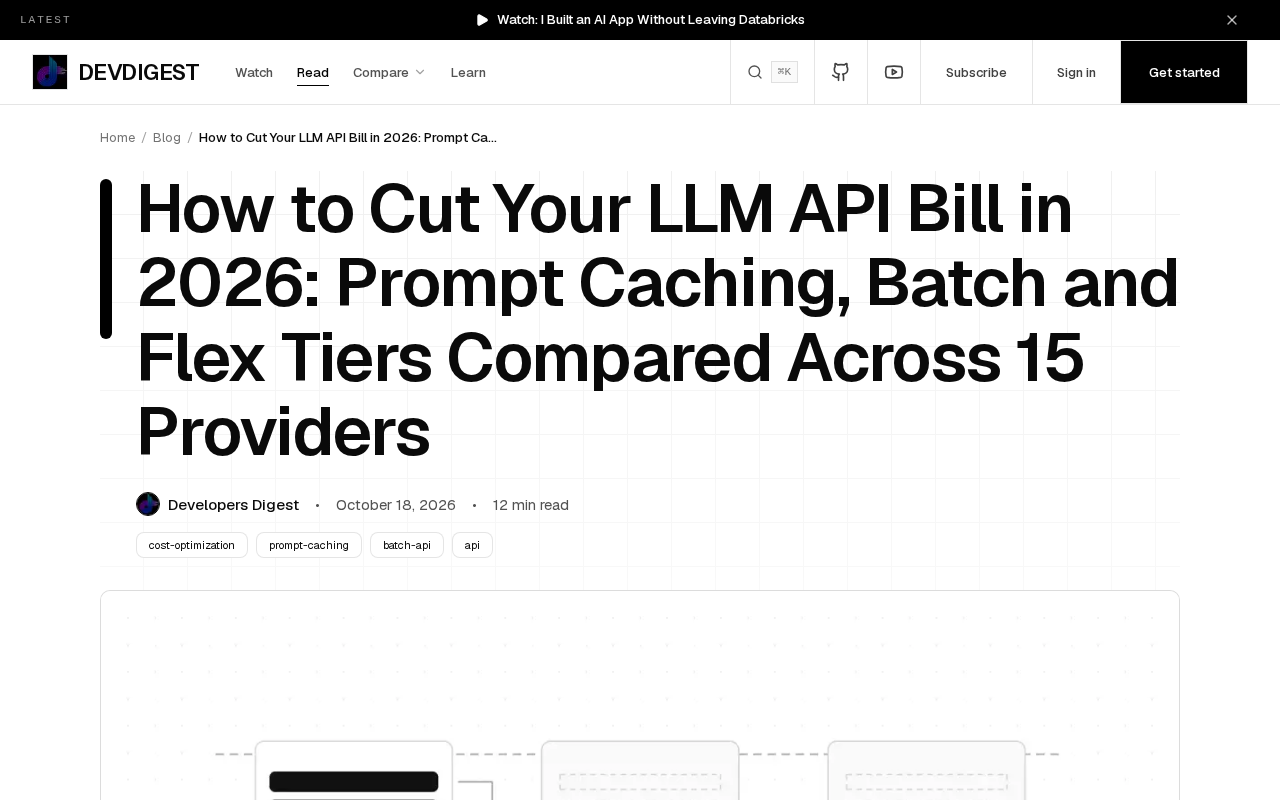
The original article's empirical data reveals a key contradiction: while discount combinations are theoretically stackable, in practice only Anthropic, Fireworks, and xAI explicitly support using caching and batching together. This means most developers need to choose between caching and batching based on their calling patterns.
Prompt Caching: The Money-Saver for Shared Context
The core logic of prompt caching is simple: when multiple requests share the same system prompt, document context, or conversation history, the provider can cache that portion of the computation so subsequent requests don't need to reprocess it.
According to the original tests, caching shared prompts across four models yielded 78–80% cost savings. The premise behind this figure is worth noting: the higher the cache hit rate and the longer the shared prefix, the greater the savings. For customer service bots with long system prompts or Q&A systems with fixed knowledge bases, caching is almost a must.
But caching isn't free. The first request still incurs full cost, cache writes are sometimes billed separately, and cache validity periods vary from minutes to hours across providers. Developers need to assess the temporal distribution of their requests—only high-frequency consecutive calls maximize caching benefits.
How Prompt Caching Works Technically
Prompt caching doesn't simply store request text; it reuses computation at the KV Cache (key-value cache) level of model inference. When a Transformer model generates each token, it computes attention key-value pairs for every token in the context; when multiple requests share the same prefix, these KV tensors are identical, and the provider can keep them resident in GPU memory for direct reuse, skipping the redundant prefill stage.
This explains why savings correlate strongly with shared prefix length: the longer the prefix, the more computation can be skipped. It also explains where cache TTLs come from—KV Cache occupies expensive GPU memory, and providers must balance hit benefits against memory capacity, so they typically set TTLs ranging from 5 minutes to 1 hour, and may charge a premium for cache writes (e.g., Anthropic charges 1.25× the write fee for 5-minute caches and 2× for 1-hour caches). When designing prompt structure, developers should place stable content (system instructions, knowledge base) in the prefix and dynamic content (user questions) at the end to maximize hit rates.
Batch API: Discount Levels Vary Significantly
Batch APIs allow developers to queue non-real-time tasks, trading latency for discounts. The original data shows most providers offer 50% discounts, with two exceptions: Moonshot at 40% and xAI at just 20%.
This divergence reflects differences in each platform's cost structure for batch processing infrastructure. The 50% discount has essentially become the industry baseline, but xAI's 20% discount means its batch channel has limited economic appeal, and developers on that platform may need to prioritize other optimization methods. Batch APIs suit latency-insensitive scenarios such as offline data processing, bulk content generation, and model evaluation.
The Cost Logic of Batch APIs
Batch API discounts aren't mere marketing giveaways—they stem from the scheduling economics of inference workloads. Real-time APIs require providers to reserve capacity for traffic spikes, often resulting in low GPU utilization; batch channels queue requests and process them during idle periods or with spare compute, pushing GPU utilization higher and lowering the amortized cost per token. The 50% industry baseline discount roughly corresponds to this utilization headroom.
typically Batch tasks have a completion window of up to 24 hours and don't guarantee ordering or precise latency, making them unsuitable for interactive scenarios like conversations or agent tool calls. xAI's mere 20% discount may reflect immature batch infrastructure or a strategic preference for preserving real-time capacity; Moonshot's 40% sits in between. When evaluating, developers should align discount rates with their tasks' latency tolerance windows rather than assuming batch is always worthwhile.
Stacking Rules: Only Three Providers Support It
This is the original article's most actionable finding: only Anthropic, Fireworks, and xAI explicitly state that caching and batch discounts can be stacked.
For scenarios with both large amounts of repeated prefixes and non-real-time needs, deploying on these three platforms allows multiplying both discount factors, yielding considerable theoretical savings. On other platforms, developers must plan a one-or-the-other strategy between caching (suited to real-time high-frequency calls) and batching (suited to offline processing).
Flex Tiers: The Underrated Third Option
Beyond caching and batching, some providers offer flex or priority tiers, trading capacity guarantees for price concessions. These tiers suit background tasks that can tolerate occasional latency jitter.
The original article covers this dimension less thoroughly, but the 15-provider comparison itself demonstrates that cost optimization has evolved from simple per-unit price comparison to multidimensional matching of calling patterns, discount rules, and latency tolerance. Developers are advised to build a price matrix covering cache support, batch discounts, discount stacking, and flex tiers when selecting platforms, rather than just looking at the list price per million tokens.
How Flex / Priority Tiers Work
Flex tiers are a pricing strategy where providers split the same model into multiple service tiers: the standard tier guarantees regular throughput, the priority tier pays a premium for lower latency and higher availability, and the flex tier gives up capacity guarantees for significant discounts, with requests potentially queued or degraded under high system load. This mirrors the spot instance concept in cloud computing—trading tolerable latency jitter for price advantages.
For background batch processing, log analysis, and offline evaluation, flex tiers may offer better value than Batch APIs, since the former still maintains near-real-time responses, just without SLA commitments. Notably, stacking rules for flex tiers with caching and batching also vary by platform, so developers should list them as a separate column in their price matrix to avoid conflating them with batch discounts.
Practical Recommendations
Based on the above analysis, the cost optimization path can be summarized in three steps: first identify shareable prefix portions in requests and assess caching hit potential; then migrate non-real-time tasks to batch channels; finally confirm the target platform's discount stacking rules. For teams deploying across platforms, routing workloads with stackable discounts to Anthropic, Fireworks, or xAI may be the most cost-effective choice currently.
Related articles

Random Pruning of the DPO Computation Graph: 1.4x Training Speedup and Lower Peak Memory
DPO training too slow and memory-hungry? This paper proposes a random pruning framework for the DPO computation graph, sampling independently across position, sequence, and branch dimensions; branch pruning achieves a 1.426x step-time speedup and cuts training time by about 30%, with in-depth attribution of memory and time gains.

Why Does JEPA Underperform MLM in Longitudinal EHR Representation Learning?
New study compares JEPA and MLM for longitudinal EHR representation learning on MIMIC-IV: three JEPA variants train stably without collapse but underperform MLM; target size, not heterogeneity, drives prediction error.

Transfer Learning + Visible Light Communication: A New Approach to Energy-Efficient Indoor Positioning
A study proposes a transfer learning-based visible light communication indoor positioning method, achieving 47% accuracy improvement on the BOSCH factory dataset, 67.5% model efficiency under high noise, and introducing the ME composite metric for energy-efficient positioning in energy-constrained industrial IoT scenarios.