LLM Cross-Checking UVM Scoreboard Escapes: Verifying the Verifier
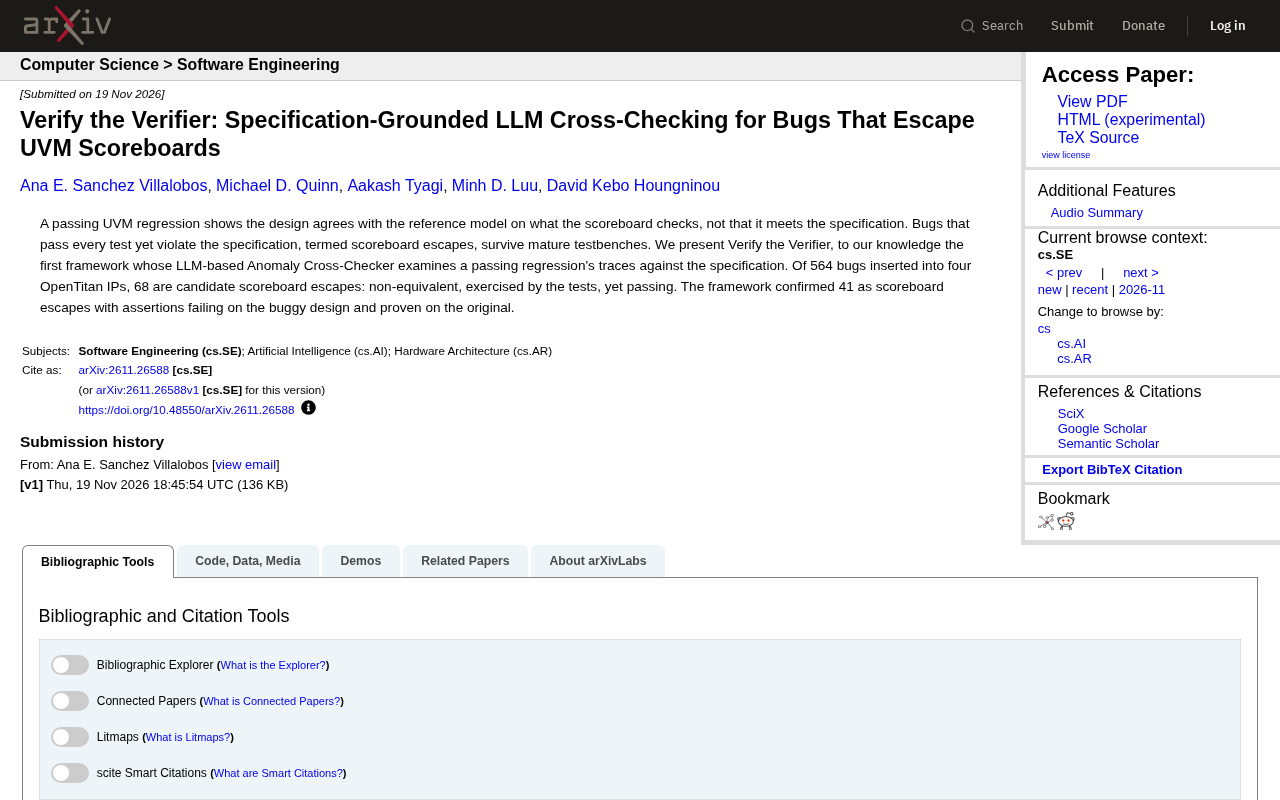
LLM cross-checker finds scoreboard escapes missed by UVM regression tests, confirming 41 real bugs on OpenTitan.
Researchers from Oregon State University and others propose Verify the Verifier, the first LLM-based anomaly cross-checker for finding "scoreboard escapes"—bugs that pass UVM regression but violate specs. Using natural language specs, it analyzes regression-passing traces, flags candidate escapes, and generates assertions that fail on buggy and pass on original designs. Injecting 564 bugs into four OpenTitan IPs, it identified 68 candidates and confirmed 41 real escapes. The two-stage design reduces false positives, but cost and spec quality remain challenges.
Introduction: When Regression Tests All Pass but Bugs Still Exist
In chip verification, a fully passing UVM regression test suite is typically regarded as a signal that the design meets expectations. But researchers from Oregon State University and other institutions point out that this only shows the design aligns with the reference model within the scope of scoreboard checks—it doesn't mean the design conforms to the specification. Bugs that pass all tests yet violate the spec—known as scoreboard escapes—can survive in mature testbenches. To address this, the researchers propose the Verify the Verifier framework, claimed to be the first LLM-based anomaly cross-checker specifically designed to compare regression-passing traces against specifications to uncover such escapes.
UVM (Universal Verification Methodology) is a standardized methodology widely adopted in IC verification, providing a SystemVerilog-based class library and verification component framework, including test stimulus generation, scoreboards, coverage collection, and more. UVM regression testing refers to validating design functionality by automatically running a large number of test cases; "all passing" typically means no errors were found under existing test stimuli and checking mechanisms. However, UVM's checking capability is limited by the completeness of the reference model in the scoreboard and the coverage of test stimuli, creating the risk of "tests pass but spec is violated."
Core Idea: Using LLMs to Cross-Check Specification Conformance
In traditional verification flows, the scoreboard is responsible for comparing design outputs against a reference model to ensure consistency. But the reference model itself may be incomplete, or tests may not cover certain specification clauses. Verify the Verifier takes a clever angle: since regression has already passed, any behavior that deviates from the spec may be a blind spot not covered by the scoreboard.
The framework's LLM anomaly cross-checker analyzes regression-passing traces and compares them against natural language specifications. If anomalies contradicting the spec are found in the trace, they are flagged as candidate escapes. This effectively adds an independent specification-based checking layer on top of the existing verification flow, rather than replacing UVM or formal verification.
Scoreboard is a key component in UVM verification platforms, responsible for comparing design outputs against expected values from a reference model to determine whether design behavior is correct. The reference model is typically manually written by verification engineers based on the specification and may fail to fully cover all design behaviors due to misunderstandings, spec omissions, or simplifications. When a design has defects that violate the spec but are not captured by the reference model, the scoreboard cannot flag errors—such defects are "scoreboard escapes." The core innovation of Verify the Verifier is that it doesn't rely on the reference model but directly uses natural language specifications as the basis for judgment, performing semantic-level cross-checking of regression-passing traces via LLM to uncover specification violations not covered by the reference model.
Experimental Design and Key Data
Researchers inserted 564 bugs into four OpenTitan IPs (via fault injection). Of these, 68 were identified as candidate scoreboard escapes: bugs that are non-equivalent to the original design, were exercised by test stimuli, yet still passed regression.
After the LLM cross-checker analyzed the candidate escapes, 41 were confirmed as genuine scoreboard escapes. For each confirmed escape, the framework generated assertions that fail on the buggy design and pass on the original design (proving their correctness). This result demonstrates the potential of LLMs in specification-level verification—they can uncover subtle violations missed by traditional scoreboards.
Interestingly, only 41 of the 68 candidates were confirmed, indicating that the LLM checker also produces false positives that require subsequent assertion validation to filter out. This two-stage design of "LLM screening + assertion confirmation" improves the reliability of results.
Fault injection is an experimental technique for evaluating the effectiveness of verification methods. It involves artificially inserting errors into a design (e.g., bit flips, logic modifications) to simulate potential defects, then running regression tests to observe whether these errors are detected. In this study, researchers injected 564 bugs into OpenTitan IPs, of which 68 were exercised by test stimuli but not captured by the scoreboard, forming the candidate escape set. OpenTitan is an open-source secure chip project containing multiple rigorously verified hardware IPs (e.g., cryptographic accelerators, processor cores), with relatively complete specification documents, making it a suitable benchmark platform for evaluating LLM specification-checking capabilities.
Technical Details and Limitations
The current framework depends on the quality and completeness of natural language specifications. If the specifications themselves are ambiguous or missing, the LLM may not be able to make accurate judgments. Additionally, the LLM's reasoning process may be unstable, and the cross-checking coverage for complex timing behaviors or datapaths remains to be evaluated.
Another limitation is computational cost: performing LLM analysis on every regression trace may be expensive, especially in large-scale regressions. The researchers did not mention performance data in the abstract, but practical deployment requires balancing coverage and efficiency.
Assertions are declarative statements used in hardware verification to describe design properties or behaviors, typically written in SystemVerilog Assertion (SVA), and can be automatically checked during simulation or formal verification. In the Verify the Verifier framework, the LLM generates assertions for each confirmed escape; these assertions fail on the buggy design (indicating they capture the erroneous behavior) and pass on the original design (indicating the assertions themselves are correct). This "assertion confirmation" stage essentially transforms the LLM's semantic judgments into formally verifiable properties, thereby filtering false positives and providing reproducible evidence. The quality of assertions depends on the LLM's precision in understanding the specification and trace, as well as the syntactic correctness of the generated SVA.
Implications for Verification Flows
Verify the Verifier points to a direction worth noting: using LLMs as a "second pair of eyes" in the verification flow, specifically checking specification conformance. It doesn't replace existing UVM tests or formal verification but serves as a supplement targeting the blind spot of "tests pass but spec is violated."
For verification teams, this means adding an LLM-based specification review step after regression passes, especially for safety-critical or specification-complex IPs. Of course, generated assertions need to be confirmed through formal verification or simulation to avoid the extra debugging burden of false positives.
Future Outlook
This research has so far only been evaluated on OpenTitan IPs and has not yet been validated on broader designs or industrial-grade projects. Future work may include: improving the precision and recall of LLM checking, reducing computational overhead, supporting more specification languages (e.g., direct SVA generation), and integration with other verification methods (e.g., formal verification, coverage-driven verification).
As LLMs advance in code understanding and reasoning, specification-driven verification automation is expected to become an active direction in EDA. Verify the Verifier provides an early, data-backed example for this direction.
One-line Summary
LLM cross-checker uncovers scoreboard escapes missed by UVM regression tests, confirming 41 genuine bugs on OpenTitan.
Paragraph Summary
Researchers from Oregon State University and other institutions propose the Verify the Verifier framework, the first LLM-based anomaly cross-checker for uncovering "scoreboard escapes"—bugs that pass UVM regression tests yet violate specifications. The framework uses natural language specifications to perform LLM semantic analysis on regression-passing traces, flagging candidate escapes and generating assertions that fail on buggy designs and pass on original designs for confirmation. Injecting 564 bugs into four OpenTitan IPs, they identified 68 candidate escapes and ultimately confirmed 41 genuine escapes. The two-stage design (LLM screening + assertion confirmation) reduces false positives, but computational cost and specification quality remain challenges. This work provides an early example of specification-driven verification automation.
Related articles

VP ≠ VNP: A Major Breakthrough in Computational Complexity Theory
A study claiming to prove VP ≠ VNP over every field sparks heated discussion on Hacker News. This article analyzes the algebraic complexity background of VP and VNP, the proof approach, community controversy, and its potential impact on computational complexity theory.

Developer Naming Woes: The Technical Names That Drive Us Crazy
Why is technical naming so maddening? From Nginx and Vite to Qt and Sudo, a YouTube creator rants about the chaos of developer naming and pronunciation, revealing the tug-of-war between creators' intentions and community habits, and the cultural roots behind spelling traps like PyPI and GNOME.

Figma Workplace Scandal: Employee Sues CEO for Forcing Confrontation with Harasser
Figma and its CEO are sued by a current employee alleging sexual harassment and discrimination, and forcing the victim to confront her harasser. This article outlines the background, potential impact, and industry reflection.