LLM-Driven Log Semantic Tuning: A New Paradigm for MIP Solver Configuration

LDST uses LLMs to extract diagnostic info from solver logs and semantically tune MIP solvers, greatly improving efficiency and generalization.
This paper proposes Log-Driven Semantic Tuning (LDST) to address inefficient black-box optimization for MIP solver configuration. Inspired by human experts, LDST uses LLMs to extract compact diagnostics from solver logs, propose sparse edits based on parameter semantics, and validate them before execution. On 215 instances, LDST cuts geometric mean loss by 43.9% on easy and 16.7% on medium instances versus the best of SMAC3, RBFOpt, and random search, reaching lower loss with 10 proposals than baselines with 50. Tuned configurations also generalize to unseen instances of the same family. LDST further introduces a mechanism-adaptive objective unifying solved and unsolved runs.
Title
LLM-Driven Log Semantic Tuning: A New Paradigm for MIP Solver Configuration
Meta Description
LDST uses LLMs to analyze solver logs and semantically tune MIP solver configurations, reducing loss by 43.9% on 215 instances and surpassing baseline results with 10 proposals vs. 50.
Article Content
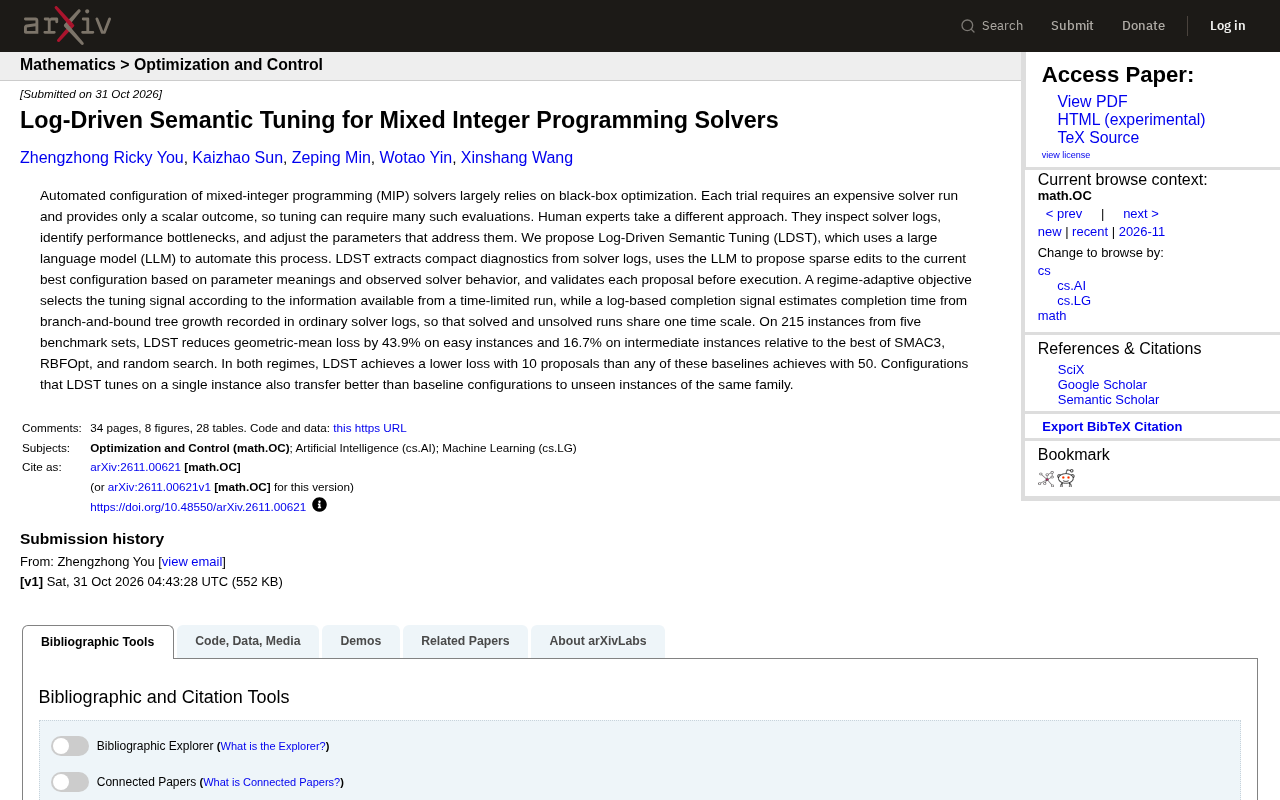
Automatic configuration of Mixed Integer Programming (MIP) solvers has long relied on black-box optimization, where each trial requires an expensive solver run and returns only a scalar result, leading to poor tuning efficiency. Human experts, by contrast, solve the problem by inspecting solver logs, identifying performance bottlenecks, and adjusting relevant parameters. Inspired by this, researchers propose Log-Driven Semantic Tuning (LDST), which leverages Large Language Models (LLMs) to automate this process. LDST extracts compact diagnostic information from solver logs, and based on parameter meanings and observed solver behavior, the LLM proposes sparse modifications to the current best configuration and validates each proposal before execution. On 215 instances from five benchmark sets, LDST reduces the geometric mean loss by 43.9% on easy instances and 16.7% on medium instances compared to the best of SMAC3, RBFOpt, and random search. In two difficulty regimes, LDST achieves lower loss with only 10 proposals than these baselines achieve with 50 proposals. Furthermore, configurations tuned on a single instance also outperform baseline configurations when transferred to other unseen instances from the same family.
The Bottleneck of Traditional Tuning and Lessons from Human Experts
Automatically configuring MIP solvers is typically framed as a black-box optimization problem: the tuner repeatedly tries parameter combinations, observes the scalar objective values returned by the solver (such as solve time or gap), and updates its search strategy accordingly. While general, this paradigm has clear drawbacks—each trial requires a full solver run, which is costly; scalar results discard the rich intermediate information from the solving process; and the tuning process resembles the blind men and the elephant, requiring many evaluations to converge.
In contrast, human experts read solver logs directly, observing details such as the growth of the branch-and-bound tree, node processing speed, and cutting plane effectiveness, to diagnose the bottleneck (e.g., an inappropriate branching strategy or insufficient preprocessing) and adjust a few key parameters accordingly. This semantic reasoning approach is precisely what black-box optimization lacks.
The core idea of LDST is to automate this human expert reasoning process. It does not treat the solver as a black box but instead uses an LLM to understand the semantic information in the logs and propose informed modifications based on parameter meanings.
Mixed Integer Programming (MIP) is a class of optimization problems in which some decision variables are constrained to be integers (or 0-1 variables), with the goal of minimizing or maximizing a linear objective function subject to linear constraints. MIP is widely used in logistics scheduling, production planning, financial portfolio optimization, and other scenarios. The classic algorithm for solving MIP is Branch and Bound: it progressively narrows the search space by repeatedly decomposing the problem into subproblems (branching) and computing lower bounds for each subproblem (bounding), until the optimal solution is found. Solver logs record exactly the process information of branch-and-bound tree growth, node processing, and cutting plane generation, which forms the basis for LDST's semantic diagnosis.
How LDST Works: From Logs to Semantic Edits
The LDST pipeline consists of three key steps:
-
Log diagnostic extraction: Extract compact diagnostic information from solver logs, such as branch-and-bound tree growth patterns, node solve time distribution, and cutting plane generation efficiency. This information is more concise than raw logs but preserves key semantic features.
-
LLM proposes sparse edits: Feed the current best configuration, parameter meanings, and diagnostic information into the LLM, asking it to propose sparse parameter modifications (i.e., adjusting only a few parameters). The LLM reasons based on its understanding of parameter roles and the observed solver behavior, for example: "if the branch-and-bound tree grows too quickly, the branching strategy parameters may need adjustment."
-
Validation and execution: Each proposal is validated before actually running the solver, ensuring parameter values are legal and the modification direction is reasonable, avoiding invalid trials.
In addition, LDST introduces a mechanism-adaptive objective: it selects the tuning signal based on the information available from a time-limited run. For solved runs, solve time is used; for unsolved runs, completion time is estimated from the branch-and-bound tree growth records in the logs, unifying solved and unsolved runs onto the same time scale. This design allows the tuning process to fully utilize information within a limited time, rather than simply treating unsolved runs as failures.
Sparse editing refers to modifying only a few parameters in the current best configuration at each tuning step, rather than adjusting many parameters simultaneously. This strategy draws on how human experts tune: experts typically adjust one or two key parameters (e.g., branching strategy or preprocessing intensity) in a targeted manner based on the specific bottleneck observed, rather than performing global random search. The advantage of sparse editing is that it reduces the dimensionality of the search space for each proposal, making the LLM's reasoning more focused and reducing the risk of invalid trials. In LDST, the LLM is asked to propose sparse modifications based on diagnostic information, thereby gradually approaching better performance while maintaining configuration stability.
Mechanism-adaptive objective is an objective function construction designed by LDST to handle time-limited tuning scenarios. In MIP solving, many instances cannot be fully solved within a given time limit, in which case traditional tuning objectives (such as total solve time) cannot be used directly. LDST selects different signals depending on whether the run completes: for solved runs, solve time is used directly; for unsolved runs, completion time is estimated using the branch-and-bound tree growth records in the logs. This design unifies the two types of runs onto the same time scale, allowing the tuning process to fully utilize the information provided by unsolved runs rather than simply treating them as failures.
Experimental Performance: Fewer Proposals, Lower Loss
Researchers evaluated LDST on 215 instances from five benchmark sets. Baselines include SMAC3, RBFOpt, and random search—representative methods of black-box tuning.
Results show that on easy instances, LDST reduces the geometric mean loss by 43.9%; on medium instances, by 16.7%. Even more striking is the efficiency advantage: in two difficulty regimes, LDST achieves lower loss with only 10 proposals than baseline methods achieve with 50 proposals. This means LDST substantially reduces the number of solver runs required, thereby significantly lowering tuning costs.
In terms of transferability, configurations tuned by LDST on a single instance also outperform baseline configurations when transferred to other unseen instances from the same family. This indicates that what LDST learns is not an overfitted configuration for a specific instance but a parameter adjustment strategy that generalizes to similar problems.
SMAC3 (Sequential Model-based Algorithm Configuration) and RBFOpt (Radial Basis Function Optimization) are two representative black-box optimization methods commonly used for algorithm configuration and hyperparameter tuning. SMAC3 is based on a random forest surrogate model and an expected improvement acquisition function, iteratively fitting the model and selecting the next evaluation point to optimize the objective; RBFOpt uses radial basis function interpolation to build a surrogate model combined with a global optimization strategy. Both rely solely on scalar objective values and do not exploit internal solver log information. LDST is compared against them to validate the advantages of semantic tuning in efficiency and effectiveness.
The Significance and Limitations of Semantic Tuning
LDST demonstrates the potential of bringing LLMs into solver tuning: by leveraging semantic information in logs and parameter meanings, the LLM can perform targeted reasoning like a human expert rather than blind search. This approach not only improves tuning efficiency but also reduces reliance on extensive evaluations.
However, LDST still depends on the reasoning quality of the LLM, and the way log diagnostics are extracted may affect the final results. Future work might explore richer log features, hybrid tuning combined with other optimizers, and extension to more types of solvers (such as SAT and CP solvers).
Overall, LDST offers a new path for automatic configuration of MIP solvers: moving from black-box optimization to semantically guided sparse editing, bringing the tuning process closer to how human experts think.
One-line Summary
LDST uses LLMs to extract diagnostic information from solver logs and semantically tune MIP solvers, greatly improving efficiency and generalization.
Paragraph Summary
This paper proposes Log-Driven Semantic Tuning (LDST) to address the inefficiency of black-box optimization in automatic configuration of Mixed Integer Programming (MIP) solvers. Inspired by how human experts tune, LDST leverages Large Language Models (LLMs) to extract compact diagnostic information from solver logs, propose sparse modifications based on parameter semantics, and validate them before execution. On 215 benchmark instances, LDST reduces the geometric mean loss by 43.9% on easy instances and 16.7% on medium instances compared to the best of SMAC3, RBFOpt, and random search, and achieves lower loss with only 10 proposals than baselines with 50 proposals. Moreover, configurations tuned by LDST perform better when transferred to unseen instances from the same family, indicating that the learned strategy generalizes. LDST also introduces a mechanism-adaptive objective that unifies the time scale of solved and unsolved runs.
Related articles

Running a Local LLM on a Laptop CPU: Ollama + Qwen3 Gives a Desktop Pet a Brain
An ordinary laptop without a GPU can run a local LLM: a Bilibili creator uses Ollama plus open-source Qwen3 8B on pure CPU to give an original desktop pet a local brain, with DeepSeekHarness handling plugin development and three rounds of debugging — 0 yuan, works offline, privacy stays on-device.

AgentScope 2.0 in Practice: A Guide to Enterprise-Level AI Agent Development in Java
AgentScope 2.0 is Alibaba's Java enterprise-grade distributed agent framework. This article explains why it suits server-side AI applications, contrasts client-side AI apps in permissions, state management, and concurrency, and outlines a practical learning path from environment setup to project integration.

GPT-6 Astra Directly Edits Weights to Fix Models? Full Analysis of the MIT Paper and Leaks
MIT paper shows GPT-6 Astra repairs small models by directly editing weights, raising math scores from 7.9% to 48.1%; OpenAI internal charts hint an unreleased model leads on BenchCAD 2.0; Fable 5.5 pure-code movies and the Claude WiFi radar incident analyzed.