llm-gemini 0.35 Adds Gemini 4 Argon Support: Performance and Pricing Highlights

llm-gemini 0.35 quickly supports Gemini 4 Argon; this article analyzes its capabilities, pricing, and real costs.
The open-source tool llm-gemini has released version 0.35, adding support for Google's new model Gemini 4 Argon so developers can call it directly from the command line. Simon Willison's "pelican riding a bicycle" test shows that Argon continues the Gemini series' strengths in SVG generation, performing well at low, medium, and high output levels. On pricing, launch rates were $2 per million input tokens and $10 per million output tokens, on par with GPT-6 Sol, but prices will double on December 1 to match Claude Opus 5.5. Artificial Analysis benchmarks show that Argon's total task cost was $2,407, in the low-to-middle range among 14 compared models, and after the price increase it is still slightly lower than GPT-6 Astra. The article advises developers to focus on actual token consumption under agent frameworks rather than unit price alone.
Introduction: llm-gemini 0.35 Quickly Follows Up on a New Model
The open-source tool llm-gemini has released version 0.35, adding support for Google's new model Gemini 4 Argon right away. The model is available to developers through the Gemini API, and also to users on the $100/month subscription plan. For developers who are used to calling large models from the command line, this means they can test Argon's capabilities directly in the terminal.
llm-gemini is a plugin for the LLM command-line tool developed by Simon Willison. LLM itself is a CLI tool written in Python that lets developers call various large language models through a unified interface in the terminal, and it supports storing prompts and outputs in a SQLite database for tracing and reuse. llm-gemini is specifically responsible for connecting to Google's Gemini series models, making requests through the Gemini API. The advantage of this plugin model is that when a new model is released, you only need to update the corresponding plugin to gain support, without modifying the main tool. The follow-up on Argon in version 0.35 is exactly a demonstration of this rapid iteration capability.
Model Capabilities: SVG Generation Remains a Strength
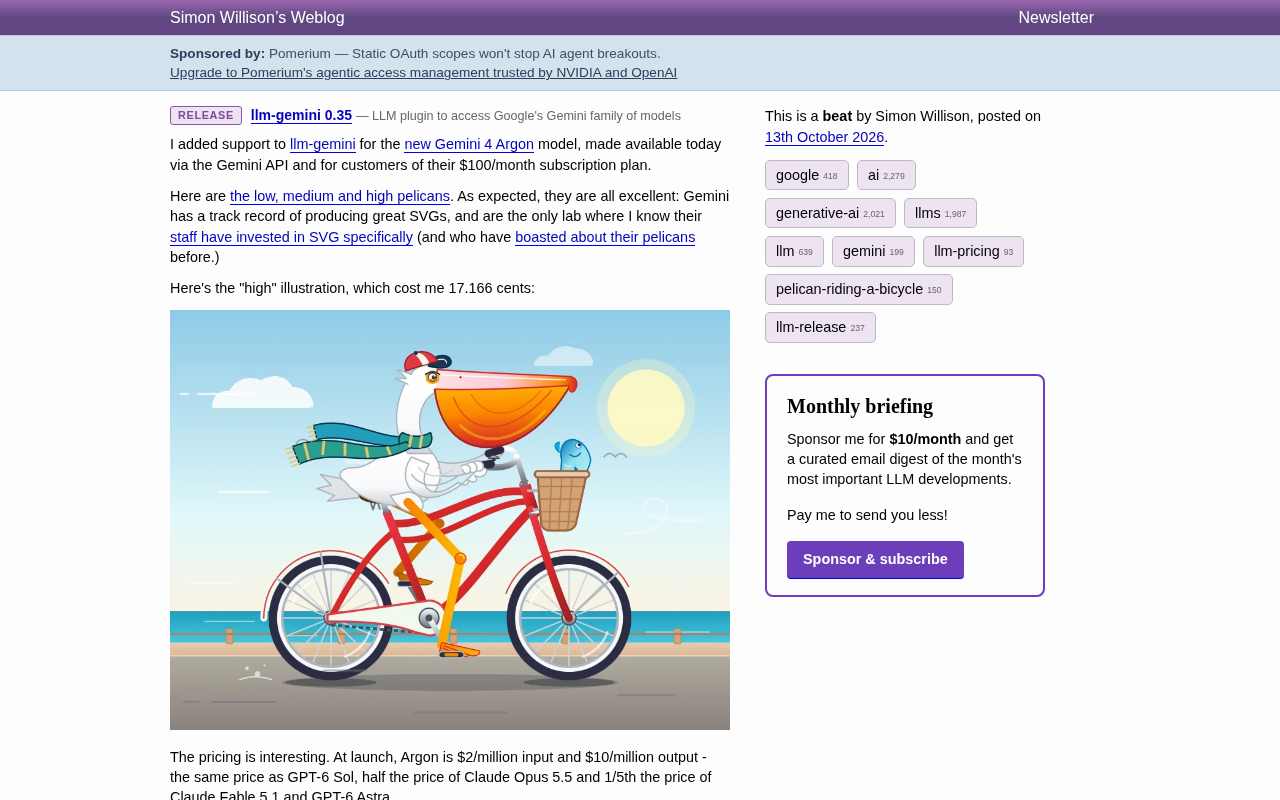
As usual, publisher Simon Willison tested Gemini 4 Argon's low, medium, and high output levels with the "pelican riding a bicycle" prompt. The results were unsurprising: all three levels performed quite well. The Gemini series has long had a good reputation for SVG generation, and it is one of the few labs with employees specifically dedicated to SVG research; it has even publicly boasted about its own model's pelican images in the past.
The "high" illustration Willison showed is rich in detail: the bicycle frame is accurate, there is a fish in the basket, the scarf is stylish, both feet are on opposite sides of the pedals, the spokes, little hat, beak, and throat pouch are all in place, and it even has a fierce expression. This generation cost 17.166 cents.

"Pelican riding a bicycle" is an informal benchmark that Simon Willison has used since 2024 to compare the drawing abilities of various large models. He asks the model to generate an SVG vector image of a pelican riding a bicycle. This subject was chosen because it simultaneously tests the model's understanding and combination of animal anatomy, mechanical structure (frame, pedals, spokes), and the spatial relationship between the two. SVG is a plain-text vector graphics format, making it easy to directly inspect the accuracy of the generated code, so it has become an intuitive window for observing a model's spatial reasoning and instruction-following abilities.
Pricing Strategy: Low First, Then Double
Gemini 4 Argon's pricing is worth attention. At launch, it was priced at $2 per million input tokens and $10 per million output tokens, on par with GPT-6 Sol, half the price of Claude Opus 5.5, and only one-fifth that of Claude Fable 5.1 and GPT-6 Astra.
But this price is not long-term: starting December 1, Argon's price will double, at which point it will be the same price as Opus 5.5. This strategy of "low price to acquire customers first, then restore the original price" is not uncommon in today's model competition, but for developers who need to call the API over the long term, cost planning needs to take it into account in advance.
Pricing per million tokens is the most common billing unit for large model APIs, usually distinguishing between input and output directions, with output prices generally significantly higher than input. Here, "token" refers to the smallest unit the model processes when handling text, roughly corresponding to part of an English word or a Chinese character or word. Input tokens refer to the prompts and context sent to the model, while output tokens refer to the replies generated by the model. When estimating costs, developers need to multiply these two parts by their respective unit prices and then add them together. For agent-type applications, because context is repeatedly carried and calls are made many times, the cumulative amount of input tokens often far exceeds that of a single conversation.
Actual Costs: Artificial Analysis Benchmark Data
Comparing unit prices alone is no longer accurate, because what really determines cost is the total number of tokens a model needs to complete a task under an agent framework. The total benchmark cost data published by Artificial Analysis is more useful as a reference.
In this data, Argon performs impressively: the total cost of running the benchmark was $2,407, close to GLM-5.3 and clearly lower than the latest models from OpenAI, Anthropic, and Meta. Even after the price doubles, it is still slightly cheaper than GPT-6 Astra.
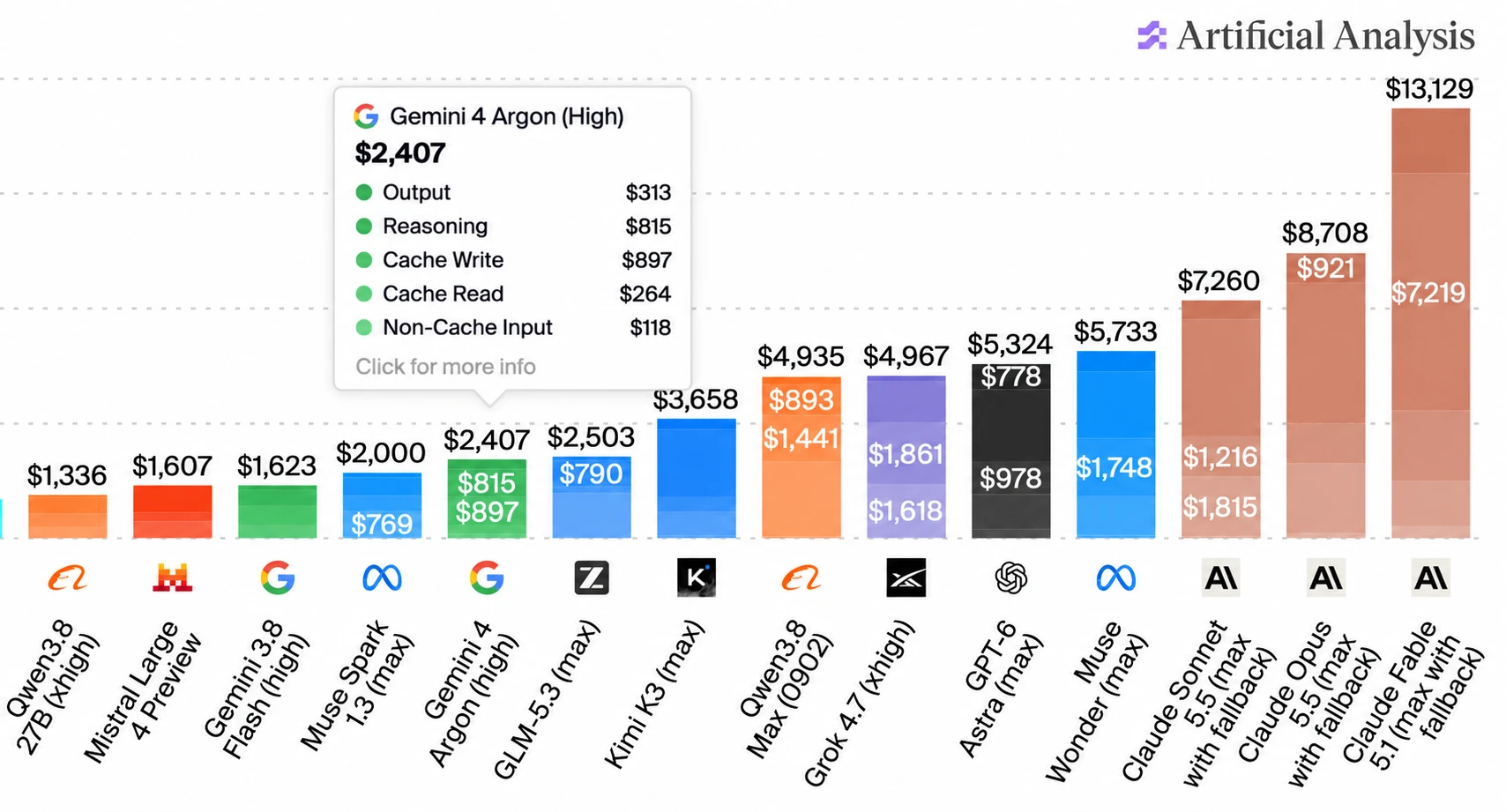
From the bar chart, among the 14 models compared, Argon's total cost is in the low-to-middle range, with inference cost and cache write cost accounting for a larger share. This data provides developers with a more practical reference for choosing a model.
Artificial Analysis is an independent large model evaluation organization. Its benchmarks not only examine model response quality, but also systematically count the number of tokens consumed and the corresponding cost of completing the same set of tasks. Unlike simply comparing the price per million tokens, this evaluation method counts all tokens generated by a model under an agent framework as it repeatedly calls tools and reasons back and forth. Therefore, a model with a higher unit price may actually cost less overall if it reasons more concisely and takes fewer detours. This is also why the article emphasizes that "what really determines cost is the total number of tokens."
What This Means for Developers
The rapid follow-up in llm-gemini 0.35 lets developers connect to Gemini 4 Argon in their command-line workflows right away. Combined with Artificial Analysis's cost data and the upcoming price increase, the current stage may be a suitable time to test and evaluate Argon's cost-effectiveness. For teams that rely on agents to complete complex tasks, the model's actual token consumption efficiency is more worthy of attention than the unit price.
Conclusion
Gemini 4 Argon continues the Gemini series' advantages on tasks such as SVG generation, while its pricing strategy shows clear phase-based characteristics. llm-gemini 0.35 provides developers with a convenient way to connect, while Artificial Analysis's cost data reveals another evaluation perspective beyond unit price.
Related articles

Gaussian Process Bandit Optimization: Exploration Strategies and Inference Regret Guarantees
Cumulative regret guarantees in Bayesian optimization fail to reflect final recommendation quality. This article examines a new study that provides inference regret guarantees for Gaussian process bandit optimization through exploration query strategies and fill distance analysis, validated on hyperparameter optimization and control tasks.

The Most Detailed Codex Guide on Bilibili: From Installation to Real-World Practice
The most detailed Codex guide on Bilibili: from app store installation to daily work mode configuration, with a real coffee shop project demonstrating file organization, data extraction, dashboard creation, and other practical tasks. Learn to use Plan Mode and desktop pets to leverage Codex efficiently.

Appearance Compensation in Volume Rendering: Why RGB Accuracy Cannot Guarantee Density Correctness
Volume rendering research reveals that volumetric data perfectly reproducing external RGB views may still contain density errors: appearance compensation can double central density and keep external rays unchanged even when L2 error exceeds 14.52%. Density recovery depends on appearance capacity, spatial resolution, and measurement design.